The Home as a Prison
The HousemaidThe Home as a Prison is the transformation of the Winchester residence from a protected family home into a system of confinement. Andrew Winchester controls more than access to the attic: he uses isolation, unpredictable punishment, surveillance, and threats against Cecelia Winchester to make the whole household feel like a trap. Nina Winchester’s changing perception of the home’s gates gives that transformation its clearest image, while the attic makes its violence physical.
A Home Recast as a Prison
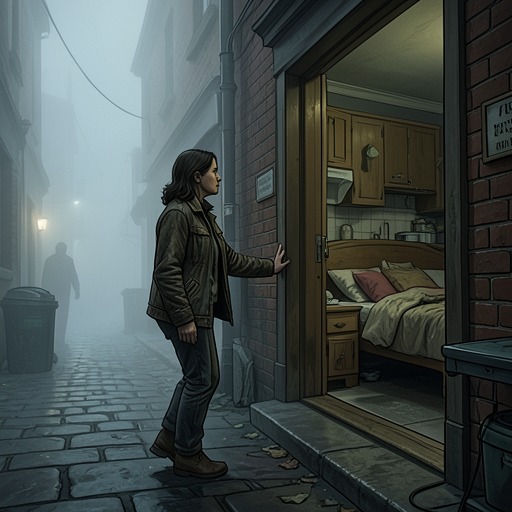
When Nina first saw the gates around the house, she found them charming. After years of living under Andrew’s control, she sees them for what they have become: the boundary of a prison. The reversal is not a change in the property but in what its features mean. A gate that once suggested privacy and security now marks the limits of her movement and the authority Andrew exercises within them.
The house’s respectable appearance makes that confinement harder to name from the outside. Andrew has supported Nina financially and acted as a father figure to Cecelia; he appears even-tempered and agreeable. Against that public picture, Nina’s efforts to describe her treatment risk being dismissed through her history of mental-health problems. The domestic setting thus supplies Andrew with both a place to exert control and a credible-looking exterior behind which to conceal it.
The Attic and the Repeated Punishment
The attic is the home’s most explicit prison space. After Andrew locks Nina inside, she pounds and scratches at the door until splinters lodge under her fingernails, and screams until she loses her voice. She eventually stops because no neighbor has responded. Andrew later explains that the area below the attic is soundproofed: people downstairs, even guests at a dinner party, would not hear her. The house’s construction turns her cries into something the household can absorb without interruption.
The room’s confinement is also made bodily through its plain discomfort. Nina sits on a cot whose springs dig into her as she cries and worries about Cecelia, left alone with Andrew. On another occasion, she has been there for about twenty hours, having been taken upstairs after Cecelia went to bed. The duration and timing vary, but the uncertainty itself is part of the punishment: Nina does not know when Andrew will send her up, how long she will remain, or what supposed offense he will use to justify the next stay.
Over seven years of marriage, the attic becomes a recurring threat rather than an isolated episode. On average, Andrew sends Nina there once every other month, though the interval can be shorter or longer; once, six months passed without a stay. Even time outside the locked room is therefore shadowed by the possibility of return. Nina tries bargaining, performing the part of a perfect wife, and then deliberately repelling Andrew, but none of these strategies changes the pattern. When he catches her eating chocolate cake, he confines and starves her for two days. The rules remain unknowable to her, while the power to punish remains Andrew’s.
Control Beyond the Locked Door
Physical confinement is only one part of Andrew’s control. Nina fears that resisting him could lead to another stay at Clearview Psychiatric Hospital, or to the temporary loss of Cecelia, whom Andrew might keep away from her. She also fears that he can persuade police that she is unstable or dangerous. Her earlier experience of being locked in the attic has taught her to expect that Andrew may present her as a threat to herself or to their daughter, a story that could make others believe him and separate mother and child again.
Andrew also uses Cecelia’s ordinary routines to discipline Nina. He buys itchy, frilly dresses that Cecelia dislikes and that other children mock. Cecelia understands that refusing to wear them or getting them dirty may mean her mother disappears for days, so she complies. Nina accepts punishment to spare her daughter, but knows that Andrew’s threat to punish Cecelia directly is part of what keeps her from leaving. The danger is not only what happens behind the attic door; it is the pressure exerted on Nina through the child she is trying to protect.
The same coercion reaches into the pantry. Andrew keeps peanut butter there despite Cecelia’s allergy, and it repeatedly reappears after Nina throws it away. He sometimes puts a little into Cecelia’s dinner, causing welts, to demonstrate that he can override Nina’s efforts to keep their daughter safe. He has also told Nina that if he dies, his attorney will send police a letter describing her alleged instability and homicidal threats. The threatened letter makes even imagined escape or resistance seem vulnerable to the story Andrew has prepared for the authorities.
Escape, Surveillance, and Repetition
Nina’s attempts to leave show how the house’s restrictions extend beyond its walls. When Andrew tells her it is time to go upstairs again, she refuses because she has promised Cecelia she will pick her up. She runs out through the front door and nearly hits the gate while speeding away, but has no clear destination; she considers taking Cecelia and driving toward the Canadian border, then recognizes that she lacks both passport and driver’s license and expects Andrew to call the police with a story about her mental state. Crossing the threshold is an act of resistance, not yet a secure escape.
The pattern is repeated with Millie Calloway, whom Andrew also locks in the attic. A hidden camera lets him watch her there; when Millie searches for it, he tells her he has only been watching for a few weeks. His calm insistence that she is in no position to make demands echoes the larger imbalance embodied by the room: he sets the terms, monitors the captive, and presents release as a favor he controls. The house’s methods are therefore not confined to Nina’s past or to one marriage. Andrew can reproduce them against another woman.
Narrative and Thematic Significance
The home’s transformation is conveyed through the contrast between familiar domestic features and their coercive use: gates enclose rather than welcome, a cot becomes the only place to sit through confinement, a pantry becomes a site of threat, and the soundproofed structure ensures that screams remain unheard. The attic concentrates this violence, but the rest of the house sustains it through routines, child care, food, and the constant possibility of punishment.
Nina’s account also shows why domestic imprisonment cannot be reduced to a locked door. Andrew’s control narrows her choices by making resistance seem likely to cost her access to Cecelia, her credibility with authorities, or her safety. The home appears orderly enough to support Andrew’s public image, while its private spaces make confinement repeatable and difficult to prove. Its most decisive change is in Nina’s understanding: the gates she once admired now name the condition she has been living in.