
The Story’s Changing View of Truth
The HumansThis thread follows the narrator’s deceptions and revelations, asking when concealment protects others and when honesty becomes necessary.
increasing Bearing strength in each event
 decreasing
Bearing strength in each eventdecreasingA Life Built on a Lie

The Borrowed Identity
Impersonation
The narrator claims to be Andrew Martin and uses his name, home, and family role to complete the mission. The disguise depends on everyone believing a false account.
A practical necessity
At first, deception appears to be merely operational. The narrator does not yet understand how the lie enters other people’s emotional lives.
Questions Left Unanswered

Knowledge Held Back
Concealment
The narrator asks Isobel Martin about the proof and family history while hiding his origin and purpose. She answers as a wife speaking to a husband she thinks she knows.
Unequal intimacy
Their conversations create closeness under false assumptions. The narrator begins to understand that information can be true while the relationship built around it remains deceptive.
Ari Does Not Believe

Truth Without Persuasion
The disclosure
The narrator tells Ari that he is an alien who has surrendered his powers. Ari hears the words as a joke and cannot accept them as fact.
Limits of explanation
The narrator learns that sincerity cannot force belief. Some truths remain socially impossible even when spoken plainly.
The Truth in the Kitchen

A Necessary Revelation
The confession
The narrator tells Gulliver Martin that Andrew Martin is dead, that he is an alien, and that he was sent to kill the family. The truth must compete with the replacement’s claim that the narrator is the impostor.
Recognition through action
Gulliver Martin responds by helping resist the replacement. Trust is not granted by explanation alone; it is tested by what the narrator does.
A Lie of Mercy
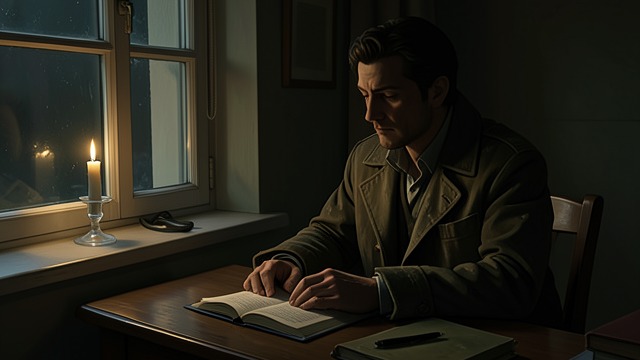
The Limits of Truth
A bereaved son
Gulliver Martin wants to know whether his father suffered. The narrator gives an answer meant to comfort him, though he cannot be certain it is true.
Love and concealment
The narrator recognizes that truth is not always the only form of care. Human relationships require judgment about what to reveal and when.
From the narrator’s first encounter with the police
During the narrator’s first conversations with Isobel Martin
After the narrator is beaten
During the replacement’s attempt to kill Gulliver Martin
After the replacement dies
