Advice for a human
The HumansAdvice for a human is a 97-item set of counsel the Alien narrator types for Gulliver Martin, moving from broad principles for living to unmistakably personal reassurance. It gives the narrator’s farewell a written form: a response to Gulliver’s fragile smile that turns abstract reflections on love, mortality, and kindness into direct encouragement to keep living and to be kind to himself and others.
Composition and occasion
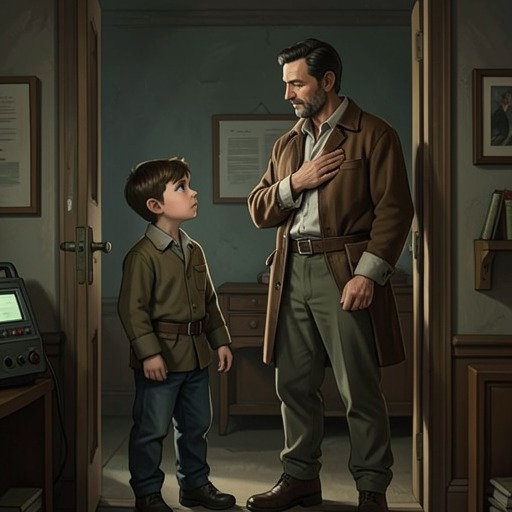
After Gulliver leaves the room with a faint smile that he tries to conceal beneath his discontent, the narrator sits breathing in the warm air and reflects on the lungs that will one day stop functioning. He then turns to Gulliver’s primitive Earth computer and begins typing, trying to set down as much advice as he can think of to help a human. The contrast is central to the list’s occasion: the narrator considers his own mortality while addressing a young person whose pain makes continued life uncertain.
The advice is numbered through 97, so the form suggests an accumulation of thoughts rather than a single maxim. Its entries move among ethics, imagination, scientific imagery, and ordinary relationships. Some are expansive claims about how to live; others offer practical permission to simplify, attend to the present, or resist shame. The mixture makes the list feel less like a formal system than an attempt to find enough different ways to reach its intended reader.
Kindness, feeling, and attention
The opening instructions establish a compact moral center. Shame is presented as something that constrains a person and can be cast off. The next point shifts attention away from measuring one’s abilities: the ability to love is enough. A third instruction extends that ethic outward, asking the reader to treat other people kindly because, at a universal level, they are not separate from oneself. Together, the opening points answer self-judgment with both self-acceptance and responsibility toward others.
Other entries develop this defense of feeling through the contrast between passion and indifference. The list warns against merely liking things at a distance and urges wholehearted engagement instead. It treats indifference as a danger that can accompany civilization’s advance, and offers art and love as ways to resist it. This is not simply advice to feel more intensely: it connects attention to care, suggesting that a person’s manner of encountering the world has ethical consequences.
The guidance also resists rigid categories. Rather than sorting people into supposedly fixed types, it describes each person as containing a wide range of ingredients and competing possibilities. In this account, complexity is part of being human, but the list does not require mastering every complexity. It explicitly grants the reader a right to simplify when exhaustive analysis would become unbearable. The counsel therefore balances openness to human variety with permission to protect one’s own capacity to live.
Mortality, darkness, and the duty to live
The list’s recurring awareness of death becomes especially direct in its later numbered entries. One instruction calls being alive a supreme duty to the world. Another uses the sudden formation of a black hole and its gamma-ray burst to evoke how abruptly entire worlds could be lost; from that cosmic possibility, it draws a personal imperative to spend the present doing something one would be glad to have done if death came. Scientific scale does not make individual life insignificant here. Instead, the vastness of the universe intensifies the value of a chosen moment.
A further entry addresses suicidal despair without treating darkness as permanent. It urges the reader not to kill himself, even when the darkness feels total, and counters that feeling with movement through time: the mind is likened to a galaxy, and the instruction is to wait for the stars. The image offers neither a quick solution nor certainty about when relief will come. Its reassurance rests on the claim that life is still moving, so the present darkness need not be the whole of what follows.
These instructions give the list’s scientific imagery a distinctive purpose. Black holes, gamma-ray bursts, galaxies, and the sub-atomic world are not presented as problems for the reader to solve. They become ways to think about suddenness, inner darkness, complexity, and perspective. The movement between cosmic scale and practical counsel repeatedly brings the argument back to a finite human life: simplify where necessary, remain alive, and choose what matters while time is available.
Personal address and departure
Near its end, the list turns explicitly toward Gulliver Martin. It asks him to be kind to his mother and try to make her happy, then assures him that he is a good human. The last numbered message says that he is loved and should remember it. These closing points narrow the distance between general counsel and personal care: the narrator is no longer addressing an abstract human, but affirming Gulliver’s character and telling him that he matters to someone.
The surrounding actions give those final instructions added weight without turning them into a cure or a promise that Gulliver’s difficulties are over. A very brief hug follows. The narrator then packs a bag of clothes and leaves. The sequence places written reassurance beside a small gesture of affection and an actual separation: the narrator cannot remain simply to repeat the advice, so the list becomes a parting expression of concern.
Significance
The list gathers the narrator’s developing human perspective into a form meant to be useful to another person. Its counsel ranges from freedom from shame and kindness toward others to a direct appeal against suicide; its largest claims are repeatedly grounded in particular needs, including Gulliver’s relationship with his mother and his need to know he is loved. The progression from universal principles to personal affirmation is what makes the list more than a collection of maxims.
Its ending also reflects the tension between care and departure. The narrator offers Gulliver words intended to persist beyond the room, then leaves after the hug. Advice for a human consequently functions both as a practical attempt to help and as an intimate farewell: a written insistence that love, attention, and continued life remain possible even when the person receiving the message cannot yet feel their force.