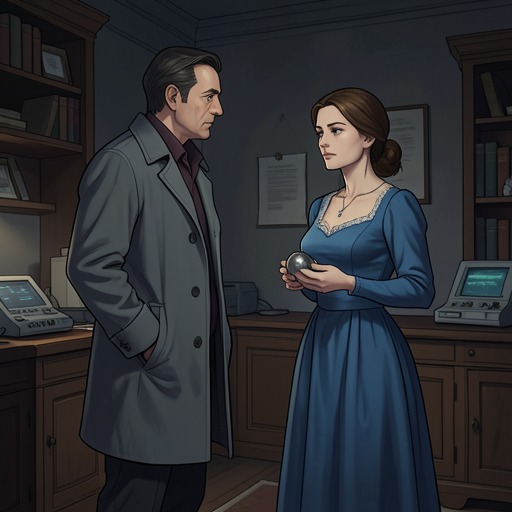
Alien narrator and Isobel
The HumansThe relationship between Andrew Martin (the alien narrator) and Isobel Martin, author of the unfinished novel, is the central measure of the narrator’s change: a wife initially regarded as an alien becomes someone he loves, protects, and ultimately wounds through the deception that made their closeness possible. Their marriage is not a simple discovery of mutual understanding. Isobel believes she is living with her human husband, while the narrator knows that he has taken another being’s place; the difference between those realities shapes both his growing attachment and the eventual collapse of their life together.
From imposed distance to attention
At first, the narrator regards family bonds as obligations he must enforce against his own response. Seeing Gulliver Martin, Isobel’s son, at breakfast, he has to remind himself that the boy is not his son and that he must feel nothing for him. Isobel presents an even more complicated contradiction. The narrator’s mission requires him to treat her as a human specimen rather than as someone close to him, yet the more he regards her as alien, the more familiar she becomes. He begins to observe her as a person: drinking pink grapefruit juice and watching her son with worry and helplessness. Her attention to Gulliver gives the narrator a way to perceive the vulnerability of parenthood, as Isobel hopes her child will find safe passage into an uncertain future.
That change in attention also alters what he can see in her. He recognizes her beauty as a source of irresolvable attraction and confusion, despite having previously found her repellent. His disorientation is not yet a settled declaration of love; it marks the failure of the categories with which he had tried to keep her at a distance. Isobel is no longer only an example of an unfamiliar species. She is becoming singular to him, even as he remains unable to tell her what he is.
Intimacy and the choice to protect her
A small domestic moment makes their developing closeness tangible. After glass breaks, Isobel touches the narrator’s hand in gratitude and embraces him while the fragments remain on the floor. The narrator responds to the warmth of the embrace and reflects on human loneliness: people are alone, yet seek connection through friends, children, and lovers. He finds that need attractive rather than merely irrational. The scene gives physical form to a bond he had previously understood only as a human convention.
The relationship is then tested by the possibility that the narrator may lose his emotional connection to her altogether. Under the hosts’ influence, he looks at Isobel as a mere human and feels nothing for her. As he touches her, their power turns toward killing her. Isobel, still believing him to be the husband she loves, speaks to him in her sleep. The narrator’s sense of himself separates from the collective force acting through him; he recognizes that she has nearly been killed and understands the intensity of his own attachment. His response is to kiss her, using intimacy as defiance when he cannot explain what is happening. He tells her that he loves her, and his repeated insistence marks a decisive change: attachment is no longer an idea he studies from outside but a commitment through which he resists the hosts. His love also protects Gulliver, although Isobel does not yet know the danger or the part the narrator has played in averting it.
The truth beneath the marriage
The narrator’s love does not remove the deception at the heart of the relationship. Isobel believes she is married to Andrew Martin; the narrator knows he came from far beyond Earth and has been living under that identity. He reflects that loving Isobel has changed how he sees himself, while the gap between what she believes and what he knows remains immense. At one point he prepares to tell her something important, but the evidence of their relationship’s later course shows that the truth is not delivered as a single, simple revelation. The eventual explanation includes his origin and the circumstances of his arrival and mission.
That disclosure takes place in a relationship already damaged by the narrator’s infidelity. He tells Isobel that he has had sex with his student, Maggie, and recognizes that the admission is carrying them into a dangerous confrontation. Isobel takes time to absorb what he has said; the narrator’s own unease intensifies. His later attempt to explain that he is not from Earth, has never loved before, and gave up immortality does not repair the immediate harm. Isobel says she wants a divorce and accuses him of destroying their family and Gulliver again. The narrator admits that he should let her leave but instead holds her wrist, a gesture that exposes the distance between his professed love and his failure, in that moment, to accept her decision.
Disclosure, grief, and the relationship’s cost
After the narrator has explained his identity and mission, Isobel cannot readily fit what she has learned into her understanding of the world. A historian who looks for patterns, continuities, and causes, she is confronted with a rupture that makes her familiar account of reality impossible to follow. She seeks medical help and is given tablets that do not help; exhausted, she stays in bed for three weeks. The narrator understands this not as the illness suggested to her but as grief: she has lost both her husband and the reality she thought she inhabited.
Isobel’s anger is rooted in more than the extraordinary fact that the man beside her is an alien. The narrator lied to her, slept with her while she did not know his identity, and allowed her to care for his wounds without telling her the truth. His love, and his belief that his defiance saved her and Gulliver, cannot erase the unequal terms on which their intimacy began. He recognizes that, to her, he is both an alien and a killer. Their relationship therefore ends in a painful contradiction: his attachment is real, but it cannot make the deception harmless or restore the marriage she believed she had. The bond that first drew him toward human connection becomes the place where the cost of his concealed identity is most fully felt.