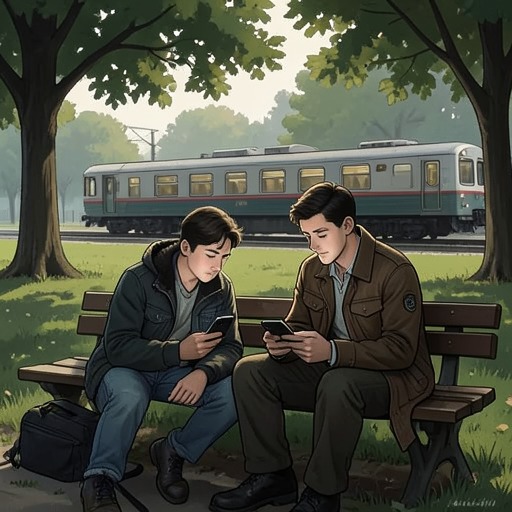
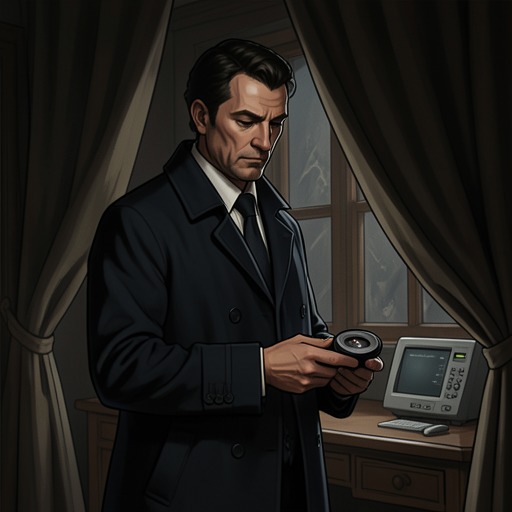
Andrew Martin (the alien narrator)
The HumansAndrew Martin (the alien narrator) is an alien operative sent to Earth in the identity of the mathematician Andrew Martin. His decisive change is not a discovery about mathematics but a change in how he sees the people he was ordered to eliminate: the humans he first regards as alien become particular, vulnerable individuals for whom he feels empathy, affection, and love. By the time he tells Gulliver Martin the truth, he has chosen those attachments over his mission and relinquished the powers that once made him an effective agent.
Identity and the human household
At first, the operative’s adopted life is a problem of becoming accustomed to a human body and routine. Seeing himself in the bathroom mirror without the revulsion he had previously felt, and finding that wearing clothes is beginning to seem normal, mark small accommodations to life on Earth. The more consequential adjustment comes downstairs, where Gulliver Martin is eating toast and listening to music. The narrator initially has to remind himself that this boy is not his son and, under the terms of his assignment, must mean nothing to him.
That discipline is harder to maintain with Isobel Martin, author of the unfinished novel. He understands that she loves the man he is impersonating but does not like him, and recognizes that her hurt has a history in the original Andrew Martin’s conduct. He also knows that what he is preparing to do will be worse from her perspective. His alien classification of her is stark: she is a human primate, related to chimpanzees. Yet the familiarity of daily observation unsettles the distance that classification is meant to preserve. Watching her drink pink grapefruit juice and look anxiously at her son, he recognizes the vulnerability of parenthood: a parent can watch a child venture into uncertain waters, hope for safe passage, and have no way to know what lies ahead.
His response to Isobel shifts from classification toward perception. He sees beauty in her, while acknowledging that beauty remains tantalizing and difficult to resolve. The recognition does not give him a clear account of what he feels; it leaves him confused and lost. That uncertainty is important to his change. He does not master human feeling by explaining it away. Instead, ordinary proximity makes his imposed categories less adequate.
The mathematics he has destroyed
The cost of the mission becomes newly concrete when he enters Andrew Martin’s study. After securing the door, he sits in Andrew’s chair and reads the thin, uncorrected proof copy of The Zeta Function from beginning to end. The book concerns the Riemann hypothesis and Andrew’s prolonged effort to prove it, including his attempt to explain the increasing gaps between prime numbers. The narrator finds the account depressing because it records how intensely Andrew wanted to solve the problem. By the time the book was written, Andrew had succeeded; the proof itself, however, had been destroyed by the operative, so the benefits Andrew had imagined could not follow.
Reading changes the meaning of that destruction. The narrator compares the lost human breakthrough with the Second Basic Theory of Prime Numbers, a mathematical advance that enabled his own civilization to travel through the universe, inhabit other worlds, transform into other bodies, live as long as it wished, and search other minds and dreams. The comparison reveals the scale of what human achievement might have made possible, and turns the erased proof from an isolated mathematical loss into a blocked future.
The Zeta Function also lists steps in human development: fire, the plough, the printing press, the steam engine, the microchip, and the discovery of DNA. The narrator sees the pride humans take in these advances alongside the limits Andrew identifies. Humans have built rockets, probes, and satellites, but have not achieved brain synchronization, free-thinking computers, automation technology, or intergalactic travel. As he reads, he understands that his mission is stopping those possibilities. His guilt follows from the contrast between the future his species has already reached and the future his actions are preventing on Earth.
From a painless ideal to human attachment
The narrator’s doubts extend beyond the immediate mission to the society that formed him. He considers whether a life without pain might be the only necessary aim, while also wondering whether love, lust, misunderstanding, flaws, and even some violence are part of what gives experience its shape. He recalls that he had once valued existence without pain, but that he is younger than the hosts and no longer shares their appreciation of having achieved it. The reflection marks a break with the assumptions of his society: what once appeared sufficient now seems incomplete.
His awakening on Earth gives that change a compact, recurring form. After the intervening reflection, he wakes there. Later, in a bedroom, he experiences himself as part of the hosts rather than as a separate Andrew Martin. A violet perception persists even when he tries to switch off the light, and he urges the hosts to withdraw. The episode presents his identity as vulnerable to the collective presence of his own people, even as his growing attachment to humans is making him less willing to act for them. Earth is not simply a place where he performs a disguise; it is where the separation between assignment and feeling begins to fail.
Confession and refusal
When the conflict comes into the open, Andrew Martin (the alien narrator) tells Gulliver Martin that he is not his father and that the original Andrew Martin is dead. He identifies the date as Saturday, the seventeenth of April. The people the operative works for took the original Andrew, extracted information from him, and killed him; they then sent the narrator to Earth in his place. His orders were to kill Gulliver Martin, Isobel Martin, and anyone who knew what the original Andrew had achieved that day.
The disclosure explains the danger behind the narrator’s impersonation, but its focus is his failure to carry out the order. He says, in effect, that he could not kill them because he began to empathize with Gulliver Martin, grew to like him and worry about him, and came to love both Gulliver and Isobel. This attachment has changed the operative’s allegiance through experience rather than argument: the people who were supposed to remain irrelevant have become the people for whom he is willing to sacrifice what he had.
He tells Gulliver that he has given everything up and has no power or strength. Jonathan Roper attempts to interrupt the disclosure by telling Gulliver not to listen and ordering him to turn off the radios. The narrator instead warns Gulliver not to do so, explaining that the signal interferes with the technology and directing his attention to the left hand. The exchange leaves the confession entangled with an immediate struggle over whether the alien technology can be disrupted. It also makes the cost of the narrator’s decision tangible: his refusal is not a claim of human feeling while retaining the advantages of his former identity; he presents himself as having surrendered the capacities that once supported his mission.
Narrative significance
The character’s transformation is shaped by a reversal in the meaning of alienness. He begins by applying an evolutionary label to Isobel and denying any meaningful bond with Gulliver; sustained attention to their ordinary lives makes those labels insufficient. His reading of The Zeta Function extends the same change from individual relationships to responsibility for humanity’s future. The destroyed proof forces him to see humans not just as an inferior civilization but as people whose unrealized possibilities he has helped suppress.
The confession brings these strands together. Mathematical loss, the limits of a painless society, and attachment to Isobel and Gulliver all contribute to a refusal that costs the narrator his powers and strength. His change does not erase the original Andrew Martin’s death or restore the future the destroyed proof might have opened. Instead, it defines the narrator through what he now declines to do: he will not complete the mission by killing the people he has learned to love.