Andrew Martin and Gulliver Martin’s father–son relationship
The HumansAndrew Martin and Gulliver Martin’s father–son relationship is presented as a bond strained by years of perceived neglect and brought into sharp focus when Gulliver confronts the person he knows as his father. Andrew Martin (the alien narrator), inhabiting Andrew’s place, encounters a son who wants recognition and attention but expects neither. The scenes show the gap between a parent’s belated effort to ask questions and a teenager’s conviction that the interest has come too late.
Identity and Estrangement
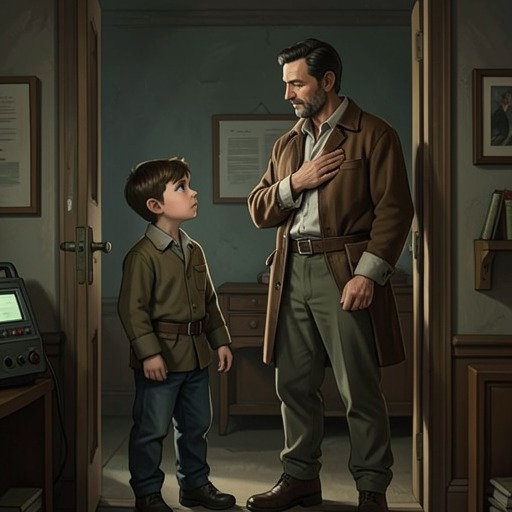
When Gulliver first sits on the bed with his father, he is fifteen and nearly as tall as the man he faces. His dark hair partly shades his eyes; he wears black clothes, a Dark Matter T-shirt and wristbands, with his hands in his pockets. The description emphasizes how unfamiliar he is to the narrator, who reads these details as signs of a social world he does not yet understand. Gulliver, meanwhile, seems uncomfortable looking at his father. Their discomfort is mutual, and the scene makes the relationship feel less like an easy family intimacy than an encounter between people who do not know how to approach one another.
The first question Gulliver asks is why his father did it. Andrew answers that he does not know. Gulliver says that school will now be hell, then describes his life as ruined and himself as a joke; he explains that school was already bad before the incident. These are not abstract complaints about parental authority. He connects his father’s actions to humiliation that will follow him among his peers, and presents the damage as something he must live with in public.
The Failed Attempt to Talk
The conversation repeatedly stalls. When Gulliver demands more than a bare expression of surprise, Andrew struggles to answer. Gulliver tells him that it does not matter because his father never wants to talk to him except for the previous night. The narrator, however, is thinking about Daniel Russell and urgently wants to telephone him. Gulliver notices the lapse in attention. In this small exchange, the old pattern Gulliver describes is enacted again: a request for engagement meets a father whose thoughts have turned elsewhere.
Andrew then presses Gulliver to tell him what he said and what his mother knows. Gulliver turns away and tells him to go. When Andrew insists on knowing what he had said, Gulliver springs from his chair and moves toward him, demanding to be left alone. He says that his father has never been interested in a single thing about his life and challenges the timing of this new attention. After pacing, he returns to his computer. The movement from confrontation back to the screen does not resolve the dispute; it leaves the request for connection unanswered and the two physically separated again.
Gulliver Names the Injury
In a later exchange, Gulliver looks directly at Andrew, angry and confused, and says he does not believe him. He sets out the role reversal he feels: the child should be absorbed in himself, not the parent. He contrasts his own age, fifteen, with his father’s forty-three, and says that if Andrew is genuinely ill he wants to be there for him. That offer of care sits beside a sharp accusation. Apart from the recent streaking and strange swearing, Gulliver says, Andrew is acting very much like himself.
Gulliver also rejects the assumption that the family should care about Andrew’s intellectual work. He lists prime numbers, his work, his books, his exceptional brain and the problem he has solved, then says these things hurt them. The accusation gives the conflict its particular shape: Gulliver does not merely resent an absent father, but describes a household in which the father’s achievements have taken up space that should have belonged to family life. His anger contains concern as well as rejection; he explicitly wants to support Andrew if he is ill, but will not pretend that the earlier neglect has disappeared.
Recognition Without Resolution
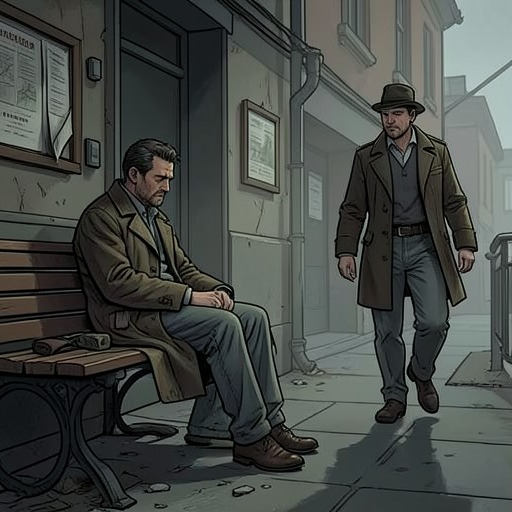
Later, Andrew sees Gulliver walking alone along a pavement when he is supposed to be at school. Gulliver tries to hide behind his hair, freezes when he sees his father, then turns and walks away faster after Andrew calls to him. Andrew worries that Gulliver knows the world’s greatest mathematical puzzle has been solved by his own father and might reveal it. He recalls that Gulliver has said he will not tell anyone, but questions whether he can be trusted. The scene places suspicion beside the father’s claimed desire to understand his son: even while watching Gulliver withdraw, Andrew is preoccupied with what he knows and whether that knowledge is safe.
A night section headed Sleepwalking shifts the emphasis from confrontation to silent attention: Andrew stands beside Gulliver’s bed in the dark and listens to him breathing. The passage offers no conversation or assurance between them. Its contrast with the earlier arguments is telling: the father is physically present, but the son is asleep and cannot answer him.
Afterward, Isobel Martin, author of the unfinished novel, tells Andrew that they have lost Gulliver. Andrew takes a moment to understand whom she means. He suggests that they may have to accept Gulliver as he is, even if he differs from the son they thought they knew. Isobel answers that they have known him for sixteen years and yet she feels she does not know him at all. The exchange widens the distance beyond father and son to the parents’ shared failure to understand their child. Andrew’s willingness to accept Gulliver marks a change in stance, not a reconciliation: the relationship remains unsettled, and the text offers no evidence that Gulliver has accepted this belated effort.