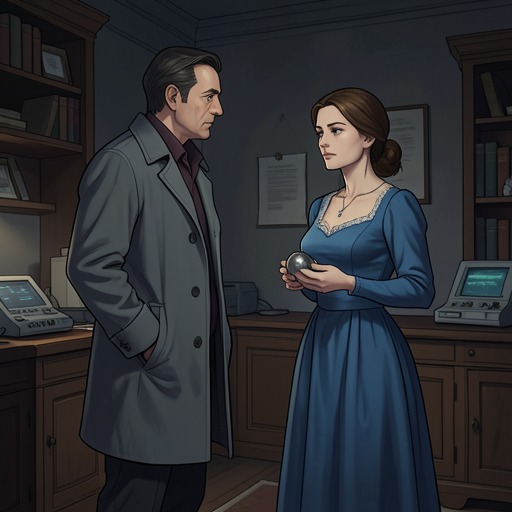
Andrew Martin and Isobel Martin’s marriage
The HumansAndrew Martin and Isobel Martin’s marriage is the narrator’s first sustained encounter with intimacy on Earth: he approaches Isobel as a human specimen and a source of information, but her care gradually makes that distance harder to maintain. Because the narrator is an alien occupying Andrew Martin’s life, the marriage is at once an existing human bond he does not understand and a relationship he must inhabit without possessing its history. Its small gestures—an offered hand, a ring, a shared bed—become tests of whether he can recognize care rather than merely analyze it.
Identity and an Unfamiliar Marriage
When Isobel visits him in his room, a nurse watches. The narrator understands the visit as another test, consistent with his suspicion that human life is organized around scrutiny and rules. Isobel is not simply another person to study: she is his wife, and he expects to spend more time with her to gather information before carrying out his task. That practical purpose shapes the encounter even as he recognizes that their relationship carries obligations he cannot yet interpret.
His first response is fear and repulsion. He sees Isobel as a collection of poorly arranged cells, notices her pale face, tired eyes, and prominent nose, and finds her frightening. Yet he also registers her poise and restraint, describing her as someone who seems to hold something back. The contrast matters: his first perception reduces her to biology, but even then he senses an interiority his account cannot explain. He is frightened not only of her but of Earth and of his own hands, so his revulsion belongs to a broader terror of embodied human existence.
He asks why they married and what marriage is for, as well as what rules govern it. The questions expose how completely he lacks the shared understanding that would normally make such questions unnecessary. Isobel answers instead with concern about Andrew’s recent behavior: for weeks, perhaps months, she has urged him to slow down because he has been working excessive hours. She says the crisis was sudden and had no warning signs, and wonders what triggered it, including whether she herself was involved. Her account establishes a history of worry and attempted intervention, while the narrator can offer no explanation grounded in Andrew’s experience.
Care Misread as a Rule
The narrator tries to explain his strange behavior as having forgotten the importance of clothes and of acting as he was supposed to act. His answer turns a personal crisis into a failure to follow human conventions. Isobel holds his hand, stroking it with her thumb. Rather than receiving this as reassurance, he wonders why a wife would touch him at all, distinguishing her gesture from a policeman’s grip and searching for its purpose. The small diamond on her ring catches his attention, a visible sign of the marriage whose emotional meaning remains obscure to him.
Isobel continues to manage the social consequences of his condition. She tells him she has been fielding calls and has told people he is too ill to talk. When she sits on the bed and strokes his hand again, he feels his skin crawl and momentarily wishes he could kill her. He also knows that he has a sequence to follow. The passage holds tenderness and danger together: her ordinary act of care reaches a person who cannot yet bear it, while his violent impulse remains subject to the alien task he is carrying out.
Learning to See Isobel
Later, after following Isobel into the kitchen and putting his plate and cutlery in the dishwasher, the narrator notices her in greater detail. He sees her cardigan and blue jeans, the thin silver necklace around her long neck, and eyes that seem to search for something just beyond sight. What changes is not Isobel but his attention. He had first treated her as generically human; now he distinguishes her from other people and senses depth in her, an inner distance rather than an arrangement of cells.
When Isobel asks how he feels, he says he is fine, though she appears worried. The narrator’s growing attention does not mean he can yet answer her as a husband might. Instead, the scene shows the beginnings of a different kind of perception: her concern is legible to him even while he conceals his own state. The ordinary domestic setting, with dishes and clothes, gives their relationship a material life that his earlier questions about marriage could not grasp.
Pain, Loss, and a New Recognition
After he is injured, the narrator apologizes to Isobel for everything, including the past and the future. He finds that saying sorry while in dull pain makes him feel as close to human as he can imagine being, almost capable of writing a poem. Isobel places blood-stained cotton wool in a bin beside the sink, and later holds his hand in the dark. He gently withdraws it. The apology marks a change in him, but the withdrawal shows that closeness still exceeds what he can comfortably accept.
Isobel says they have lost Gulliver. The narrator takes a moment to understand that she means her son, and the loss gives their conversation a gravity beyond his bewilderment about marriage. He suggests that they might try to understand less and accept more; Isobel remarks on how strange such advice sounds from Andrew. When he asks whether he understands her, she answers that she does not think he understands himself. Her response names the uncertainty at the heart of the relationship: he knows he is not Andrew Martin, yet feels himself losing a stable sense of who he is.
In bed beside Isobel, the narrator can almost appreciate her as beautiful. He attends to her skin and to the fact that she has cared for him, while the pain in his wounds offers a strange comfort he does not want sleep to erase. He contrasts this care with the emotional isolation of his own people, whose technology serves their preservation and whose lives, as he understands them, require no emotional dependence. Isobel’s hand, first an unnerving mystery, has become evidence that someone can care for him. The marriage therefore registers not as a restored partnership or a resolution of their history, but as the place where his alien certainty begins to give way to vulnerability.