Babraham
The HumansBabraham matters in the novel chiefly as the home of Daniel Russell and the site of his death. The alien narrator reaches Daniel’s large house after obtaining its address from Isobel Martin, author of the unfinished novel, and enters under a false pretext. Inside, an encounter intended to secure information becomes an act of killing; its aftermath, as Tabitha Russell tends to her husband, unsettles the narrator’s contempt for human attachment. The place is defined less by a description of the settlement than by the house that concentrates the story’s conflict between mission and emerging empathy.
The route to Daniel’s house
The journey begins with a question about where Daniel lives. When the narrator asks, Isobel confirms that she knows the address because the family has visited Daniel and Tabitha for dinner. Her surprise at the narrator’s apparent inability to remember that visit makes the gap between his borrowed identity and his knowledge of Andrew Martin’s life difficult to conceal. She describes Daniel’s home as being in Babraham and as an imposing property.
The narrator later obtains the address from Isobel’s notebook. Isobel offers to drive him and insists that he is not ready to leave the house, unaware that he has already gone to Fitzwilliam College. He tells her he needs exercise and that Daniel urgently wants to speak to him, perhaps about a job; he promises to keep his phone with him. These explanations allow him to leave for Babraham while concealing his actual purpose. The detour is therefore not an open visit between colleagues: it is a journey organized around deception, made possible by the trust and practical help of the household he is preparing to betray.
The house and its interior
The narrator calls Daniel’s home the largest house he has seen. That scale is the principal physical distinction the account gives it; rather than describing Babraham’s streets or wider landscape, the narrative draws attention to a private interior and the people gathered within it. Daniel’s wife answers the door. The narrator then makes his way along the first-floor landing, unsure where the study is, until he recognizes Daniel’s dry voice.
The movement from doorstep to landing to study narrows the scene toward its confrontation. The house is at once a familiar social setting—the Martins have previously dined there—and a place Daniel’s visitor enters by pretending to remember and belong. Its domestic character is not separated from the violence that occurs inside it. Instead, the ordinary arrangements of a home, including a wife’s presence and care, become inseparable from what the narrator has come to do.
Daniel’s death
The narrator asks Daniel to slap his back. At their first contact he acquires the reading he needs; when he turns, his face briefly ceases to look like Andrew Martin’s and becomes his own. Daniel recoils against his desk, having seen the change. The narrator prevents him from calling out and uses another touch, placing his left hand on Daniel’s shoulder to complete the task. Pain then begins, summoned by the narrator. Daniel suffers, while the narrator also experiences head pain and fatigue.
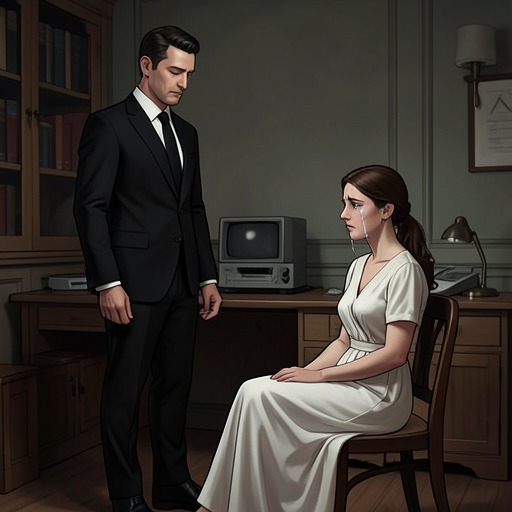
The killing’s aftermath gives the house a second, sharply different meaning. Daniel’s head rests on Tabitha’s knee as she caresses his face. The narrator recognizes in their dependence something he had expected to dismiss as weakness, but instead understands it as love. Daniel becomes still, and Tabitha’s grief is overwhelming to the narrator. The scene does not undo the violence or make the narrator’s purpose innocent; it makes the human bond he has violated impossible for him to treat as an abstraction.
A turning point in the mission
Babraham marks a point at which the narrator’s mission and his developing response to human beings come into direct contact. Before this journey, he has acknowledged that he will have to kill Isobel, though he delays and seeks to learn what she knows. In Daniel’s house, he carries out a killing, but witnesses the intimate reliance and grief that follow it. The change is not a sudden repudiation of his orders at the doorstep; it emerges through what he sees and feels in the aftermath.
Later, when the narrator tells Gulliver the truth, he explains that he was sent to kill him, Isobel, and anyone who knew what Daniel had achieved, but that he could not carry out the order against them. That disclosure places the death in Babraham within a wider operation to suppress knowledge and eliminate those connected to it. The house is consequently both a specific domestic setting and an early measure of the narrator’s transformation: he can still inflict lethal harm, yet the human attachment revealed in its aftermath begins to change what he is willing to do.