Cambridge
The HumansCambridge is both the town the alien narrator must pretend to know and the place he ultimately chooses as home. Its buildings first confront him as evidence of how unlike his former world Earth is; later, its colleges, streets, and familiar inhabitants give his return a human meaning that neither mathematics nor his alien abilities can provide.
Arrival in an Alien Town
The narrator finds Cambridge by opening a map and matching its name to the curve of a narrow, traffic-free road. After running from a lorry, he continues across a field to that road, then heads towards the town. His arrival is not the return of someone who feels at home: as he walks, he imagines himself becoming Professor Andrew Martin, while facts about that identity arrive from those who sent him. Cambridge is therefore first approached through a borrowed name and an imposed past.
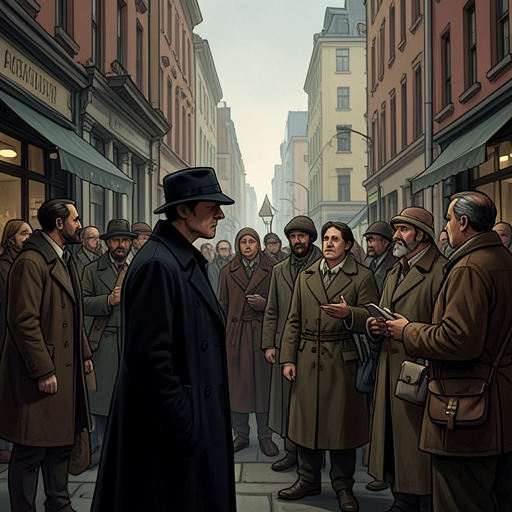
By morning, he is in Cambridge, looking at its buildings with fascination and dismay. Their most striking feature is their immobility: garages are not an exception, but part of a world in which structures for living and consumption remain fixed to the ground. He finds the buildings’ limited geometry startling, noting the absence of even a decagon. Some are larger and more ornate than others, but their designs do not offer the imaginative variety he expects. His first reading of the town turns ordinary architecture into a measure of the distance between his former assumptions and earthly life.
That distance is sharpened by the knowledge that Cambridge is supposed to be his town. The identity he is inhabiting says he has lived there, on and off, for more than twenty years; in practice, he sees it as the most alien place he has ever encountered. He must act as though the place belongs to his past when he has no lived familiarity with it. The mismatch makes Cambridge more than a setting for his impersonation: it is where the difference between a supplied identity and an emerging self becomes visible.
A Return Through Academic Life
Much later, Cambridge draws the narrator back from England. He feels a sadness that seems to pull him east, telling himself that he wants only to see his former family from a distance and know they are safe. By coincidence, he is invited to Cambridge for lectures debating the relationship between mathematics and technology. The invitation gives his return a public reason, but his attention is also moving towards the people he left behind.
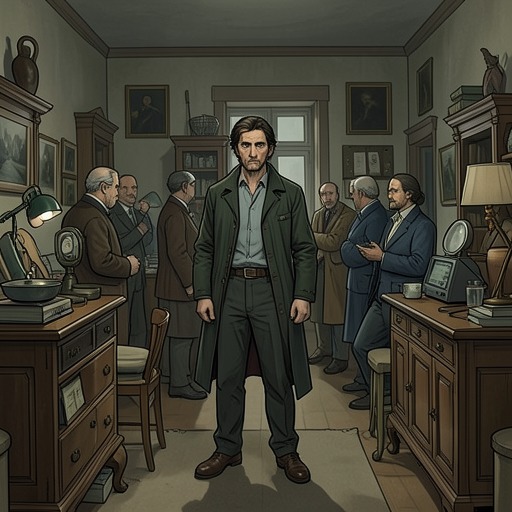
He stays in student accommodation at Corpus Christi College and tries to avoid recognition. His changed appearance—a beard, a tan, and some added weight—helps people fail to identify him. He delivers his lecture to fellow academics, arguing that mathematics is dangerous territory and that humans have explored it as fully as they can. Further advance, he warns, would mean entering a perilous unknown. The scene brings his scientific authority back into view, but now that authority is used to question the value of pursuing further knowledge without regard for its consequences.
Among the audience is Margaret Lowell, whom he recognizes immediately. She asks him to go to the Hat and Feathers; he declines, and she appears to understand that he means to refuse. After making a jovial remark about his beard, she leaves. Cambridge thus gathers pieces of the life he once inhabited—the academic world and Margaret—without restoring his former relationships to him. His refusal marks a boundary within this return: recognition does not require him to resume the past.
Streets, Distance, and Recognition
After the lecture, the narrator walks towards Isobel Martin’s college. He sees Isobel on the opposite side of the street, but she does not see him. The moment is unequal in its significance: for him it is overwhelming, while for her it passes unnoticed. He watches her in the rain, absorbed by her presence and the fact of her living body. Cambridge’s street briefly holds them near one another while preserving the separation between them.
The narrator compares their passing to galaxies that collide and move straight through each other. The image gives the encounter a precise shape: proximity need not produce contact, and an event can transform one person’s inner life while remaining imperceptible to another. The rain begins without his noticing; his attention is fixed on Isobel. In Cambridge, the ordinary act of walking becomes a scene of longing whose force comes partly from what does not happen: she does not see him, and he does not approach her.
From Destination to Home
The town’s meaning changes again when the narrator encounters Gulliver beside Newton. He strokes and holds Newton but can no longer heal him. Gulliver recognizes him and recalls that he had been right about Emily Dickinson. Their exchange makes the return more than a private act of watching from a distance: the narrator is recognized by Gulliver, and the earlier academic lecture gives way to an encounter grounded in shared memory and concern for Newton.
At the end of his journey, the narrator names what he wants as a life with people he can care for and who will care for him: family and happiness in the present, not merely in the future or the past. He understands this desire as wanting to go home, stands up, and finds that home is only a short walk away. Cambridge’s decisive transformation is not architectural; the town that once seemed utterly alien becomes the place from which he can choose connection. Its streets link the impersonated identity he arrived with to a home defined, at last, by the people he hopes to live beside.