Clothing as concealment
The HumansClothing as concealment links an ordinary social convention to the Alien narrator’s attempt to understand what humans hide from themselves. At first, clothes appear to him as an arbitrary requirement backed by law; later, they become a central image for civilization’s distance from human nature. The metaphor also shapes his interpretation of recovery, violence, and art: to be covered can mean to appear healthy and normal, while the truth remains beneath the surface.
The literal rule and its strangeness
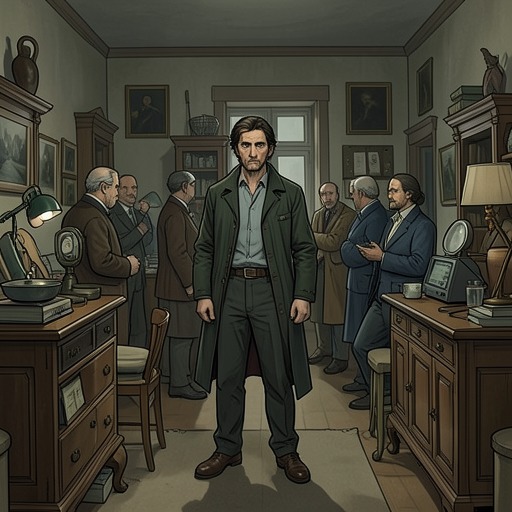
When the Alien narrator first arrives, people make him put on clothes. He cannot believe that simply being unclothed has broken the law. In his view, human beings already know what a naked person looks like, and being without clothes is not itself an act of wrongdoing. His bemusement exposes a gap between bodily fact and social meaning: the body is visible, but the rules governing its visibility are not self-evident to an outsider.
The episode gives clothing its first force as an imposed convention. Its significance does not depend on any harm the narrator has caused; the violation lies in appearing outside the accepted arrangement. What humans treat as ordinary, he experiences as a rule requiring explanation. That initial puzzle prepares the later metaphor: clothes are not merely objects worn on the body but part of a wider system through which people manage appearances and make the world seem orderly.
Appearances, truth, and mastery over nature
The narrator’s later account rejects a simple division in which appearances are false and truth lies somewhere entirely separate. Humans, he says, exist simultaneously in both the world of appearances and the world of truth, connected by strands that take many forms. Clothing matters because it belongs to this connection: it is a visible practice that also points toward less visible ideas about nature, identity, and control.
He groups clothing with other distinctions that initially perplexed him. A dead cow becomes beef; grass cut in a particular way is not to be walked upon; household pets matter greatly; architecture favors unnatural shapes. He interprets these practices as expressions of human fear of nature and the reassurance people take in believing they have mastered it. In this account, nature in its pure form becomes a symbol of human nature, and the two become interchangeable. Clothing consequently signifies more than modesty or dress: it belongs to a human effort to arrange, name, and contain what remains unsettling or uncontrolled.
Civilization’s covering and art’s bridge
The narrator extends the image from literal clothing to metaphorical clothes. Humans have worn them for so long that they have lost understanding of themselves. Civilization, in his formulation, was built at the price of closing a door on the true self; people are lost because the covering has become so familiar that its function is difficult to recognize. The claim is his interpretation of human beings, shaped by the difficulty he has had in understanding them, rather than a neutral account of a rule everyone consciously follows.
Art offers a route back toward what civilization has covered. Books, music, films, plays, painting, and sculpture act as bridges toward the self and toward who people are. Yet the bridge never fully restores what has been lost: however near art brings people, they remain removed. This tension gives the clothing image its particular force. Covering is not simply discarded, and artistic expression does not erase the distance; instead, art makes the separation perceptible and offers a way to approach it.
The narrator connects this theory to the recent episode involving Gulliver Martin. He says that he had been close to killing the boy when Gulliver, in his sleep, was about to fall down the stairs; Gulliver’s true nature emerged, and he attacked the narrator. The narrator reads the incident as a revelation of violence beneath a more composed human surface. In his account, what lies under the covering is not automatically gentle or safe. The metaphor therefore unsettles any easy idea that uncovering the true self would resolve human difficulty: what is concealed can include violence as well as authenticity.
Recovery, the wardrobe, and what lies beneath
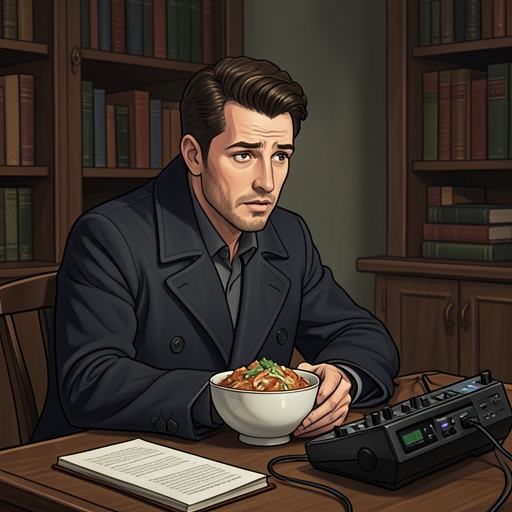
Later, while alone in the house with Newton, the narrator is still described as recovering. He pauses over the word itself, interpreting it as one of the most human terms because it suggests that healthy, normal life involves covering something. He connects physical clothing to metaphorical concealment and to the violence he had seen in Gulliver the previous night. In this reading, being healthy means being covered, while the narrator’s search is directed toward what the covering hides.
That search takes him to Isobel Martin, author of the unfinished novel’s wardrobe. Among the clothes, he finds a yellowing pile of paper tied with an elastic band, apparently at least a decade old. Its top sheet bears the title Wider than the Sky and identifies it as a novel by Isobel Martin. The manuscript, concealed among garments, gives the metaphor a concrete form: the wardrobe contains both literal clothing and a piece of writing that may offer access to something beneath ordinary appearances. The narrator reads some of it as part of his effort to discover what lies beneath, hoping also to find something that will satisfy the hosts and justify his delay in carrying out his task.
Clothing as concealment thus develops from an outsider’s bafflement at a legal convention into a framework for interpreting human life. It marks the gap between what people present and what they may not understand in themselves, but it does not make truth simple: nature and civilization, appearance and truth, covering and revelation remain entangled. The image culminates not in the removal of every covering but in the search for bridges—especially art—that allow people to approach what civilization has placed at a distance.