Confessing his alien identity to Ari
The HumansThe Alien narrator’s confession to Ari is both an act of trust and a dangerous breach of secrecy. He tells Ari plainly that he comes from another planet and describes the technology that brought him to Earth, even though his former powers are gone. Ari cannot accept the claim, but the disclosure still matters: it opens a rare channel of honesty between them and gives the narrator reason to fear that others have heard him.
The decision to tell Ari
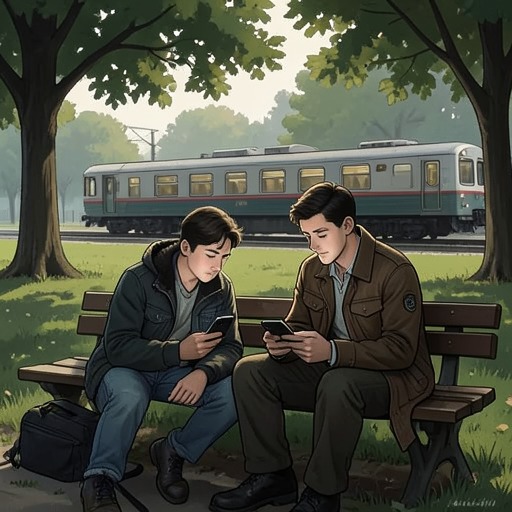
The confession follows a moment of deliberate trust. The Alien narrator looks at Ari for a long time and recognizes him as a good man, someone he can trust. The subject is not entirely new between them: at a café at the college, the narrator had been about to tell Ari something before a migraine interrupted him. Now he returns to that unfinished conversation. His hesitation reflects the stakes of speaking openly, but he also believes he is disconnected from the forces that once constrained him. He acts on that belief, or at least on the possibility that it is true.
His disclosure is direct rather than metaphorical. He says that he is from another planet, in another solar system and another galaxy. When Ari jokes about contacting home through the Andromeda galaxy, the narrator corrects him: his home is much farther away. He explains that his journey did not use any conventional means Ari would recognize, but antimatter technology. Home, he says, is at once impossibly distant and only a second away; nevertheless, he can never return. The contradiction gives the confession its emotional shape: the technology makes home seem close in one sense, while his separation from it is absolute.
Ari’s disbelief
Ari responds first with loud laughter. He treats the claim as a joke, imagining a familiar science-fiction solution and asking whether the narrator arrived by spaceship or wormhole. The narrator’s answers do not persuade him. Ari had previously shown interest in the possibility of alien life, but abstract openness proves different from accepting an alien who is present before him. His laughter is not simply a refusal to discuss the idea; it reveals the distance between entertaining a possibility and allowing it to reorganize one’s understanding of reality.
The narrator tries to make the claim credible through what he knows of Ari. He points to Ari’s understanding of quantum physics, his writing about simulation theory, and his stated view that there is a thirty per cent chance that none of their perceived reality is real. He also recalls that Ari had said he believed in aliens. These are not proof of the narrator’s identity, but they are reasons he expects Ari to be able to consider it. Ari tells him that he cannot. The exchange ends not in agreement but in a clearer recognition of the limits of Ari’s belief: even a person receptive to extraordinary ideas may be unable to accept this one when it demands a personal, immediate change of perspective.
Powers lost, origins disclosed
Ari asks the narrator to demonstrate his special talents. The narrator explains that they were gifts produced by technology, but he cannot show them now: he has no powers and is exactly like a human. The confession therefore contains two distinct claims, not one. He identifies himself as extraterrestrial while also insisting that the abilities that might seem to prove his difference have disappeared. Ari has to assess an extraordinary past through a present in which the narrator says he possesses no visible powers.
Ari’s concern turns toward the narrator’s medication. He urges him to keep taking all of his tablets, not only the painkillers. The narrator understands that Ari thinks he is mad and considers how much easier it might be to believe the account himself as a delusion, or someday to wake believing it had all been a dream. That possibility does not erase his conviction. Instead, it exposes the isolation built into the confession: the listener he trusts interprets the truth as illness, while the narrator must continue to live with the knowledge that his account is real to him.
A confession with consequences
Ari’s disbelief also changes what the narrator imagines telling others. He concludes that if Ari will not believe him, Isobel Martin never will. He still holds open the possibility of telling Gulliver Martin one day, but immediately confronts the harder question of whether Gulliver could accept him as a father after the narrator had lied. The confession thus reaches beyond the exchange with Ari. It raises the difference between revealing a fact and repairing a relationship: telling Gulliver the truth might answer who the narrator is, but would not undo the concealment that preceded it.
Later, while running toward the house where he had been living with the people he had come to love, the narrator connects the confession to a new danger. He believes the watchers may still be listening, even though he had been disconnected, and pleads for Isobel Martin and Gulliver Martin not to be harmed because they know nothing. A later explanation confirms that the danger is not simply imagined: the narrator has been given broader instructions than the other operative, including an order to destroy anyone told of his origins. The technology in the narrator’s left hand remains a means of surveillance; his powers were taken, but the watchers retained theirs.
The confession therefore succeeds in one sense and fails in another. Ari hears the narrator’s account, and the narrator has finally spoken without the warning that once made disclosure agonizing. But Ari does not believe him, and speaking creates a risk for others because the watchers may hear. The scene marks trust as a genuine human impulse, not a guarantee of recognition or safety. By telling Ari, the Alien narrator gains no proof of acceptance; he gains the knowledge that honesty can matter even when it cannot make another person believe.