Daniel Russell
The HumansDaniel Russell is a mathematician whose death gives personal and human consequence to the story’s account of a suppressed mathematical breakthrough. He appears chiefly through what follows his death: a funeral attended by the narrator and a widow left to manage ordinary tasks amid grief. He is also linked to Original Andrew Martin’s work through an email addressed to him, placing him within the chain of communication around the Riemann hypothesis and its destroyed proof.
Identity and Place in the Story
Daniel’s presence is defined less by direct action than by the effects of his absence. The narrator attends his funeral and watches his coffin lowered into the ground. Earth is scattered over the wooden casket as a crowd gathers, most dressed in black; a few mourners cry. The account does not dwell on biographical particulars, instead making the funeral the scene through which Daniel’s death becomes visible to the narrator and to the reader.
His name also marks a point of contact in Original Andrew Martin’s mathematical life. The narrator recalls being in Andrew’s office after deleting an email to Daniel. The detail places Daniel in the orbit of Andrew’s work, although the scene does not reproduce the message or establish its full contents. Daniel is therefore connected to the novel’s mathematical crisis without being made a participant in the narrator’s later reflections on Andrew’s book.
Mathematics and the Destroyed Proof
The office scene expands the stakes surrounding the email. Books line the walls of Original Andrew Martin’s office, arranged so that a visitor would see a book from any angle. Among them is Andrew’s thin volume, The Zeta Function, marked as an uncorrected proof copy. The narrator locks the door, sits in Andrew’s chair, and reads it from beginning to end.
The book describes Andrew’s effort to prove the Riemann hypothesis and explain the widening gaps between prime numbers. Its account makes the effort seem futile, but the narrator recognizes the tragedy in Andrew’s determination: after writing the book, Andrew did solve the problem. The proof itself, however, had been destroyed by the narrator. Daniel’s deleted email belongs to the immediate circumstances surrounding that loss, while the office and its book reveal what the lost work meant. The text does not make Daniel the author of the proof or specify what he knew; his significance here is as a named correspondent within the human network around Andrew’s mathematics.
Reading the book also forces the narrator to compare human achievement with the mathematical breakthrough that transformed his own civilization. The narrator recalls that the Second Basic Theory of Prime Numbers enabled interstellar travel, life on other worlds, bodily transformation, extended life, and the searching of minds and dreams. Against that scale, the human achievements listed in Andrew’s book—fire, the plough, the printing press, the steam engine, the microchip, and the discovery of DNA—mark a long advance, but not the leap the narrator believes humanity might make next. He concludes that he has been stopping those possibilities and has killed humanity’s future. Daniel’s association with the email gives him a place in this consequential academic episode, even as the proof’s destruction overshadows the individual correspondence.
Funeral and Family Aftermath
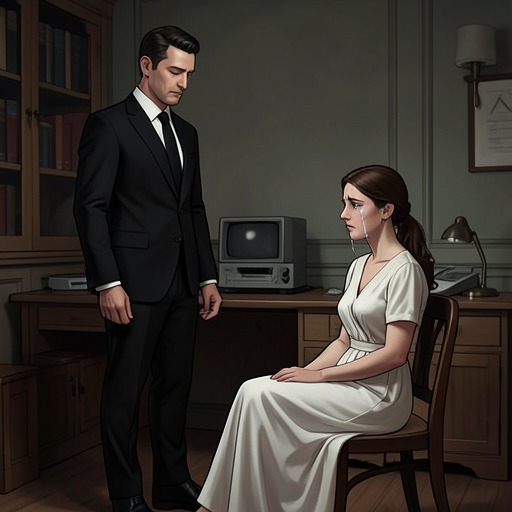
The funeral’s public ritual is followed by a quieter encounter. Afterwards, Isobel Martin wants to speak to Tabitha Russell. Tabitha looks older than when the narrator last saw her, though only a week has passed. She is not crying, but maintaining that composure seems to require effort. The description makes grief legible not through a speech about Daniel, but through the change in Tabitha’s appearance and the strain of not weeping.
Isobel offers support in concrete terms. She strokes Tabitha’s arm and tells her that the family is there for her, whatever she needs. When Tabitha explains that she has never mastered online shopping, Isobel suggests handling the basic necessities, including a supermarket order. Her offer is practical rather than ceremonial: after the coffin has been lowered and the mourners have dispersed, care takes the form of helping with an everyday task that grief has made difficult.
That offer is carried out. Isobel gets another person’s shopping, pays for it, and brings it home. When she tells the narrator that he is looking better, he asks whether he is; she answers that he is looking like himself again. Daniel’s death thus has a consequence beyond the funeral scene: it prompts an act of care between the two households, and that act is also part of the narrator’s renewed attention to human feeling and obligation.
Narrative Significance
Daniel’s funeral places death and mathematical possibility in close proximity. The narrator sees the physical finality of a coffin being covered with earth, then later confronts a book about a proof whose destruction may have obstructed humanity’s future. These are distinct losses—one personal, one civilizational—but the sequence makes the narrator’s responsibility harder to treat as an abstract calculation. Human lives and scientific futures alike have consequences that cannot simply be recovered by reasoning about them.
Daniel remains largely outside the narration’s direct focus, yet his name connects the intimate and intellectual strands of the story. The deleted email situates him near Andrew’s mathematical work; the funeral shows the people left to live with his death. Tabitha’s strained composure and Isobel’s paid-for shopping bring the aftermath down to ordinary human needs. In this way, Daniel’s role is defined not by a detailed portrait but by what his absence reveals: grief persists in daily life, and the consequences of the narrator’s choices extend beyond the proof he destroyed.