Daniel Russell’s death
The HumansDaniel Russell’s death is both a killing and an act of evidence suppression: Andrew Martin (the alien narrator), wearing Andrew Martin’s appearance, uses contact to inflict pain on Daniel and then removes an email and its attachment from his computer. Daniel dies with Tabitha Russell beside him; afterward, the narrator reports the death as a heart attack, a plausible explanation given Daniel’s heart-risk status. The sequence brings bodily violence, digital erasure, and a bereaved witness into the same scene, while showing how the narrator converts an intentional death into an apparently ordinary one.
Background and confrontation
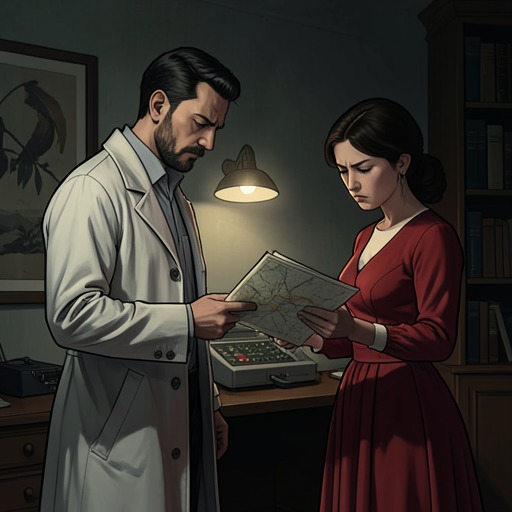
The encounter takes place in Daniel’s office, where the narrator needs contact with him. He asks Daniel to slap his back. Daniel hesitates: his eyes register a mixture of concern and fear before he does as requested. The narrator waits for the touch, and when it comes, makes what he calls a reading. The evidence does not specify what information that reading yields; its importance in the scene is that contact gives the narrator an opportunity to act.
For less than a second, the narrator’s face is no longer Andrew Martin’s. Daniel sees the change and recoils into his desk. Although the narrator’s appearance returns to Andrew Martin’s, Daniel has witnessed something that contradicts the identity being presented to him. His alarm threatens to turn the encounter into a public exposure. The narrator responds by paralysing Daniel’s jaw, preventing him from screaming, and then touches his shoulder. That second contact is described as sufficient to complete the act.
The killing and its concealment
Pain begins after the contact, and the narrator identifies it as pain he has summoned. Daniel clutches his arm and his face turns violet. The narrator, too, experiences pain in his head and fatigue, details that mark a physical cost to the act without undoing its deliberate character. He does not stay to help Daniel. Instead, he walks past him while Daniel drops to his knees and deletes an email and its attachment from Daniel’s computer. He checks the sent folder and finds nothing suspicious there.
The order of these actions gives the death two linked dimensions. The narrator first disables Daniel’s immediate ability to call for help, then inflicts the pain that precedes his collapse; he also removes material stored on the computer. The scene does not identify the contents of the attachment, so its precise significance remains unstated. But the later account to the hosts confirms that the deletion belongs to a wider effort to destroy information, not to routine computer housekeeping. The narrator treats the digital trace and the human witness as parts of the same problem, even as his actions make Daniel’s death irreversible.
Daniel’s death and Tabitha’s grief
The scene shifts from the narrator’s brisk handling of the killing to Daniel’s final moments with Tabitha. His head rests on her knee as she caresses his face and pleads with him to stay with her. The narrator recognizes the scene as love: two forms of life relying on one another. He had expected, or believed he was meant, to regard that dependence as weakness. Instead, he finds that he cannot see it that way. Daniel’s dying presence unsettles the contempt the narrator associates with his former outlook.
Daniel stops making noise. His body seems to become heavier against Tabitha, and the clenched lines around his eyes relax. The narration marks this as the moment of death without turning it into a medical account. Tabitha howls, as though something has been torn from her, and the sound troubles the narrator. Her response is not an explanation of how Daniel died, but it makes the consequence of the narrator’s action impossible to reduce to the convenient category of a heart event. A startled cat briefly appears at the doorway and then retreats, an incidental movement set against the finality of the loss.
The account afterward
When the hosts ask whether the evidence and its possible sources have been destroyed, the narrator says that information on both Andrew Martin’s computer and Daniel Russell’s computer is gone. He reports Daniel as destroyed and gives heart attack as the cause of death, adding that Daniel was at risk of heart problems and that this was the most logical explanation under the circumstances. The report is carefully shaped: it presents a natural cause that can account for the death while leaving out the narrator’s contact, the summoned pain, and the brief revelation of his face.
The death therefore exposes a gap between the narrator’s operational language and the scene the reader has witnessed. In his report, Daniel becomes a plausible cause of death and the information on a computer becomes something successfully erased. In the room, Daniel is a person whose final moments are shared with Tabitha, and whose death provokes a grief the narrator did not anticipate. That contrast gives the killing its narrative weight: the narrator can control Daniel’s body, silence him, and delete records, but he cannot make Tabitha’s loss—or his own disturbance at witnessing it—disappear.