Destroying the Riemann hypothesis proof
The HumansDestroying the Riemann hypothesis proof is the act through which the Alien narrator realizes that his interference has not merely erased Andrew Martin’s achievement: it has cut off possibilities for humanity’s future. The proof is already gone when the narrator reads Andrew Martin’s account of the problem, and the knowledge of what it might have made possible turns that destruction into a source of despair and responsibility.
Discovery of the loss
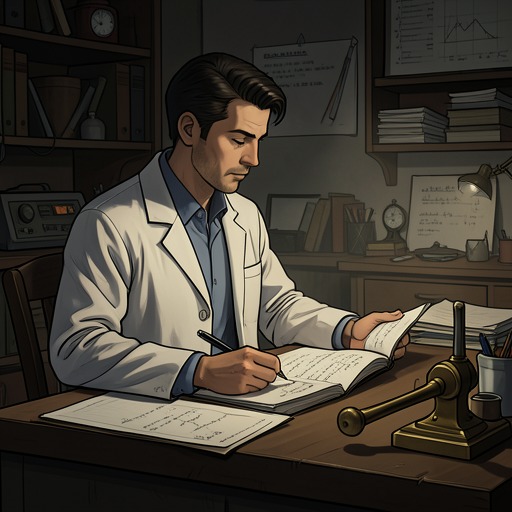
In Andrew Martin’s study, the narrator finds a thin, previously unnoticed book, The Zeta Function, bearing the words Uncorrected Proof Copy. After locking the door, he sits in Andrew Martin’s chair and reads every word. The book recounts Andrew Martin’s effort to explain the Riemann hypothesis and the changing spaces between prime numbers. Its account makes the loss personal: Andrew Martin had wanted intensely to solve the problem, and, after writing the book, had in fact solved it. The narrator had already destroyed the proof, so the achievement Andrew Martin later reached could no longer produce the benefits he had imagined.
The order of these facts matters. The narrator does not encounter the proof and then decide what to do with it; he reads an account of the work after destroying it. The book becomes evidence of the human achievement he has suppressed, and of the gap between Andrew Martin’s completed discovery and the future now denied to others.
A future cut short
The narrator measures the loss against his own civilization’s mathematical breakthrough, the Second Basic Theory of Prime Numbers. He understands that breakthrough as the basis for capacities his people take for granted: travel across the universe, inhabiting other worlds, transforming into other bodies, choosing how long to live, and searching one another’s minds and dreams. Against that standard, the proof represents more than an individual mathematical victory. It is a possible threshold in humanity’s development.
The Zeta Function lists earlier human advances, including fire, the plough, the printing press, the steam engine, the microchip, and the discovery of DNA. The narrator recognizes the pride humans might take in this history, but sees that their mathematics has not yet enabled the larger developments reached by other intelligent life forms. Rockets, probes, and satellites exist, though only a few work; brain synchronization, free-thinking computers, automation technology, and intergalactic travel remain unrealized. Reading the book, he understands that destroying the proof means stopping these opportunities and, in his own words to himself, killing humanity’s future.
Significance of the act
The proof’s destruction joins a private intellectual ambition to a civilizational consequence. Andrew Martin’s account gives the vanished result a human scale—the intensity of his desire to solve the problem—while the narrator’s comparison with the Second Basic Theory of Prime Numbers gives it a vast one. The proof is not shown as guaranteeing any particular invention or social transformation; rather, the narrator sees it as a lost opening toward advances that might have followed.
That recognition changes the meaning of the act for the narrator. What he had done as an intervention against human progress becomes, through reading Andrew Martin’s book, a conscious obstruction of possibilities he can now name. The discovery does not restore the proof or reverse its destruction. It leaves the narrator with the knowledge that the future he has blocked is not an abstraction: it is made up of concrete capacities that his own civilization’s mathematics once enabled.