Dogs
The HumansDogs occupy a small but decisive place in the Alien narrator’s education on Earth. At first he sees them as domesticated creatures whose dependence reflects human power; through Newton, an old household dog, he discovers a bond that cannot be reduced to utility. The dog’s pain, trust, and loyalty make care concrete, and their relationship helps reveal how far the narrator has moved from his supposedly emotionless origins.
Dogs in the Martin Household
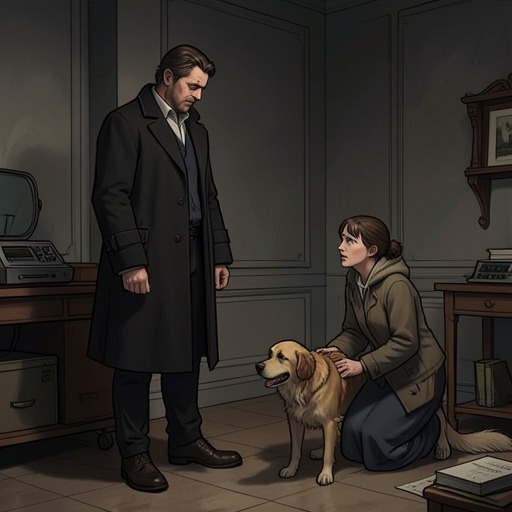
The Alien narrator’s first encounter with a dog in the house is not tender. He finds a male animal asleep in a basket in the kitchen, its body covered in brown-and-white hair. It growls when he enters. Later, he understands this dog to be Newton, named after the human associated with gravity and inertia. Newton’s slow, difficult departure from his basket makes the name seem apt to the narrator, who observes that the dog is old, hobbles, and is half-blind. This is not an abstract specimen but a vulnerable animal whose condition becomes central to the narrator’s first sustained act of care.
Dogs also belong to the ordinary architecture of the household. The Alien narrator knows that the original Andrew Martin walked the family’s English Springer Spaniel, while presenting the walks as an excuse to leave home. In that memory, a dog is entangled with a human marriage already marked by neglect: the routine of taking an animal outside can serve as cover for avoiding domestic life. Yet the replacement Andrew’s later experience of Newton gives the same routine a different meaning. A dog walk can be an evasion, but it can also become time spent attending to another living creature.
Newton and the Turn to Care
The narrator initially approaches Newton with practical motives. After Daniel Russell’s death, he wants the dog on his side, imagining that Newton might have gathered information or heard something useful. His reasoning follows a rule he believes applies across the universe: win another being’s cooperation by relieving its pain. Even as he recognizes an impulse to heal, he treats that impulse as unsettling and dangerous to acknowledge. He gives Newton a biscuit, then restores the dog’s sight and heals him. The effort brings on an intense headache and waves of fatigue, and the narrator falls asleep on the kitchen floor.
When he wakes, Newton is licking him enthusiastically. The narrator asks the dog to stop, but Newton cannot manage it until the narrator stands. Even then, the dog tries to rise with him and clamber onto him. The narrator finds this affection overwhelming, insisting to himself that he does not want it. The scene reverses the earlier growl: the creature he hoped to recruit has become devoted to him, and the narrator is less prepared for love than for hostility. Newton’s dependence is comic in its intensity, but it also gives the narrator an experience of attachment that demands no argument and cannot be kept at a convenient distance.
The change is not only Newton’s. The narrator discovers that stroking the dog feels pleasant: the animal’s warmth and the repeated movement hold his attention. When Isobel Martin returns, he has shifted on the sofa to watch the simple sequence of her entering the house. Newton has been lying on his lap; at the sight of Isobel, he jumps down and runs to her. The dog’s movement places him within an existing household bond as well as the new one he has formed with the narrator. Newton is not simply a device for making the visitor feel affection: he moves between people, seeking contact on his own terms.
Dogs, Domestication, and Human Power
Walking Newton gives the narrator another view of the relationship between humans and dogs. He considers the arrangement ethically questionable because, in the universal scale of intelligence he imagines, the two species are somewhere in the middle and not far apart. Nevertheless, he observes that dogs generally seem content with the arrangement. Newton wears a lead, and the narrator lets him choose the way. The walk makes their interdependence visible: the human holds the means of control, while the dog supplies the direction and pace.
In a stretch of grass, the narrator watches dogs run as if they were free, imagining that they are proclaiming their freedom to one another. He sees this as a collective illusion they have accepted, noting that they show no nostalgia for their former wolf selves. His description is pointedly skeptical, but it also unsettles his confidence that a creature’s nature is fixed. Humans, he concludes, can shape the path of other species and alter their fundamental nature. The thought turns back on him: perhaps he, too, can be changed by his time among humans. The dog’s domestication becomes both an observation about human power and a warning that the narrator’s own identity may not remain untouched.
Loyalty and the Narrator’s New Attachments
Newton’s loyalty becomes most consequential when the narrator considers leaving Earth. During the rain, he sees Gulliver Martin sitting on the roof edge, cold and bedraggled. The scene brings the narrator to regard Gulliver not as an unusual arrangement of particles but as a person to whom he feels connected. Later, when the narrator is in the garden, Newton comes out and appears to know who is standing behind the juniper bushes. The dog does not bark or draw attention to him. The narrator calls him a good dog and recognizes that he loves him. Newton’s quiet presence does not decide the narrator’s choice by itself, but it belongs to the accumulating attachments that make a return to a painless home less compelling.
The bond also persists through an episode of family crisis. After Gulliver has been brought inside and is asleep, Newton stays upstairs with him, keeping guard. The detail is modest and exact: the dog remains beside the sleeping boy while the adults are elsewhere. In the narrator’s later counsel, Newton’s loyalty becomes an explicit lesson. Dogs, he writes, are geniuses of loyalty, and that is a good kind of genius to have. He urges Gulliver to walk Newton whenever possible, adding that the dog likes to get out and is lovely. The advice carries the weight of experience: loyalty is not an abstract virtue but a relationship maintained through attention, company, and the ordinary work of taking a dog for a walk.
Narrative Significance
Newton’s role culminates in separation. When the narrator prepares to leave Isobel and Gulliver, he longs for the ordinary intimacies of family life, including Isobel’s voice and care. Newton stands by her and looks up at him with forlorn eyes. The narrator says goodbye. The dog’s expression makes the departure register not only as a break between people but as the loss of a bond the narrator had once rejected as needy and inconvenient.
Across these encounters, dogs challenge the narrator’s habit of treating living beings as categories, tools, or sources of information. Newton first growls, then accepts healing, seeks physical closeness, remains with Gulliver, and finally watches the narrator leave. These actions give the dog a presence beyond the lessons the narrator draws from him. At the same time, Newton’s changing place in the narrator’s life traces the movement from calculation toward care: a biscuit and a healing act become fatigue, affection, loyalty, and grief at parting. Dogs thus make the novel’s transformation legible through domestic gestures rather than abstract declarations.