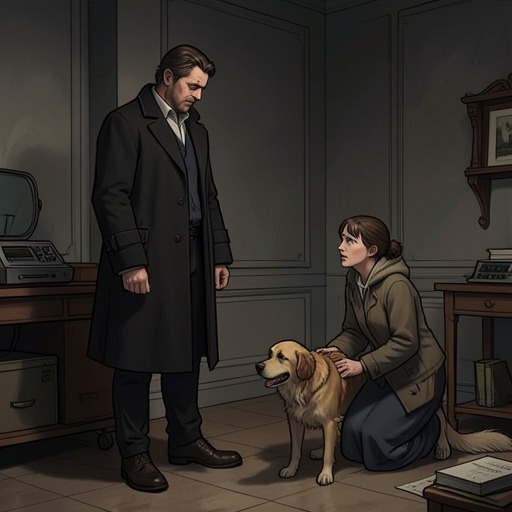
Domestic dogs
The HumansDomestic dogs occupy a small but consequential place in the narrator’s life on Earth: they make companionship tangible through walks, pain, recognition, and play. Newton is not simply one dog among others. The narrator measures another dog against him, and their final reunion turns an ordinary exchange with a pet into a test of what the narrator can no longer do—and what he can still offer.
Dogs in Everyday Life
After settling into an apartment, the narrator walks a dog for an elderly woman who lives upstairs. The account gives no details about the neighbor or her dog beyond this routine, but its comparison is telling: the dog is “never quite Newton.” That qualification makes the two animals distinct rather than interchangeable. Caring for one does not erase the narrator’s attachment to the other; instead, the ordinary task of walking a neighbor’s dog keeps Newton present as a measure of particular affection.
This routine belongs to a period of newly human, often solitary life. The narrator describes walking the dog alongside other habits: attending academic functions, shouting in forests, and returning to Emily Dickinson each night. The dog is part of a life assembled from repeated, modest actions rather than extraordinary powers. The contrast also gives the animal a place within the narrator’s daily world without making it a substitute for the human relationships he misses.
Newton as an Individual Companion
Newton returns as a familiar presence in the park, where Gulliver had walked him. When the narrator sits on a bench, the dog approaches and presses his nose against the narrator’s leg. The encounter is initiated by Newton’s movement toward him; the animal is not merely scenery in a conversation between people. His body communicates a need, and the narrator recognizes what that need is: Newton’s arthritis has returned, and he is in pain.
The name Newton carries continuity across the narrator’s changed circumstances. Recognizing the dog connects the present meeting to an earlier life in which Newton was already known to him, while the renewed arthritis makes clear that the animal’s condition is not fixed. The dog has an individual history of bodily vulnerability. His appearance brings that history into the scene without requiring him to become a speaking character or to explain himself in human terms.
Care, Limits, and Ordinary Gestures
In the earlier routine, the narrator could heal Newton; now he cannot. He strokes the dog and holds his hand against him instinctively, but the healing ability is gone. The scene makes the loss concrete through a small act of care: the impulse remains, while the power to relieve Newton’s pain does not. The narrator’s response is neither indifference nor a claim that affection can repair the animal’s condition. It is a gesture of comfort beside a limit he cannot overcome.
Newton’s needs also keep the scene grounded in ordinary care. The narrator notices the pain, touches the dog, and remains with him on the bench. Later, Newton comes over with a stick and drops it for the narrator to throw; the narrator does. The exchange is simple, but it gives the dog an active part in their reunion. Newton seeks play, and the narrator answers. Even after losing the ability to heal him, he can still participate in this familiar interaction.
Recognition and Narrative Significance
Gulliver approaches while the narrator and Newton are together and says, “Dogs are better than human beings because they know but don’t tell.” The remark gives the animal a distinctive place in the encounter: dogs are presented as perceptive companions whose knowledge does not depend on explaining it in words. Newton’s earlier actions have already made that idea concrete. His approach, the pressure of his nose, and the stick he drops are meaningful without becoming human speech.
The novel’s treatment of dogs therefore rests on particular relationships rather than a general claim about animals. The unnamed neighbor’s dog is not Newton; Newton’s returning pain is his own; and the stick game is an exchange between this dog and the narrator. These details grant the dogs a modest but recognizable presence beyond their usefulness to human characters. They also make the narrator’s change legible in practical terms: he can no longer command a cure, but he can notice, touch, and play. In the meeting with Gulliver, Newton is both the reason the narrator remains on the bench and the companion through whom an old connection begins again.