Emotion as infection
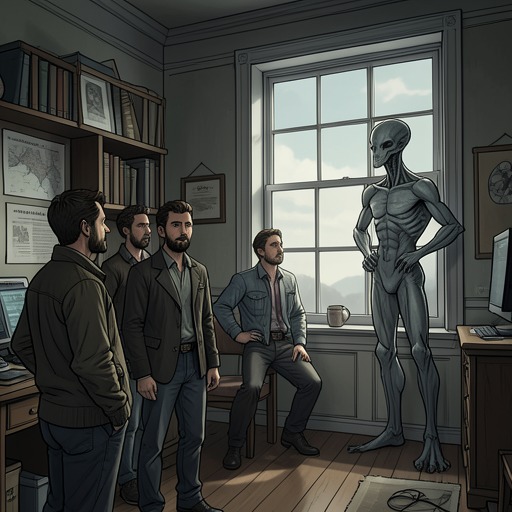
The HumansEmotion as infection is the name the Alien narrator’s Vonnadorian kin give to his growing capacity for attachment and care. Their accusation casts his change as contamination and a threat to collective identity; the story instead shows emotion becoming the basis of responsibility toward particular lives. The idea is tested not in abstraction but through the Alien narrator’s actions toward Newton, Isobel Martin, author of the unfinished novel, and Gulliver Martin, and through the pain he anticipates when he leaves them.
The accusation and its logic
The Vonnadorian collective argues that the Alien narrator has been corrupted by human beings and infected with emotion. He rejects the diagnosis: what has happened, he insists, is that he has gained knowledge. His kin answer that he is speaking like a human, while asserting that he remains one of them and that they are one. The disagreement is more than a dispute over terminology. For the collective, emotional attachment threatens the unity and identity that define their people; for the Alien narrator, care has a logic that his original, detached account of the world could not accommodate.
He answers that emotions help humans care for one another, and that this mutual care supports the species’ survival. His reasoning still bears the marks of his former way of thinking: he explains attachment as a form of self-preservation, something that can be made intelligible in rational terms. Yet the distinction between an abstract rule and an actual relationship has begun to collapse. He is no longer merely describing why care might be useful. He has become involved in caring for others, and that involvement is precisely what his kin call infection.
When they insist that he must return home, he refuses. He says he never had a family. The refusal exposes the emotional stakes beneath their language of unity: the collective claims a shared identity, but he does not experience that bond as the equivalent of family. His emerging attachments are instead grounded in the imperfect, vulnerable relationships he has formed on Earth.
Care before explanation
The change is already visible in the Alien narrator’s treatment of Newton. At first he approaches the dog strategically, hoping that winning Newton’s support might bring useful information. He gives him a biscuit, then restores his sight and heals him. The narrator recognizes an impulse behind the healing that he finds difficult to admit: an urge to relieve suffering, distinct from the practical advantage he first expected to gain. What begins as an attempt to recruit an ally becomes an act of care whose physical cost falls on the narrator himself.
Healing leaves him with an intense headache and waves of fatigue; he falls asleep on the kitchen floor. When he wakes, Newton is licking him, and the narrator asks him to stop, but the dog cannot. The scene makes their connection bodily and reciprocal without requiring a shared language. The narrator has acted on Newton’s need; Newton responds with attention. Elsewhere, with Newton resting on his lap, the narrator notices that stroking him feels pleasant, registering the warmth and rhythm of the contact. These small exchanges give the supposed infection a concrete form: not a theory imposed from outside, but a new responsiveness to another creature.
That responsiveness also changes how the narrator sees ordinary human behavior. When Isobel Martin returns home, he watches her unlock and close the door, put her keys into a small oval basket, and move through these familiar tasks in fluid gestures. What he might once have dismissed as routine instead seems almost like a dance, a melody above rhythm. His attention lingers on the unremarkable because he has begun to perceive a human life from within its daily patterns, rather than measuring it only against a detached standard.
Recognition within family life
The Alien narrator’s developing emotional understanding does not erase the harm in the Martin family’s history. In a conversation about their marriage, Isobel recalls that when Gulliver Martin was between two and four, the original Andrew Martin was never home in time for a bath or bedtime story. She also describes his anger when work was interrupted and his unwillingness to delay a book deadline when she tried to discuss the career sacrifices she had made for the family. The Alien narrator acknowledges that he has been terrible and thinks of her unfinished novel, Wider Than the Sky. The evidence does not make him the author of the original neglect; rather, his response shows him recognizing the damage attached to the identity and life he has inherited.
His remorse is not offered as a cure for that damage. He tells Isobel that she might be better off without him and imagines leaving permanently; she rebukes him for sounding younger than Gulliver. The exchange places his new emotional sensitivity beside an old pattern of failure, without suggesting that insight alone repairs a marriage. His ability to recognize Isobel’s sacrifices marks a change in perception, but the relationship remains shaped by what was not done as well as by what he now understands.
Attachment and the cost of leaving
Later, when speaking with Jonathan Roper, the Alien narrator admits that he has been unable to harm more humans, especially the people with whom he has lived. He describes having adopted human habits and experienced physical and emotional pain, but insists that he still understands his original purpose. His account holds two positions together: he calls himself corrupted, adopting the Vonnadorian judgment, while also admitting that his attachments have made violence impossible for him. The emotional change is therefore not an incidental softness alongside the mission; it has altered what he can bring himself to do.
The cost of that change becomes clearest when he prepares to leave Isobel. Asked where he will go, he says he does not know and tries to reassure her. After they embrace, he longs for the ordinary intimacy of their life together: Isobel humming the theme to Cinema Paradiso, talking about Alfred the Great, making him a sandwich, tending to a minor hurt, or sharing worries about work and Gulliver. He understands that she cannot continue to offer those forms of closeness. Newton, beside her, looks up at him as the embrace ends, and the narrator says goodbye. The departure gives emotional attachment its sharpest consequence: the ordinary details that once seemed small have become precisely what he cannot bear to lose.
As a concept, emotion as infection names the conflict between a collective ideal of emotional purity and the particular obligations that arise from living with others. The Alien narrator’s kin treat feeling as something that separates him from his own people; the scenes on Earth show it connecting him to a dog and a family through attention, remorse, and grief. The novel does not present care as painless or as a guarantee of reconciliation. Its force lies in the change it makes possible: the narrator can no longer treat other lives as abstractions when he has learned to experience their needs and their absence as matters of his own.