Gulliver and the alien kill the replacement together
The HumansGulliver and the Alien narrator kill the replacement together after it turns its mind-control technique against Gulliver. Their victory depends on a sudden reversal: the Alien narrator disrupts the replacement’s influence with competing sounds, Gulliver chooses to resist, and the two work together to disable the technology in the replacement’s left hand. The encounter also forces the Alien narrator to disclose the truth about Gulliver’s father and his own mission, making their physical struggle inseparable from the question of whom Gulliver can trust.
The attempted control and the countermeasure
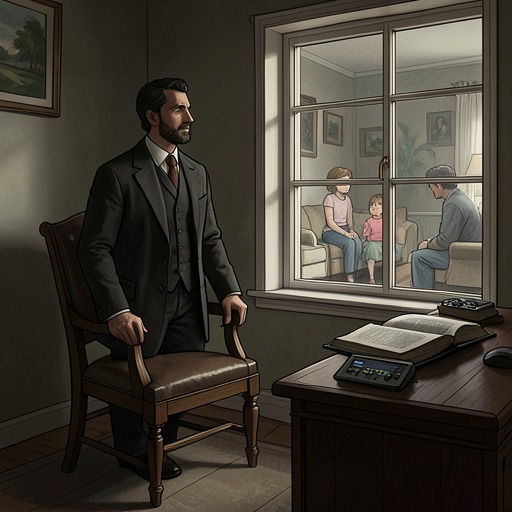
The replacement begins directing Gulliver toward suicide, using the same shepherding of thought that signals its mind-patterning technique. The Alien narrator has anticipated that the attack may come and goes to the bookcase for the clockwork radio. He switches it on, tunes it to 90.2 MHz, and carries it toward the kitchen, where the replacement is in contact with Gulliver. The narrator also turns on the kitchen radio; the television remains on in the adjoining room. Classical music, news broadcasts, and rock music combine into a deliberately disruptive wall of sound.
The intervention interrupts the replacement’s hold on Gulliver. The knife falls away, and Gulliver’s body convulses as the narrator pulls the replacement’s arm away from his head. The narrator understands that the replacement’s command is logical from its own perspective, but its logic has made Gulliver’s life the object of an imposed decision. Sound does not settle the conflict; it creates an opening in which Gulliver can recover enough awareness to act.
The narrator’s immediate tactical concern is to keep the replacement in the kitchen. With the radios operating there and the television on in the next room, the narrator believes the sound will leave the two opponents evenly matched. The replacement seizes the narrator by the throat, but the narrator maintains the contest while trying to make contact with Gulliver. The same measures that interfere with the replacement’s control also turn the kitchen into a confined arena in which neither opponent can easily gain an advantage.
Disclosure and Gulliver’s decision
Gulliver asks whether the narrator is his father. The narrator answers that neither of the two men before him is his father: the original Andrew Martin died on Saturday, the seventeenth of April. He explains that the people he and the replacement work for took Andrew, extracted information from him, and killed him. The narrator was then sent to Earth in Andrew’s place, with orders to kill Gulliver, his mother, and anyone who knew what Andrew had achieved.
The narrator also explains why he disobeyed. During his time with the family, he began to empathize with Gulliver, worry about him, and love him and his mother. He says he has given everything up and no longer has his former power or strength. This confession changes the terms of the confrontation: the narrator does not ask Gulliver to accept him as Andrew, but gives him the truth about the dead father and the imposture. The replacement counters by insisting that it is Gulliver’s father and the narrator is an alien monster. Gulliver’s uncertainty remains visible as the two identical men struggle.
The narrator warns Gulliver not to switch off the radios and identifies the replacement’s left hand as the location of its technology. When the replacement turns one radio off, Gulliver responds not by obeying its earlier command but by attacking it with the knife that had been intended for himself. His act is a decisive shift from being the target of the replacement’s control to becoming an active participant in resisting it. The sound has given him an opening; the disclosure has given him grounds to choose.
Disabling the replacement
With Gulliver’s help, the narrator drags the replacement to the Aga cooker. He orders Gulliver to lift its cover, then asks him to help restrain the replacement’s arm. Together they press the replacement’s left palm against the hot metal. The act is not presented as an ordinary victory over an opponent: the narrator recognizes that he is destroying the gifts that sustain one of his own kind and killing a fellow alien. His description of this as the ultimate crime marks the cost of the choice even as he continues it.
The narrator holds the replacement there until it loses consciousness. When he finally pulls the injured hand away and checks for a pulse, the replacement is dead. He understands that it is disconnected not only from the hosts but from life itself. The phrase links the destruction of its technology to its death, while the physical struggle gives Gulliver and the narrator a means of stopping the attack that speech alone could not end.
Death and aftermath
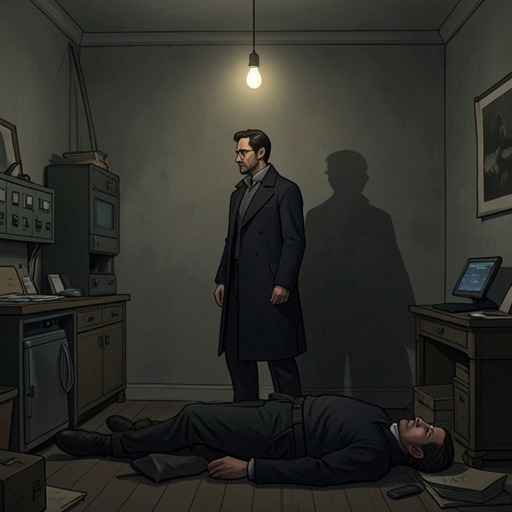
After death, the replacement’s body begins to reconfigure into its underlying form. Its shape changes, its face flattens, its skull lengthens, and its skin takes on mottled purple and violet shades; the knife remains in its back. In the setting of an Earth kitchen, the transformed creature appears alien even to the narrator, whose own structure was once precisely like it. Gulliver watches in silence, too shocked to speak.
The ending resolves the immediate threat but does not make the violence uncomplicated. Gulliver and the narrator have acted together to save Gulliver from the replacement’s command, yet the narrator has had to destroy alien abilities and kill one of his own kind to do so. The body’s transformation makes the distinction between the two identical men materially visible only after the replacement is dead. The scene thus joins a practical defeat of mind control to the narrator’s irreversible break with the mission and allegiance that brought him to Earth.