Gulliver attacks the alien operative while sleepwalking
The HumansThe event titled “Gulliver attacks the alien operative while sleepwalking” marks a reversal in the Alien narrator’s attempt to carry out his assignment: instead of directing Gulliver to his death, he is beaten by him and chooses not to stop the attack. The encounter ends with Gulliver awake and recognizing the narrator as his father, while the narrator conceals what happened from Isobel Martin.
The attempted command
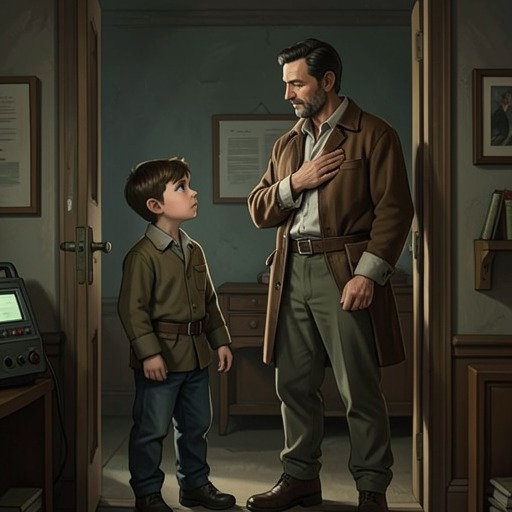
The Alien narrator stands beside Gulliver’s bed in the dark, listening to his breathing as he sleeps. After perhaps half an hour, Gulliver rolls over, and the narrator decides that the moment has come. Through a command carried into Gulliver’s sleeping mind, he directs him to sit up, put his feet on the rug, and stand. Gulliver obeys, then walks toward the doorway, unaware of anything but the voice guiding him.
At the doorway, the narrator’s intended command is for Gulliver to fall forward. But he delays. Close enough to smell sleep on Gulliver, he recalls that he must complete his task or someone else will be sent to do it. He feels his mouth go dry and confronts the vast neutrality of space, time, mathematics, logic, and survival. Before he gives the final command, Gulliver turns on him.
The attack and its aftermath
Before the narrator can give the command to fall, Gulliver grips him by the throat. Gulliver has turned around, and his fists swing wildly as the narrator pulls away; one blow catches the side of his head. Though the narrator could have told him to stop, he does not. He wonders whether he wants to witness human violence firsthand, even violence committed unconsciously, in order to understand the importance of his assignment. The thought does not settle the question: he also wonders whether it explains why he lets Gulliver keep hitting him.
Driven back against Gulliver’s desk, the narrator stands still as the blows land on his head, neck, chest, and arms. Gulliver roars, and the sound wakes him. His legs nearly give way, but he recovers and, seeing the narrator consciously for the first time, recognizes him as his father. The narrator nods, blood reaching his mouth. Isobel Martin runs up to the attic to ask what is happening; he tells her that he heard a noise and that Gulliver was sleepwalking. Gulliver, sitting on the edge of his bed and flinching from the light, says nothing.
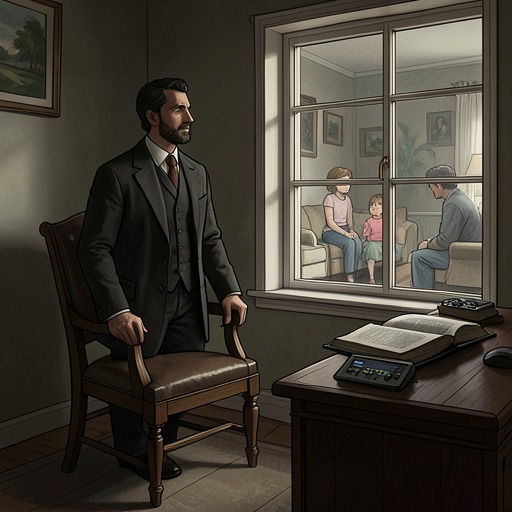
Gulliver wants only to return to sleep. Ten minutes later, the narrator and Isobel Martin are alone in the bathroom, where she dabs TCP antiseptic onto a circle of cotton wool and treats the cuts on his forehead and lip. He could have healed the wounds with a thought, and even the sting of the antiseptic does not force him to do so: he deliberately keeps the injuries, telling himself that visible damage will prevent Isobel Martin from becoming suspicious. He also questions whether concealment is the only reason he lets them remain. The encounter has turned the attempted killing into an exchange of vulnerability: Gulliver’s unconscious violence leaves the narrator bleeding, and the narrator accepts both the pain and the care that follows.
Apology and distance
While the pain from his wounds remains, the narrator apologizes to Isobel Martin for everything, including the past and the future. He finds that speaking the apology while in dull pain brings him as close to being human as he can imagine; he even feels he could almost have written a poem. The moment links bodily vulnerability to a new capacity for remorse and expression, rather than to the alien detachment that had framed his attempted command.
They return to bed, where Isobel holds his hand in the dark. He gently withdraws it. She says they have lost Gulliver, and the narrator takes a moment to understand that she means their son. Her words shift the scene from the immediate danger of the attack to the distance she feels from Gulliver, while the narrator’s retreat from her touch leaves that loss unresolved.
Narrative significance
The episode turns the narrator’s own method against his certainty. He enters Gulliver’s sleeping mind with a voice that can direct the body, yet the scene reaches its decisive turn not through another command but through Gulliver’s unchosen physical response. The narrator’s pause gives that reversal room to occur: the assignment remains clear, but the person carrying it out has become vulnerable to the human presence before him. The attack therefore does not simply interrupt the intended killing; it exposes the widening distance between the narrator’s abstract language of duty and his bodily experience of pain, fear, and care.
The scene also makes recognition unstable. Gulliver is first described as seeing the narrator without seeing him, and only after the roar wakes him does he identify him as his father. That brief recognition does not resolve the family’s estrangement: afterward, Isobel Martin names their sense of having lost Gulliver, while the narrator withdraws from her offered hand. The event’s significance lies in this disjunction between bodily nearness and emotional distance. Violence brings the characters into contact, but neither the attack nor the care that follows can restore the relationship.