Gulliver defeats Theo
The HumansGulliver defeats Theo in a confrontation at the park that turns public humiliation into a test of whether Gulliver can direct outward the violence he has so far turned against himself. The Alien narrator provokes him to fight, but the encounter does not unfold as a simple victory: Theo strikes first, Gulliver hesitates, and only then does he fight back. The narrator stops the confrontation once Theo has been beaten and takes Gulliver home, where the boy acknowledges that he has hurt someone.
The encounter begins with recognition and shame
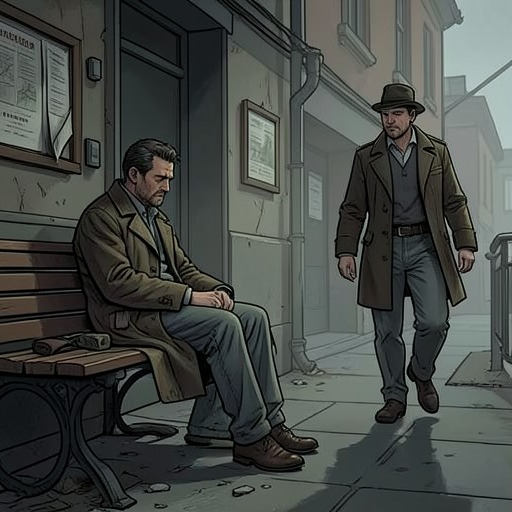
The boys and two teenage girls appear on the road behind the park while the narrator and Gulliver are there. Gulliver forgets the leaf they had been discussing when he sees them. The narrator recognizes their laughter as unkind, and identifies the boy as Theo Clarke, the person he had seen on Gulliver’s Facebook page. Theo calls them the Martin Martians and freaks. Gulliver shrinks down on the bench, cowering with shame. The episode thus begins not with a challenge to fight but with Gulliver being made an object of ridicule in front of a small group of peers.
The narrator answers Theo by asserting that Gulliver could beat him and threatening to make his face more attractive through a change in its shape. Gulliver is alarmed by this response: Theo, he tells his father, is the person who had already messed up his face. That admission gives the encounter a history absent from Theo’s taunt. It also makes the narrator’s intervention more complicated than a straightforward defense: he responds to the humiliation and the earlier harm by urging his son toward another fight.
The narrator makes the fight a test
When Theo crosses the park’s low stone wall, the narrator assesses his build and movement. Theo is shorter than Gulliver but sturdier, and he warms up by punching and kicking the air. The narrator tells him he will lose, then turns to Gulliver, who is pale and visibly nervous. Gulliver had fallen off a roof the day before, and the narrator uses that fact to argue that Theo should not frighten him: compared with the fall, he insists, this opponent is nothing to fear. Gulliver rejects the reassurance, answering that Theo will fight well.
The narrator’s next appeal is less about Theo’s physical ability than about what he represents. He recasts the boy as a symbol of everything Gulliver has hated, associating him with himself, bad weather, the primitive soul of the Internet, and the injustice of fate. He then asks Gulliver to fight as he does in his sleep, losing shame and consciousness and striking without restraint. The encouragement offers Gulliver a way to turn inward pain outward, but it also places the narrator’s own meanings onto the boy he is urging into the fight. The scene makes that pressure visible: Gulliver walks across the grass with a tense, nervous body, as if being dragged.
The reversal in the park
The two girls watch excitedly, and Theo also appears eager. The narrator reflects that some people seek violence not because they want pain but because they already have pain and want distraction from it. That observation frames the spectators’ excitement against Gulliver’s shame and distress. When Theo hits Gulliver twice in the face, Newton growls as if to join in; the narrator keeps him back. Theo then tries to kick Gulliver in the chest. Gulliver catches his leg, leaving Theo hopping briefly, but the moment does not yet settle the contest.
Gulliver looks at the narrator in silence. After Theo is on the ground and allowed to get up, Gulliver changes abruptly: he begins punching, seeming to fight as though he could rid himself of his own body. Theo is hurt and falls back onto the grass. The narrator’s earlier instruction has become an action, but the change is not presented as calm mastery. Gulliver’s counterattack is sudden and bound up with the wish to escape himself. Theo’s brief look at the blood on his fingers confirms that the encounter has inflicted real harm, while the girls’ laughter falls quiet.
The narrator ends the confrontation
Once Gulliver has beaten Theo, the narrator tells him it is time to go home. He approaches Theo, crouches, and makes clear that the fight is over. Theo understands. The girls remain silent, still chewing but at half-speed, as the narrator and Gulliver leave the park. Gulliver has hardly a scratch. The contrast between the boys’ condition and the change in the onlookers marks the encounter’s reversal: the boy who had cowered under their ridicule has answered it, and their eager amusement has subsided.
On the way out, the narrator asks Gulliver how he feels. Gulliver answers that he hurt Theo. The reply keeps the aftermath from becoming a simple celebration of victory. The narrator had urged him to fight and helped produce the reversal, but Gulliver registers the consequence as harm done to another person. The episode ends not with a claim that the conflict has repaired Gulliver’s shame or resolved the earlier injury, but with the two leaving together and the boy’s attention fixed on what he has done.