Gulliver’s psychological crisis and suicidal thoughts
The HumansGulliver’s psychological crisis and suicidal thoughts grow out of more than a single confrontation: school has become a place of humiliation, home offers little relief, and his father’s mathematical fame has become an expectation he cannot escape. His movement from anger and withdrawal to dangerous encounters with a train and a rooftop brings the crisis into view, while his later account makes clear how much the Alien narrator had failed to hear.
Pressure at Home and School
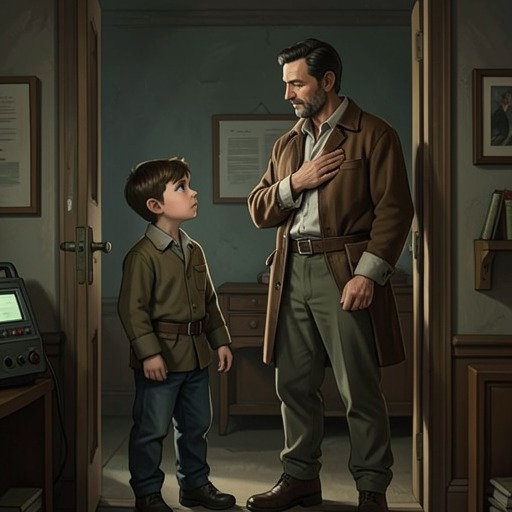
Gulliver first describes the immediate damage in stark terms: school is going to be hell, and he feels his life has been destroyed; he is now a joke. His response follows an incident involving his father, but the exchange does not make the incident itself the whole explanation. Gulliver insists that things were already bad after he started at his school. The new humiliation intensifies an existing strain rather than creating it from nothing.
His father’s response makes the distance between them visible. When Gulliver asks why he did it, the narrator cannot give him a reason. As Gulliver tries to explain the effect on him, his father is already thinking about Daniel Russell and the need to call him. Gulliver notices the inattention and says that his father never wants to talk to him except for the previous night. The crisis is therefore interpersonal as well as institutional: even when Gulliver directly asks for an explanation, his father’s attention is elsewhere.
Gulliver later challenges his father’s claim to be ill. His father’s new behavior, including streaking and swearing, does not persuade Gulliver that he has become a different person; apart from those conspicuous changes, he seems very much himself. Gulliver also rejects the assumption that the family’s money, the large house in Cambridge, or his position as perhaps the richest boy at school can make things all right. The Perse, the school on which his father had spent twenty thousand pounds a year, remains a measure of the life and expectations surrounding him, not a remedy for his distress. Material security and intellectual prestige do not give him a sense of being understood.
Withdrawal and the Railway
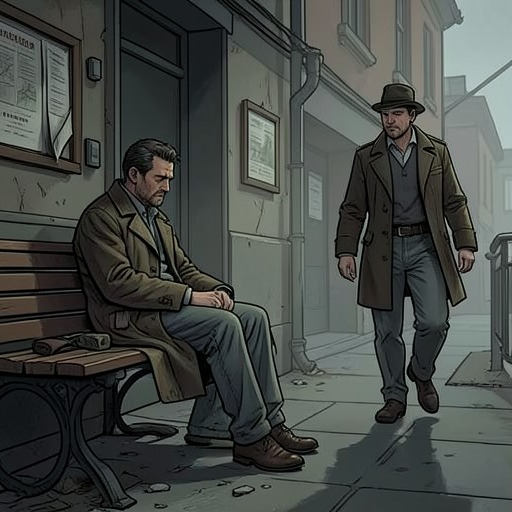
The Alien narrator finds Gulliver away from school, walking alone on a pavement beside a park and trying to hide behind his hair. When he sees his father, he freezes, turns around, and walks away faster after the narrator calls to him. The concealment and retreat give physical form to the conflict already present at home: Gulliver does not approach his father for help, and the narrator reads his behavior partly through the danger of what Gulliver knows about the mathematical proof.
Gulliver crosses a grass field and reaches four parallel metal tracks. He stands still, waiting. As a train approaches, his fists clench and his body stiffens; he is only about a metre from its path. Newton barks, but the train is too loud and too close for Gulliver to hear. The scene leaves the intention uncertain. The narrator considers that Gulliver may act on his own, and wonders whether he will have to do anything. When the train passes, Gulliver’s hands relax. The narrator cannot tell whether this signals relief or disappointment.
That uncertainty matters because the narrator has the opportunity to treat the moment as a crisis, yet instead drags Newton back and goes out of sight before Gulliver turns away. He has been thinking about the proof and the possibility that Gulliver might reveal it; his son’s immediate danger competes with that calculation. The scene does not establish what Gulliver intended, but it shows how close he comes to a lethal danger and how the narrator’s suspicion obstructs his response. Gulliver’s distress is visible, while its meaning remains something his father has not yet learned to ask about.
The Roof and the Nearness of Death
Later, the crisis takes place on a roof. The Alien narrator sees Gulliver sitting beside the gutter rail with his knees drawn to his chest, cold and bedraggled. The sight changes the narrator’s perception of him: instead of regarding him as an exotic arrangement of matter, he recognizes him as a person and feels a connection that he cannot explain through the abstract interconnectedness of atoms. The shift is important because the narrator has previously approached Gulliver as both a risk to be managed and a possible threat to his mission. Here he confronts Gulliver’s particular vulnerability.
The narrator’s first calculation is appalling in its detachment. If Gulliver wants to die, allowing it would remove a problem; yet the narrator also understands that a fall might kill him, and that injuries could be healed whereas death could not. He approaches across wet slate and tells Gulliver not to jump, warning that the roof is not high enough to guarantee death. The intervention is therefore not the product of certainty about Gulliver’s intentions. It comes amid uncertainty, but it marks a choice to address his danger rather than simply stand back.
Gulliver tries to reach his father through shared memories: swimming together in France when he was eight, and the night his father taught him dominoes. He looks for recognition. The narrator claims to remember, though the scene emphasizes how little genuine mutual understanding has existed between them. Later, Gulliver says that before going out on the roof he had taken twenty-eight diazepam. When the narrator answers that he would have needed more, Gulliver looks at him angrily, as though his father has turned knowledge into another way to humiliate him. The exchange underlines the limits of technical or factual understanding in a moment that calls for emotional attention.
The Burden Behind the Crisis
Gulliver eventually explains the longer history beneath his immediate despair. He feels that being Andrew Martin’s son brings expectations he cannot meet: his teachers have read his father’s books and regard him as a damaged remnant of the celebrated mathematician. His own history at school includes expulsion from boarding school and setting things on fire, while he remembers his parents as having given up on him. These details are not presented as a complete account of his life, but they show why his father’s reputation feels less like an inheritance than a standard against which he is continually found wanting.
He also recalls that his father was often absent during the holidays, elsewhere or making the atmosphere between himself and Gulliver’s mother tense and unpleasant. Gulliver argues that his parents should have divorced years earlier because they had nothing in common. In this account, his distress is entangled with the household’s unresolved conflict: the family remains together, but he experiences that togetherness as a source of tension rather than security. After this disclosure, the narrator cannot find an answer and asks about the name of Gulliver’s band, The Lost. The small question does not resolve the crisis, but it turns the conversation toward something Gulliver has made for himself rather than another measure of his father’s achievement.
Narrative Significance
The episodes trace a progression in what the Alien narrator can perceive. At first, Gulliver’s anger appears to him as an obstacle amid the urgency of contacting Daniel Russell and protecting the proof. At the tracks, danger is filtered through suspicion about what Gulliver knows. On the roof, the narrator recognizes a person in need of help, but even then he initially weighs Gulliver’s possible death as a practical solution. Gulliver’s memories and eventual explanation expose the gap between seeing his actions and understanding the pressures behind them.
The crisis is thus not reduced to either wealth, school failure, or a single suicidal act. Gulliver names the combined weight of public comparison, past humiliation, his parents’ strained marriage, and his father’s absence. The narrative preserves uncertainty about his intentions at the railway, but establishes the seriousness of his danger through his stillness beside the train, the rooftop confrontation, and his disclosure about the diazepam. His account also changes the meaning of the father–son relationship: the boy who had seemed difficult to reach has been trying to explain that the very things his father values most have hurt the family.