Hope
The HumansHope in the novel is not confidence that events will turn out well, but the decision to act when reason offers no assurance of success. It carries the Alien narrator from an abstract recognition of human persistence to an exhausting attempt to revive Gulliver, and returns later as direct counsel to keep living through a period of darkness. Its force lies in the gap between what can be known and what can still be done.
Hope against probability
The Alien narrator reaches hope through reading Isobel Martin’s work and considering human history. People have repeatedly tried despite poor odds: some succeeded, most failed, and failure did not prevent others from trying. The narrator sees determination and hope as capacities of these primates, an unexpected strength in a species whose behavior has often seemed difficult to comprehend.
This account does not make hope rational. The narrator explicitly recognizes that hope may make no sense; if it did, it would simply be sense. The distinction matters: hope begins where calculation cannot establish that success is likely. It does not refute the evidence or promise a favorable outcome. Instead, it permits an effort that the evidence alone would not require.
The narrator also contrasts this effort with life on Vonnadoria, where existence had been perfectly effortless. Hope is therefore not merely a feeling carried into the crisis. It asks something of the narrator: the willingness to work, despite having no prior habit of exertion. The change is expressed through action rather than a settled theory of human emotion.
The attempt to save Gulliver
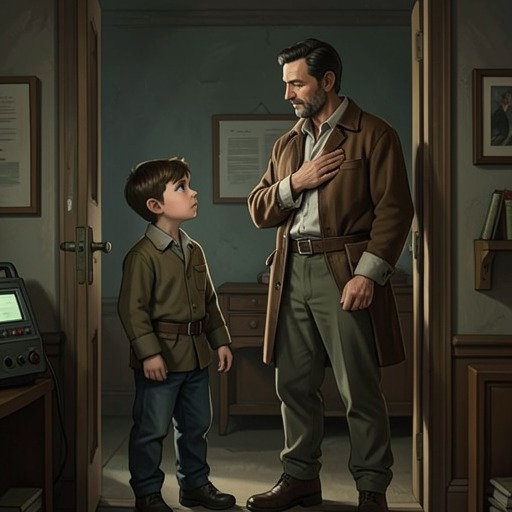
This understanding becomes concrete when Gulliver lies apparently dead. The narrator knows that death is not a condition easily reversed and compares it to crossing an event horizon: once passed, it leads into territory where ordinary intervention seems futile. Yet the narrator cannot accept Gulliver’s death as beyond challenge. Rather than remain at a distance wishing for improvement, the narrator places the left, gift-bearing hand on Gulliver’s heart and begins to work.
The effort is physically and emotionally costly. The narrator insists to Gulliver that he is not dead and continues, reasoning that life has a stubborn character and that human life itself is an act of defiance: improbable, yet present across an immense universe. The argument does not make the rescue certain. Instead, the narrator’s conviction that impossibility does not rule out possibility sustains the attempt in the absence of certainty.
A light comes on inside the house, and Newton barks; the narrator registers neither as attention turns wholly to Gulliver. Beneath the hand, a faint pulse appears. The narrator keeps going, and the pulse returns. At last Gulliver is alive: his lips move, his eyes open, and the narrator recognizes in his face a resemblance to his mother. The moment brings an exhausted, briefly paternal wonder, but not uncomplicated relief. The narrator is overwhelmed and begins to collapse. Hope has achieved the immediate reversal from apparent death to life, while the labor required to produce that reversal leaves the rescuer spent.
The image of hope
The pulse gives hope its most exact form in the scene: a small, observable sign that interrupts the apparent finality of death. The narrator does not begin with that sign; the work begins before it appears. Hope is thus both responsive and anticipatory. It can recognize evidence when it comes, but it must act before evidence guarantees that the desired change will happen.
The episode also turns on repetition. The narrator repeatedly affirms that Gulliver is not dead, and the recurring pulse answers those words without making the attempt easy or assured. Afterward, as darkness overtakes the narrator, the remembered image associated with Emily Dickinson presents hope as a bird whose song persists without words. That image suits the scene’s movement from speech and effort to a fragile rhythm beneath the narrator’s hand: hope continues, even when certainty and explanation fail.
The appearance of the poetry as the narrator loses consciousness connects private effort to a larger human inheritance. Earlier, the narrator had learned from Isobel Martin’s writing and from histories of people who persisted against the odds. Now a poem accompanies the cost of that persistence. Hope is neither a solitary invention nor an abstract maxim; it is a form of endurance carried through stories, remembered language, and action.
Hope as counsel
The novel later gives hope a more direct ethical expression in a numbered set of instructions. The counsel warns against suicide even when darkness feels total, insists that life is not still, and asks the reader to wait for the stars. It does not deny darkness or claim that despair can be argued away. Instead, it presents the present condition as incomplete: time continues, and a person is still moving through it.
That advice echoes the rescue of Gulliver without reducing the two moments to the same situation. In the earlier scene, the Alien narrator acts upon another person’s body before knowing whether the effort can succeed. In the later passage, the instruction is addressed to someone facing their own darkness and urges endurance. Both make hope a practice of continuing rather than a guarantee of rescue. The image of waiting for stars also shifts attention from immediate certainty to what may become visible with time.
Narrative significance
Hope marks a change in the Alien narrator’s relation to effort, pain, and human vulnerability. On Vonnadoria, a life without effort or fear had seemed complete. On Earth, the narrator discovers that caring about an uncertain outcome can demand exhausting work—and that the work matters even before its result is known. The attempt to save Gulliver gives this discovery a consequential form: the narrator’s hope is not passive optimism but an intervention that helps bring him back to life.
The episode’s emotional force depends on preserving uncertainty. Gulliver’s pulse is faint, the narrator’s knowledge of death suggests a boundary, and the rescue nearly overwhelms the person attempting it. The later advice likewise leaves darkness in place rather than pretending it has vanished. Across both passages, hope names a refusal to treat present despair as the whole of existence. It does not promise that every attempt will succeed; it explains why the possibility of failure need not end the attempt.