Isobel Martin, author of the unfinished novel
The HumansIsobel Martin, author of the unfinished novel, enters the story both as a published local writer and as the author of a manuscript hidden from her family. Her public novel provides an early point of recognition for Andrew Martin (the alien narrator), while the concealed pages of Wider than the Sky expose a more private literary life. The contrast between those books makes her writing more than a biographical detail: it is a record of what her outward role does not readily disclose.
Identity and Public Writing
The alien narrator first comes across Isobel Martin, author of the unfinished novel, through the arrangement of a bookshop. Searching shelves organized alphabetically by authors’ surnames, he finds The Dark Ages, marked as a local author’s work. Only one copy is in stock, alongside a much larger supply of Andrew Martin’s mathematical books: thirteen copies of The Square Circle and eleven of American Pi. The difference is concrete and commercial, not a measure of literary merit, but it places her public authorship beside the more visible abundance of her husband’s work.
The discovery gives the narrator a reason to recognize Isobel Martin, author of the unfinished novel, when she visits him later. At that first meeting, he understands that she is his wife in the identity he has assumed, but his response is not one of marital recognition. He initially sees her through an alienated, analytical gaze, describing her as an arrangement of cells before registering her pale face, tired eyes, upright bearing, and contained manner. The account records his estrangement more clearly than it establishes any objective judgment of her appearance. He is frightened of Earth and of the human body, and his scrutiny of her is part of that wider fear.
The Visit and the Marriage
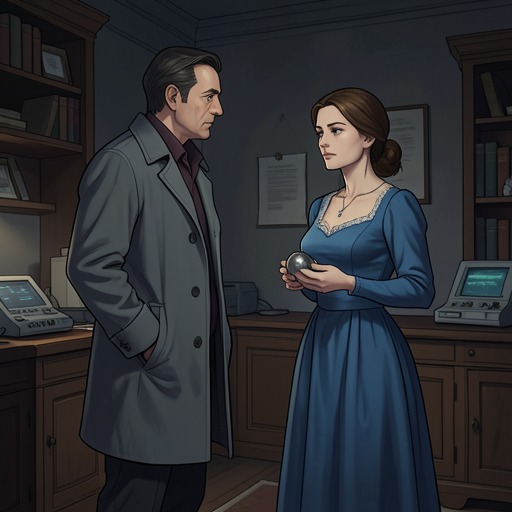
Isobel Martin, author of the unfinished novel, comes to see Andrew Martin (the alien narrator) in his room while a nurse remains present. She asks how he is and tries to establish what happened: he says that his memory is scrambled and asks whether anyone has visited his office, while she says she does not know and asks about his absence from home. Her questions show the immediate uncertainty surrounding his condition and the strain of a husband whose behavior she cannot explain. She appears afraid, though the narrator reads her facial tension, pupils, and breathing through his own unsettled attention.
Her visit also brings the narrator into contact with an intimacy he does not share. He dreads the ordinary gestures of affection he associates with human relationships; she does not hug or kiss him, but sits and watches him as if trying to understand what has happened. Later, after telling her that people are worried, she sits on the bed and strokes his hand. He recoils inwardly and acknowledges a wish to end the encounter, yet says that a sequence must be followed. The episode exposes the severe gap between the role of husband he is performing and the feelings he actually has. Isobel’s concern is real within the scene, but his response is governed by concealment and the task he believes he must complete.
The Hidden Manuscript
While staying in the house and presenting himself as still recovering, Andrew Martin (the alien narrator) finds a bundle of yellowing pages in Isobel Martin, author of the unfinished novel’s wardrobe. The papers are tied with an elastic band and hidden among her clothes. Their top sheet identifies the work as Wider than the Sky, a novel by Isobel Martin. The narrator estimates that the pages are at least a decade old and reads enough to see that its central character, Charlotte, could just as readily have been named Isobel.
The pages portray Charlotte weighed down by repetitive domestic work: filling the dishwasher, collecting a child from school, and cooking. Her child, Oliver, runs through the house playing with a toy gun, while Charlotte’s mother defends boys’ interest in guns as natural. The scene turns an apparently ordinary family routine into a picture of a woman’s exhaustion and the limits placed on her choices. Charlotte remembers university corridors and wants to teach again, but worries that she has left it too late; maternity leave has become permanent, and the expectation that fulfillment should come from being a wife and mother weighs on her. These are circumstances of the fictional Charlotte, not independently confirmed events in Isobel’s life. Their evident closeness to the author is the narrator’s interpretation, and the manuscript gives that interpretation its force without making the two women identical.
Privacy and Narrative Significance
The narrator stops reading because he recognizes the act as an intrusion, even as he admits the irony of doing so while living under her husband’s identity. He returns the pages to the wardrobe beneath the clothes. Later, he tells Isobel Martin, author of the unfinished novel, what he found. She gives him an unreadable look, her cheeks reddening in a way he cannot distinguish between embarrassment and anger, and tells him the manuscript was private and never meant for him to see.
That reaction establishes a boundary the narrator’s assumed access to her life does not erase. The manuscript has been physically kept out of sight, and its discovery does not grant him authority over its meaning. At the same time, its placement among clothing echoes the story’s recurring concern with what people cover or conceal: here, a woman’s writing preserves a voice and ambition that her visible domestic role can obscure. Isobel’s appearance in the plot therefore links public authorship, marital intimacy, and private creative work, while leaving the tension between the life represented in the novel and the author’s own life unresolved.