Love
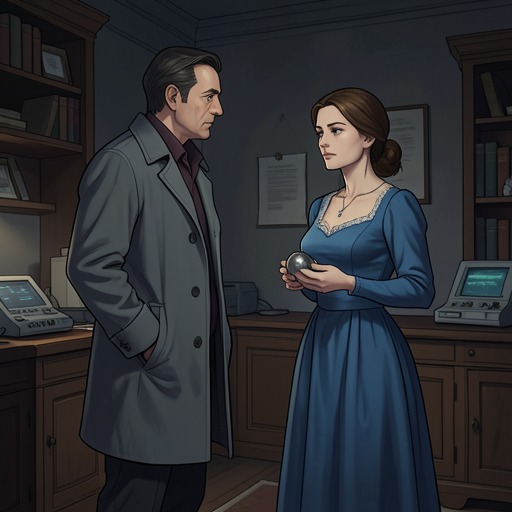
The HumansLove is the concept that most decisively unsettles the Alien narrator’s belief that human life can be assessed by logic alone. Initially, marriage and love seem incoherent; through witnessing grief and practicing care, the narrator comes to understand love as mutual reliance, a source of vulnerability, and a reason to choose finite life. The book’s developing account does not make love safe or easy. It makes the risk of pain inseparable from the value of connection.
A Concept First Approached as Illogic
The Alien narrator’s first difficulty is not simply that love is unfamiliar, but that the human institution associated with it seems internally contradictory. When told that a wife is worried, the narrator knows having one is a fact but does not understand what that fact means. Marriage is explained as a loving union in which two people stay together, yet the existence of divorce appears to undermine the union’s supposed permanence. From the narrator’s perspective, marriage seems to bolster a love that ought to be strong enough on its own, while also allowing the bond to be broken. The explanation produces confusion rather than clarity.
Love itself remains equally obscure. The narrator has encountered the word often in magazines but has no corresponding understanding of the experience. It appears to be one of the human ideas whose importance is obvious to humans and whose logic remains unavailable to an outsider. This early incomprehension establishes a contrast that the novel gradually reverses: rational scrutiny can identify the apparent inconsistencies in love, but cannot account for why people care for one another or what that care makes possible.
Reliance, Grief, and Vulnerability
A turning point comes when the narrator witnesses Daniel Russell and Tabitha Russell at the end of Daniel’s life. Tabitha tells him that she loves him and pleads for his continued presence. Daniel rests against her as she caresses his face; when he dies, her grief is immediate and overwhelming. The narrator recognizes that this is love: two lives relying on one another. The scene corrects the narrator’s expectation that human attachment should look like weakness. Instead of contempt, the narrator feels troubled by the force of what has happened.
The experience becomes personal through the narrator’s growing concern for others. When Isobel Martin, author of the unfinished novel, recalls the narrator’s earlier complaints about her, he thinks of her efforts to spare him worry, prepare food, and offer affection. He corrects the claim that she is not there for him. The details are ordinary, but their meaning has changed: care is no longer an abstract feature of marriage. It is something given in particular gestures and received within a relationship.
The narrator later admits that concern for another person has become real. A warning intended to prevent attachment has instead helped produce it. The narrator understands the cost: once another person’s pain can matter, vulnerability follows, because love grows from the possibility of being hurt. That recognition gives love its danger without reducing it to danger. The risk is not an incidental defect that can simply be reasoned away; it is part of what makes the bond consequential.
Learning Love Through Ordinary Bonds
The relationship with Isobel deepens through quiet, physical closeness rather than a new explanation of marriage. At night, the narrator lies awake beside her, unused to darkness and imagining that human relationships offer comfort against it. A little finger touches hers beneath the duvet. This time, the narrator leaves it there and imagines being the person Isobel believes herself to be beside: a human connected to another human, capable of care. The moment makes intimacy tangible while preserving the gap between the narrator’s actual identity and the identity Isobel supposes.
Care also extends beyond human relationships. In the garden, Newton senses the narrator’s presence behind the juniper bushes but stays quiet. The narrator recognizes the dog’s trust and acknowledges loving him. This attachment is evidence of change in its simplest form: the narrator now has something to lose in a relationship that asks for no abstract theory and offers no logical guarantee.
The narrator’s understanding of Isobel changes further when her capacity for love returns to view. Having set aside work for family, she had felt taken for granted by her husband, while what she still had to give remained unexpressed. The narrator witnesses love re-emerge between people who have lived long enough to know that loving and being loved in return can be difficult. Two parallel mirrors become an image for this mutual recognition: each person sees themselves through the other, and the view seems to open into depth. Love is not merely a promise of permanence; it can reveal a person to themselves in a way earlier self-understanding could not.
Mortality, the Present, and Choice
The novel links love’s intensity to the knowledge that life ends. The love the narrator witnesses in Isobel is possible, in part, because the people experiencing it are mortal and have learned how difficult reciprocal care can be. Love can make a single moment feel endless, but it does not abolish the conditions that make the moment precious. The narrator’s emerging understanding therefore reverses the initial complaint about marriage: love does not need to guarantee an unbroken union in order to matter.
This understanding also changes the narrator’s idea of what love does. After waking in an ambulance, the narrator encounters Isobel’s care and realizes that love helps a person survive. It also interrupts the search for an ultimate meaning outside experience. What matters is holding the hand of someone cared for and living in the present, which is the only time that can actually be inhabited. Since the present keeps changing, it cannot be secured by holding on; the narrator’s conclusion is to let go.
The choice to stay on Earth follows the same logic. The narrator describes love as a force that draws a person in so powerfully that it challenges reasonable expectations and makes calm, eternity, and home less compelling than anguish, mortality, and Earth. After deciding to remain, the narrator experiences fatigue, bodily discomfort, and anxiety as signs of becoming human. Love has not made that decision painless. Rather, attachment makes the finite life that the narrator once regarded as an inferior alternative worth choosing.
A Practical Ethic of Love
The narrator’s account finally shifts from attempting to define love to treating it as a practice. Humans, the narrator observes, are preoccupied with love while often failing to understand it; distractions offer a way to turn attention elsewhere, but do not resolve the underlying fear. Love is frightening because it can displace reasonable calculation and unsettle a person’s sense of self. Yet the novel does not present withdrawal from that fear as wisdom. The narrator’s movement from detachment toward care shows that remaining untouched would mean refusing the relationships that give human life significance.
The practical advice at the close makes this ethic explicit: people should not be afraid to tell someone they love them, because the world’s existing troubles are not worsened by an excess of love. This is not a promise that love prevents grief or guarantees that relationships last. The death of Daniel Russell, Tabitha Russell’s loss, and the narrator’s awareness of vulnerability all stand against such a promise. Love matters not because it defeats pain, but because it makes care, survival, and the present moment worth choosing despite pain. In this sense, the concept the Alien narrator first judged by its logical contradictions becomes the book’s clearest account of why a finite human life can be meaningful.