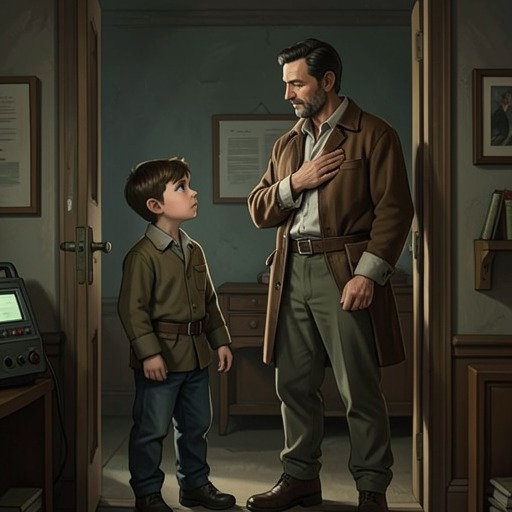
Narrator–Gulliver relationship
The HumansThe Narrator–Gulliver relationship is built on a contradiction: the narrator arrives in the place of Gulliver’s father with orders to kill him, yet gradually becomes someone Gulliver trusts and misses. The eventual disclosure that he is neither Gulliver’s father nor the original Andrew Martin makes the bond more, not less, significant. Its basis is no longer inherited kinship or borrowed identity, but care formed through shared experience and sustained after the narrator loses his powers.
A relationship founded on impersonation
The narrator’s connection to Gulliver begins within a deception. He has been sent to Earth as Gulliver’s father, but the real father is dead: the hosts extracted information from him and killed him before sending the narrator in his place. The mission was to kill Gulliver, Isobel Martin, and anyone else who knew what the father had achieved. The narrator later explains that he could not carry out the order because he began to empathize with Gulliver, like him, worry about him, and love him and his mother. The relationship therefore takes shape against the very purpose for which the narrator entered the family.
That change does not make the original danger abstract. The narrator’s admission makes clear that Gulliver was among the people he had been assigned to kill. His later tenderness is inseparable from the fact that he had once regarded the boy as a target. By naming both the mission and his failure to obey it, the narrator gives Gulliver a direct account of the threat that had been hidden behind his assumed place in the household.
From mission to attachment
The narrator’s developing attachment belongs to a broader change in how he understands human dependence. He witnesses a person in pain resting against a woman who strokes his face, and recognizes their reliance on one another as love. Though he had expected to see weakness, he finds that he does not scorn what he is watching. This moment does not describe a specific exchange between the narrator and Gulliver, but it clarifies the emotional possibility that makes their relationship different from the narrator’s original, instrumental view of human life.
The connection to Gulliver becomes especially urgent when the narrator sees Isobel asleep and, under the hosts’ influence, approaches her as a human rather than as someone he loves. As he is about to stop her heart, she says that she loves him. The narrator distinguishes her address to a single person from the collective force pressing on him, and regains his sense of self. The realization that Isobel has narrowly escaped death brings the intensity of his feelings into focus. Because Gulliver and Isobel are both named in the mission, the narrator’s growing attachment to his family is also a refusal to treat Gulliver as a disposable part of the assignment.
The truth and Gulliver’s response
When the narrator finally tells Gulliver who he is, he does not soften the facts. He says that he is not Gulliver’s father, that Gulliver’s father died on Saturday, the seventeenth of April, and that the hosts killed him after extracting information. He also explains that he was sent to kill Gulliver and Isobel, but disobeyed because he had come to care for them. He admits that he has given up his power and strength. The confession separates the narrator’s emotional claim from his former role: he cannot ask Gulliver to mistake him for a father, and he no longer offers protection through extraordinary ability.
Gulliver’s response is not fully recorded in the confession scene, where Jonathan urges him to turn off the radios. But the later reunion shows that Gulliver has not reduced the narrator to the lie or the threat. He remembers the narrator’s advice about Emily Dickinson and says that the narrator was the one who looked after him and Isobel. His account identifies care, rather than biological parenthood, as the experience that defines their bond for him.
Reunion and lasting care
At their later meeting, Gulliver is older. He has followed the narrator’s advice and read Emily Dickinson; his appearance has changed, and he wears a T-shirt bearing the name The Lost, the band he had finally joined. These details place the reunion after a period of change in Gulliver’s life, while his remembered advice makes the earlier relationship present between them. The narrator asks after Gulliver’s wellbeing, and Gulliver answers that he has not tried to kill himself. When the narrator asks about his mother, Gulliver says that she misses the narrator because he was the person who looked after them.
The narrator is careful not to claim powers he no longer possesses. He tells Gulliver that if Gulliver chose to jump from a roof, he would probably die; Gulliver answers that he does not jump from roofs anymore. Their exchange registers both vulnerability and progress. The narrator cannot guarantee Gulliver’s safety by supernatural means, while Gulliver’s response indicates a change in the danger that once surrounded him. The narrator’s approval is modest, but the exchange rests on a history in which his concern has mattered to Gulliver.
Newton’s return to the scene further marks the difference between the narrator’s former and present capacities. The dog’s arthritis has come back, and although the narrator instinctively strokes him, he cannot heal him. Gulliver remains beside the narrator nonetheless, and later attaches the lead to Newton’s collar before leaving. The small practical gesture gives the reunion a shared, ordinary setting: their bond now exists without the narrator’s ability to cure or protect by force.
A chosen family
Gulliver tells the narrator that he misses him, and the narrator returns the feeling, saying that he misses both Gulliver and Isobel. The narrator reflects that sentimentality serves no rational purpose, yet recognizes its force as authentic. Their affection is thus not presented as a restoration of the old family arrangement: the narrator does not become Gulliver’s father, and the dead father remains part of the truth between them. Instead, they acknowledge a relationship that has acquired its own emotional reality.
As Gulliver leaves, he reminds the narrator that he knows where they live. The narrator understands the invitation and, alone afterward, recognizes what he wants: to live with people he can care for and who will care for him, to have family and happiness in the present. The short distance home becomes the final measure of the relationship’s change. What began as an impersonation designed to destroy a family ends with the narrator choosing to return to the people who have made him feel he belongs.