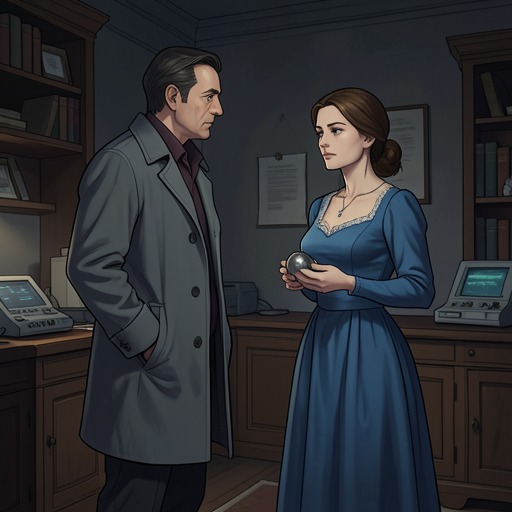
Narrator–Isobel relationship
The HumansThe relationship between the Alien narrator and Isobel Martin, author of the unfinished novel, becomes most vivid in absence. Far from her and Gulliver Martin, he discovers that distraction and distance deepen rather than diminish his attachment. When he finally sees her again in Cambridge, the encounter is one-sided: she does not notice him, but he recognizes that the ordinary life they once shared is what he wants back. Later, news that she misses him gives that desire a possible answer, while his uncertainty about his name and place in the family makes returning a real question rather than a simple homecoming.
Separation and the life recalled
During his time at Stanford University, the Alien narrator tries to occupy himself with music, films, poetry, and travel. These efforts are not presented as evidence that he has moved on. Listening repeatedly to This Must Be the Place makes him melancholy and sharpens his wish to hear Isobel Martin, author of the unfinished novel, or Gulliver Martin moving on the stairs. Even the cultural and intellectual life around him cannot replace the particular intimacy of those familiar sounds.
A copy of Isobel Martin, author of the unfinished novel’s book The Dark Ages makes that attachment especially concrete. In a campus bookstore, he spends a long time reading aloud from its account of England, the massacre of Danish settlers in 1002, and Danish rule in 1013. He presses the page to his face, imagining it as her skin. The passage matters both as her work and as a material trace of her: her written words allow him to encounter her, but only by making the distance between the page and the person more palpable.
Travel offers another attempted escape. He visits cities across several continents, hoping that the variety of human faces will help him forget Isobel Martin, author of the unfinished novel. Instead, attending to humanity as a whole makes his feeling for her more particular. The contrast he draws between the cloud and the raindrop captures the failure of general experience to satisfy a specific attachment. He stops travelling and returns to Stanford University, then turns to nature; neither strategy resolves his longing.
The distant encounter in Cambridge
A sadness associated with beauty and mortality pulls the Alien narrator eastward. He tells himself that he only wants to see Isobel Martin, author of the unfinished novel, and Gulliver Martin from a distance, to confirm with his own eyes that they are safe. An invitation to Cambridge for lectures on mathematics and technology gives him a practical reason to travel there. The invitation is coincidental, but his response follows an existing desire to return toward them.
After the lectures, Maggie Lowell approaches him and invites him to the Hat and Feathers. He declines, then walks toward Isobel Martin, author of the unfinished novel’s college. Across the street, he sees her walking alone; she does not see him. The disparity is central to the scene: for him the sight is momentous, while for her it is an ordinary passage through the day. His comparison to colliding galaxies passing through one another gives that asymmetry a larger scale without making the encounter reciprocal.
He watches her open an umbrella and continue on, pausing to give money to a homeless man, Winston Churchill. The smallness of the moment is part of its force. He is not describing a reunion or an exchange between them; he is watching her perform an everyday act without knowing he is present. His attention rests on the life that continues beyond his view, and on how much meaning he finds in simply seeing her safe.
The sight also clarifies what his absence has done to his feelings. He longs not for an exceptional declaration but for the routine of being together: a mundane conversation about their days and the comfort of coexisting. The imagined purpose he finds in the universe is that Isobel Martin, author of the unfinished novel, should be in it. His desire is therefore directed toward shared ordinary life, not merely toward recovering the intensity of a distant image.
The possibility of being missed
Later, Gulliver Martin tells the Alien narrator that Isobel Martin, author of the unfinished novel, misses him. When he asks whether she means him or Gulliver’s father, the distinction exposes a difficulty in how he understands his own place in their family. Gulliver answers that she misses him, and explains that he was the one who looked after them. This account gives the narrator’s role a concrete basis in care: Gulliver connects his presence with looking after both of them.
The narrator receives the news as a profound comfort, but does not treat it as permission to return without hesitation. He says it may not be wise, worries that Isobel Martin, author of the unfinished novel, could be misunderstood, and points to the possible difficulties of what she would call him. He has no name of his own and believes it would be wrong for her to call him Andrew. The obstacle is not an absence of feeling; it is the mismatch between the attachment he experiences and the identity he can honestly offer.
Gulliver Martin cannot report that his mother has expressly said she misses the narrator; he says he thinks she does. That qualification leaves the information short of certainty. Yet the narrator asks again whether Gulliver really believes it, and then admits that he misses both of them. His response presents sentiment as something he recognizes as irrational but nevertheless authentic. In the relationship, feeling does not settle the practical question of reunion, but it makes that question impossible to dismiss.
Home as a decision
After speaking with Gulliver Martin, the Alien narrator considers what he wants from life. The answer is not distant security or a future promise of happiness: he wants people he can care for and who will care for him, a family, and happiness in the present. Isobel Martin, author of the unfinished novel, and Gulliver are named through this longing as the people around whom a possible home takes shape.
He concludes that he wants to go home and stands up. The ending makes return an intention and an action begun, not a confirmed reconciliation: the account establishes his choice to move toward home but does not show Isobel Martin, author of the unfinished novel, receiving him or resolve what name she would use. That restraint preserves the relationship’s central tension. His attachment has carried him back across distance, but belonging still depends on a meeting that has not yet occurred. The repeated image of home gives his longing a direction, while the unresolved question of identity keeps the prospect of reunion open.