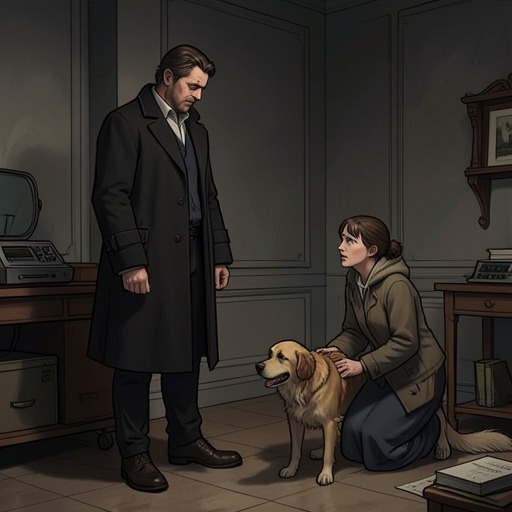
Narrator–Newton bond on reunion
The HumansThe Alien narrator’s bond with Newton begins as a practical alliance and becomes one of the clearest measures of his change. At first he hopes the dog might provide useful information; soon, he heals Newton and finds himself caring for him. Their later reunion reverses the earlier miracle: Newton is again in pain, and the narrator can no longer make it go away. What remains is the relationship itself, sustained through attention, touch, and shared company.
An Alliance Becomes Care
When the Alien narrator first considers how to make Newton an ally, he reasons that relieving the dog’s pain will earn his trust. Yet the calculation is already giving way to an impulse he does not fully understand: he feels not only a need to hurt, but also an urge to heal. He offers Newton a biscuit, restores his sight, and heals his painful hind leg. The effort leaves him with an intense headache and so exhausted that he falls asleep on the kitchen floor.
Newton responds with persistent attention, licking the sleeping narrator until he wakes. The exchange is strikingly unequal in its means—the narrator has used extraordinary powers to ease the dog’s suffering, while Newton answers with the ordinary physical closeness available to him—but it is mutual in its care. The narrator had approached Newton for what he might learn; after healing him, he is absorbed by the dog’s affection and presence.
Companionship in the Household
Newton’s place in the household becomes part of the narrator’s emerging experience of ordinary human life. While sitting with the dog on his lap, the narrator discovers that stroking him is pleasant: warmth and rhythm replace the earlier language of strategy. When Isobel Martin returns home, the narrator watches her unlock and close the door and put her keys into a small oval basket, finding unexpected interest in the habitual movements of domestic life. Newton jumps from the narrator’s lap and runs to greet her, linking the narrator’s new companionship with the family’s established routines.
Later, Newton stays upstairs beside Gulliver Martin while Gulliver sleeps, keeping watch as the narrator and Isobel sit together downstairs. The dog’s presence is not just a source of comfort for the narrator; he also attends to Gulliver. In the final separation from the household, Newton stands by Isobel and looks forlornly at the narrator as their embrace ends. The narrator’s sadness at leaving is bound up with the loss of small, familiar forms of closeness, including the dog’s company.
Reunion Without the Power to Heal
The narrator encounters Newton again in the park where Gulliver used to walk him. Newton approaches with his nose against the narrator’s leg, then angles it toward his hip. His arthritis has returned, and he is in pain. The narrator strokes him and instinctively holds his hand in place, but now he cannot heal him.
That inability marks a decisive difference from their first encounter. Before, the narrator could relieve Newton’s suffering through an extraordinary intervention; now he can offer only attentive touch. The act is modest, but it is not a rejection of responsibility. He recognizes the dog’s need, stays with him, and tries to comfort him even though the original cure is beyond reach.
Newton then brings a stick and drops it for the narrator to throw. The narrator does so. In this small exchange, the reunion becomes more than a reminder of lost power: it gives them a familiar activity that does not depend on it. Newton remains a companion, and the narrator can still answer him through an ordinary gesture.
What the Bond Reveals
The relationship traces a movement from instrumental reasoning toward care for a particular, vulnerable being. The narrator initially thinks of Newton as a possible source of information and treats healing as a way to secure cooperation. But the dog’s pain draws out an impulse the narrator cannot reduce to mission logic, while Newton’s closeness makes companionship tangible rather than abstract.
Their reunion tests that bond against the narrator’s changed condition. Healing Newton had once demonstrated what the narrator could do; being unable to heal him shows what he has given up. Yet the relationship does not end with the lost ability. A hand held gently against an aching hip and a stick thrown in the park are smaller acts than restoring sight or curing arthritis, but they establish that care can persist without mastery over pain.