Narrator’s opposition to Jonathan
The HumansThe narrator’s opposition to Jonathan Roper is both a struggle against a deadly adversary and a contest over which version of the narrator’s identity will prevail. Roper is his exact physical double, sent to finish the mission the narrator abandoned: destroy information and eliminate those who might know about it. But the narrator’s change has made him reject the mission’s cold logic. When that conflict reaches Gulliver Martin, the narrator’s refusal is tested not as an idea but as an attempt to save a life.
Identity and the Mission
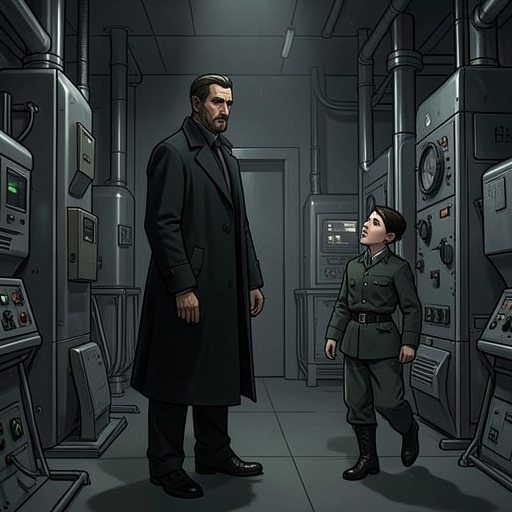
The opposition begins with the shock of recognition. Returning to the house, the narrator finds Roper sitting on the purple sofa. His clothes differ from the narrator’s, but his face and form are those of Andrew Martin, down to the tired eyes and mid-brown hair; the bruises on the narrator’s face are absent from Roper’s. The likeness makes Roper more than a new enemy. He is a double who embodies the mission the narrator was sent to carry out and the self the narrator might have remained. Roper identifies himself as the narrator’s replacement and says he has come to do what the narrator failed to do: destroy information. He confirms that he killed Ari, although Ari did not know that the Riemann hypothesis had been proved. The killing makes the replacement’s task concrete: the mission extends beyond suppressing knowledge to removing people, even when their connection to the discovery is slight. The narrator’s question about Ari is voiced through fear and anger, registering how closely the two feelings have come to overlap for him.
Their Conflict over Logic and Empathy
Roper presents the mission as rational preservation. He argues that the visitors were sent to kill humans, and that their reasoning makes them no better than the humans they judge. The narrator counters that they act through logic and intend to preserve humanity, even if that requires preventing its progress. In this framework, the mathematical advance represented by the proof is dangerous: Gulliver knows about it and must die, while Gulliver’s mother might be spared. The exchange exposes the violence concealed inside the replacement’s claim to rational purpose. Preservation depends on deciding whose life can be sacrificed. The narrator no longer accepts that reasoning as sufficient. When Roper says he is going to kill the humans, the narrator explains that he had already told the hosts there was no point in doing so, and that they seemed to understand. His new sense of humour, which he attributes to losing his gifts, is a smaller sign of the change: he can now respond in a way the replacement does not anticipate. Beneath the difference in tone lies a deeper divide. Roper treats obedience to the command as decisive; the narrator has begun to weigh what obedience would do to other people.
The Struggle for Gulliver
Roper turns that division into an immediate threat by beginning to pattern the narrator’s mind, directing his thoughts toward remaining in the room and taking a sharp knife. The narrator recognizes the onset of the influence and acts according to a plan: he uses the clockwork radio, rotating its power dial and switching it on. The device’s signal interferes with the technology associated with Roper’s left hand, giving the narrator a means to interrupt the control before it can dictate his next action. The narrator’s most consequential resistance comes when he tells Gulliver the truth. He explains that Gulliver’s father, Andrew Martin (original), died on Saturday, the seventeenth of April, after the hosts extracted information from him; the narrator was then sent in his place to kill Gulliver, his mother, and anyone else who knew what Andrew had achieved. He also admits that he could not carry out the assignment because he had come to empathize with Gulliver, worry about him, and love him and his mother. This disclosure makes the narrator’s defection intelligible as a change in attachment, not simply a change in strategy. Roper tries to interrupt the confession and urges Gulliver to turn off the radios, while the narrator warns him not to do so and points to the technology in Roper’s left hand. When Roper switches off one of the radios, Debussy’s music stops, but Gulliver does not follow the replacement’s instructions. He turns the knife he had been about to use against himself on Roper instead. The narrator then pulls Roper away before he can reach the second radio. Gulliver’s action disrupts Roper’s control, while the narrator’s intervention prevents him from completing it. The confrontation therefore depends on both of them: the narrator makes the truth and the danger visible, and Gulliver acts against the threat at the decisive moment.
Outcome and Significance
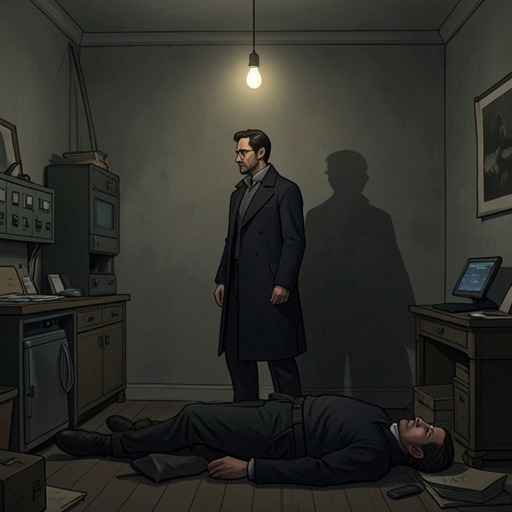
The narrator ultimately kills Roper, but the ending is presented as a grave consequence rather than a simple victory. In the aftermath, the narrator checks for a pulse and realizes Roper is dead and disconnected from the hosts. Roper’s body begins to reconfigure into the alien form that the narrator recognizes from his own nature. The narrator’s response to that transformation is telling: in the familiar setting of the Earth kitchen, the body that had looked exactly like his becomes alien to him. Their resemblance had made the conflict intimate; the change after death reveals how much the narrator’s sense of belonging has shifted. The opposition thus gives physical form to the narrator’s moral separation from his former mission. Roper’s certainty that logical necessity justifies killing stands against the narrator’s growing recognition of particular people as lives to be protected. That difference is tested through Ari’s death, the planned attack on Gulliver, and the revelation of Andrew Martin (original)’s fate. The narrator does not defeat the mission by disproving its logic; he refuses its premise that human progress and human lives can be managed as disposable risks. His resistance costs him his likeness to his assigned purpose, even before Roper’s body becomes visibly other.