Tabitha Russell
The HumansTabitha Russell is Daniel Russell’s wife, whose affectionate welcome and desperate vigil during his fatal heart attack become a turning point in Andrew Martin (the alien narrator)’s understanding of human attachment. In the large Babraham house she first recognizes the visitor as Andrew and embraces him; later, as Daniel dies, her tenderness and grief make visible the mutual reliance the narrator had expected to scorn. Her brief appearance thus matters not only as the portrait of a wife losing her husband, but as an encounter that troubles the narrator’s certainty about human weakness.
Identity and Introduction
Tabitha is introduced at the door of the Russells’ large house in Babraham. She is very tall and broad-shouldered, with long grey hair and aged skin. Seeing the visitor, she calls him Andrew, opens her arms, and kisses him on the cheek. Her familiarity is immediate: she knows him and repeatedly says his name. The greeting is intimate enough to establish a history between her and the person she believes has come to see Daniel, even though the narrator’s manner puzzles her.
That mismatch quietly shapes the visit. Tabitha notices something unusual in Andrew’s conduct but tries to conceal her confusion beneath what the narration calls energetic, chaotic politeness. Her efforts to keep the encounter hospitable coexist with an unspoken recognition that the familiar person before her is behaving differently. She does not turn the moment into a confrontation; instead, she carries on with the visit and offers him something to drink.
The Russell Household
Tabitha’s hospitality is expressed through ordinary domestic choices. She offers coffee or fruit juice and explains that she and Daniel have acquired a taste for pomegranate juice, adding that Daniel regards claims about antioxidants as a marketing ploy. The exchange gives the marriage a small, recognizable texture: they share habits, while retaining different attitudes toward the explanations attached to them. The narrator asks for water, and their conversation proceeds within the practical courtesies of a household receiving a visitor.
The house around her is large, but its kitchen is crowded enough to feel no bigger than the narrator’s comparison point: Andrew Martin’s kitchen. Saucepans hang overhead, and an envelope addressed to Daniel and Tabitha Russell lies on the counter. Elsewhere, a ceramic vase and a room with dark red walls catch the visitor’s attention. These details are filtered through his alien unfamiliarity with familiar human surroundings; the ordinary objects acquire an almost baffling significance for him. Tabitha, by contrast, treats the house as a lived-in place, moving through it and responding to her guest without pausing to explain its contents.
Daniel’s Heart Attack
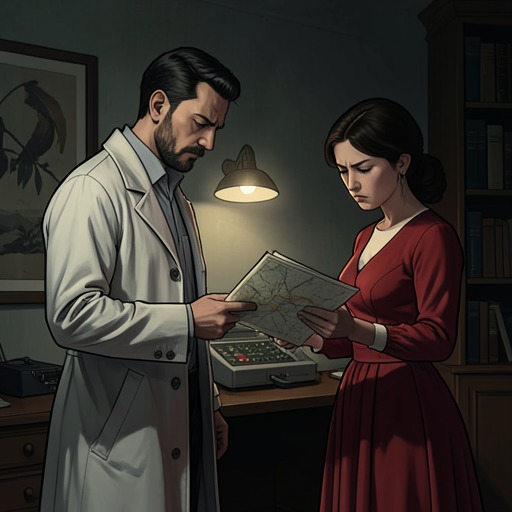
When Daniel collapses, Tabitha becomes the scene’s urgent caretaker. The narrator calls for her to summon an ambulance, and she comes upstairs in panic, kneeling beside her husband and trying to put an aspirin into his mouth. When his mouth will not open, she repeats the appeal to him and gives the emergency operator their location, identifying the Hollies on Chaucer Road and insisting that he is dying. Her actions move rapidly between hands-on care, calling for help and trying to reach Daniel through speech.
She also tries to keep him oriented toward something beyond the immediate pain. Stroking his hair, she reminds him that they are going to Egypt in two weeks to see the Pyramids, telling him it will be beautiful and that he has always wanted to go. Her recollection that he got through it the last time suggests that this is not the first such crisis. The hoped-for holiday becomes a concrete promise of a future they had planned together, and Tabitha uses it to urge him to endure the present one.
As Daniel grips his shoulder and the pain intensifies, Tabitha tells him, “I love you, Daniel.” She asks him to stay with her and says she cannot live all alone. With his head on her knee, she continues to caress his face. Her care is physical and verbal at once: she tends to his body, recalls what he wants, and tells him what his presence means to her. Daniel then falls silent and becomes suddenly heavier; the creases around his eyes relax. The narrator understands that he has died.
Grief and Narrative Significance
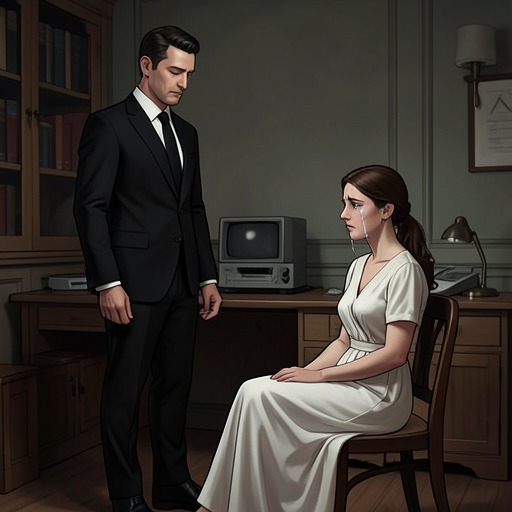
Tabitha’s response to Daniel’s death is immediate and bodily. She howls, then repeats “No” over and over. The narrator says that he has never heard a sound like her howl and that it troubles him greatly. A cat appears, startled by the noise but indifferent to the scene, a brief counterpoint to the intensity of the human loss. The episode does not give Tabitha a subsequent recovery or a longer account of bereavement; it holds her at the instant when the life shared with Daniel has been broken.
That instant also changes what the narrator can make of what he sees. He recognizes that he has prevented Daniel’s blood from reaching his heart, so the unfolding emergency is bound to his own intervention even as Tabitha responds without knowing its cause. Watching her, he feels a longing whose object he cannot identify. Where he had been expected to see weakness worthy of contempt, he instead recognizes love as two lives relying on one another. Tabitha’s grief is not presented as an abstract lesson detached from her marriage: it is carried by the promised journey, the familiar touch of her hand in Daniel’s hair, and the fear of being left alone. In this encounter, her devotion makes human attachment palpable to a visitor who has not yet learned how deeply it can matter—and how painful its loss can be.