Technological progress
The HumansTechnological progress is presented as an ambivalent history: humans have steadily built tools and institutions, yet their increasing capacity has not brought equivalent understanding of how to live or how to treat others. The novel measures progress not only by inventions already made but by the powers still out of reach—and by the consequences that might follow if mathematical knowledge unlocks them. For the narrator, this is no abstract debate. Having destroyed a proof that could advance human mathematics, he must decide whether withholding knowledge is protection or the denial of humanity’s future.
A history of achievements and an unfinished leap
The book The Zeta Function, written by Andrew Martin, traces what it presents as the main stages on humanity’s road toward civilization. Its catalogue moves from fire and the plough to the printing press, the steam engine, the microchip, and the discovery of DNA. These achievements are substantial, but the account also marks a limit: humans have not made the leap that other intelligent life forms have made. Their rockets, probes, and satellites show an appetite for reaching beyond Earth, yet the book argues that mathematics has not taken them to the next threshold.
That threshold is not another isolated invention. The unrealized possibilities named in the book include synchronizing brains, creating free-thinking computers, developing automation technology, and undertaking intergalactic travel. Set beside the list of past milestones, these prospects make progress look like a sequence that can gather momentum. The narrator recognizes that his own intervention is obstructing that sequence. Since he has destroyed the proof, he sees himself not merely as withholding one mathematical result but as stopping opportunities and, in his own stark assessment, killing humanity’s future.
The contrast with the narrator’s civilization sharpens the stakes. Its equivalent breakthrough, known as the Second Basic Theory of Prime Numbers, enabled travel through the universe, habitation of other worlds, transformation into other bodies, extended life, and the searching of minds and dreams. The comparison suggests why a mathematical advance might matter far beyond mathematics: fundamental knowledge can reorganize what a civilization is able to do. But the narrator’s experience also means that the capacities of a technologically advanced society cannot be treated as innocent simply because they are remarkable.
Capability without corresponding maturity
A later argument in the novel challenges the idea that technical or material advancement proves moral development. The critic of humanity points to contradictions in everyday conduct: people drive long distances while taking satisfaction in recycling a small number of jars; they praise peace while glorifying war; and they condemn a killing committed in rage while honoring a soldier whose bombing kills many children. The examples make technological power part of a larger problem of divided judgment. Human beings can recognize a principle in one setting and celebrate its violation in another.
The speech broadens from these contrasts to humanity’s collective habits. People, it argues, suppose that their own side is always justified, struggle to face procreation and death, and profess that money cannot buy happiness while repeatedly choosing money. Their capacity to celebrate mediocrity and take pleasure in others’ misfortune sits uneasily beside their long history and their still-unanswered questions about who they are and how they should live. The point is not that invention has failed to occur; it is that a catalogue of inventions cannot establish that those who made them have become wiser.
The image of a world that has turned inward extends this criticism to the direction of progress. Human beings have used force to dominate and civilize their surroundings, but the speaker sees no new frontier ahead and describes humanity as a self-consuming system, unable to recognize its own part in the damage. At the same time, the narrator objects that humans learn from error and care more for one another than the critic allows. Their disagreement keeps the question open: whether human cruelty and inconsistency define the species, or whether human care and capacity for change can alter its course.
Expansion and the danger of connection
The prospect of space travel gives technological progress an especially consequential direction. The speaker expects humans to keep exploring as their mathematical understanding expands, and eventually to find other life. Even if they believe their purposes benevolent, he predicts that they may seek reasons to destroy or subjugate those they encounter. The fear is not confined to a deliberate decision to do harm. The argument turns instead on connections between knowledge and consequences: a theory developed by an amateur German physicist at a patent office in Bern could, half a century later, be connected to the destruction of Japanese cities and the deaths of much of their populations. The physicist did not want that consequence, but intention could not prevent the connection from forming.
This example makes technological progress ethically difficult to control. An advance can originate in one context and acquire destructive uses in another, across decades and through decisions made by others. The novel does not present the sequence as proof that every discovery must end in disaster; rather, the argument warns that good intentions do not dissolve the risks attached to new powers. The narrator’s opponent applies that logic to the Riemann hypothesis: mathematicians can cause an apocalypse, and the possibility of future contact with other beings makes human mathematical development a matter of interspecies danger as well as human achievement.
The narrator’s restraint and the meaning of progress
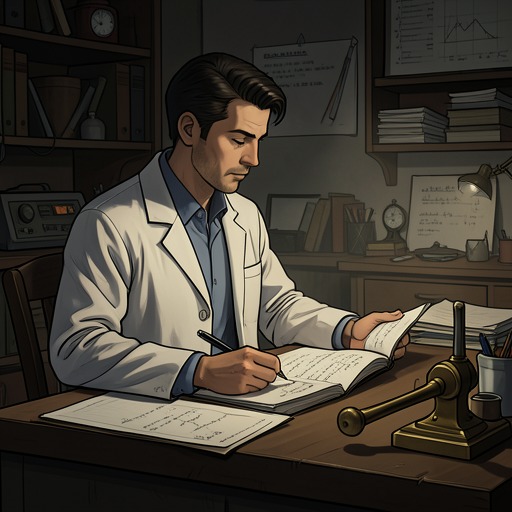
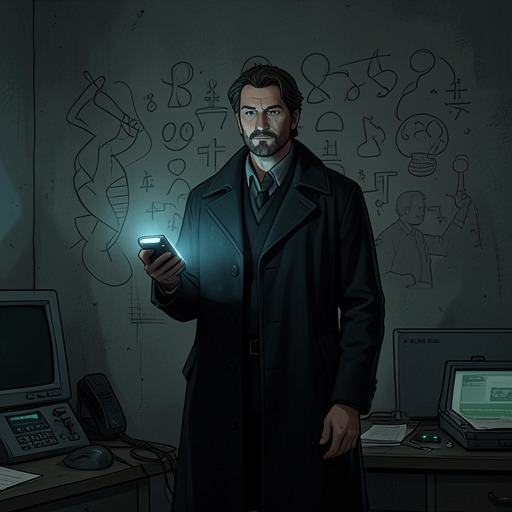
The narrator’s conduct converts this warning into a long-term policy. After taking a teaching job at Stanford University in California, he performs adequately while avoiding work that would advance mathematical understanding toward a technological leap. A poster in his office displays Albert Einstein’s warning about technological progress as a dangerous tool in the hands of a pathological animal. The image gives visible form to the narrator’s caution: intellectual advance is not automatically moral advance, and the power to build or discover can magnify the dangers of an immature society.
He also avoids discussing a proof of the Riemann hypothesis, speaking instead to colleagues of its inherent impossibility. He does so partly to ensure that no Vonnadorian needs to visit Earth, and partly because he agrees that humans handle progress badly and wishes to limit further destruction inflicted on or by the planet. His restraint is therefore protective, but it is also a deliberate obstruction of knowledge. The earlier realization that he has killed humanity’s future remains in tension with his later effort to keep that future from becoming more destructive.
A passage on human understanding complicates any confidence that civilization follows a steady, self-confirming ascent. Close study of physics, biology, neuroscience, mathematics, or love brings people nearer to uncertainty and disorder; established beliefs are repeatedly disproved, while the claim that progress is inevitable is itself questioned. Individuals, too, encounter crises in which what they believe proves wrong. Many bury the discovery rather than change, and the passage associates that denial with the narrowing of later life. Change may be an act of bravery or madness, but without it accumulated knowledge alone cannot make people wiser.
Technological progress thus remains both possibility and hazard. The narrator’s choice to suppress advances does not settle whether humanity deserves access to greater powers; it exposes the cost of treating capability as an uncomplicated good. The book’s sequence—from fire to DNA, and from rockets toward intergalactic travel—records what humans can do. The narrator’s hesitation asks the harder question of whether they can change enough to live responsibly with what they learn.