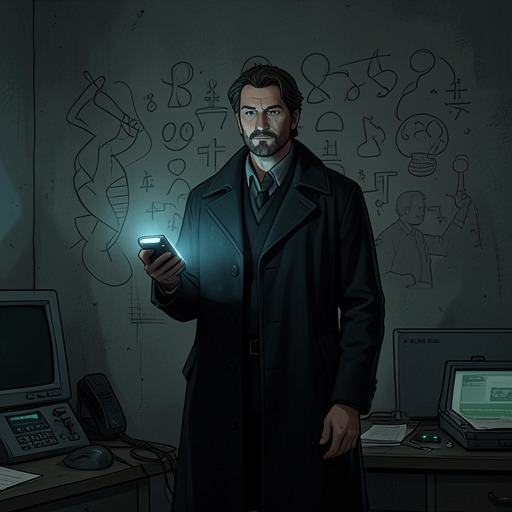
The War and Money Show
The HumansThe War and Money Show is the Alien narrator’s sarcastic name for the Earth news he watches, and a compact statement of his early judgment of human priorities. He sees broadcasts crowded with war and finance but silent about mathematics, other species, and the wider universe; his later discovery of Andrew Martin’s proof of the Riemann hypothesis makes that silence pointedly ironic.
A name for the news
The Alien narrator arrives at the phrase while listing what he finds strange about Earth’s news. In his account, the coverage is not simply selective: it treats human affairs as the natural measure of importance. Reports include a bomb in Afghanistan, concern about North Korea’s nuclear capability, and falling stock markets. Viewers study the market figures as if they were the only mathematics that mattered, while the Alien narrator waits in vain for any mention of the Riemann hypothesis.
His name for this pattern turns the news into an imagined show with two defining subjects. It is not presented as an actual programme title but as a satirical description of the priorities he sees on screen. The phrase reduces apparently varied headlines to a recurring combination of violence and money, and makes his bewilderment at human news values audible without requiring a separate argument.
What the headlines leave out
The phrase belongs to a broader observation about the scale of human attention. The Alien narrator notices that people care more about events close to them: national concerns give way to local ones, and local concerns narrow to what affects a person’s own neighbourhood. He also observes that coverage largely excludes the planet’s other species and gives little attention to what lies beyond Earth. The omissions are part of his critique: news makes human proximity seem like importance itself.
Mathematics provides the clearest counterexample to the priorities he describes. The Alien narrator finds no coverage of new mathematical observations or undiscovered polygons, and the Riemann hypothesis does not appear either. He considers two explanations—that nobody knows about it or nobody cares—and finds neither reassuring. His coined title thus expresses more than dislike of particular headlines: it marks the disparity between what he regards as consequential and what humans choose to notice.
The proof behind the silence
The contrast becomes concrete when the Alien narrator searches Andrew Martin’s office. He finds a document named Zeta, whose introduction identifies it as a proof of the Riemann hypothesis. He also discovers Andrew’s last sent email, addressed to Daniel Russell, the Lucasian Professor of Mathematics at Cambridge University. The message presents the proof for Daniel’s review, asks for discretion until it becomes public, and wonders whether it could be the biggest news since 1905.
Instead of entering public circulation, the proof and its email are erased by the Alien narrator. He deletes the message and attachment, then designs a virus to prevent anything on the computer from being accessed intact. The episode makes the phrase’s irony sharper: a result that Andrew himself imagines as momentous news remains absent from the broadcasts the narrator has watched, while the narrator actively suppresses the private record that could bring it closer to public attention.
Mathematics, money, and recognition
The discoveries also complicate the Alien narrator’s first impression of Andrew’s motives. When he asks Isobel whether solving the hypothesis is about money, she says that glory and ego matter too, describing Andrew as wanting his name everywhere and comparing that ambition with Einstein’s. The proof therefore sits at the intersection of mathematical achievement, financial reward, and personal recognition—not outside the human contests that dominate the news.
Later, the Alien narrator returns to Andrew’s office with time to look more carefully. Among its mathematics books he finds Andrew’s thin volume, The Zeta Function, marked as an uncorrected proof copy, and reads it in full. The phrase remains a lens on the gap between public attention and mathematical work: the news gives him abundant evidence of war and markets, while the proof is encountered through a private email, a computer document, and an unpublished book.