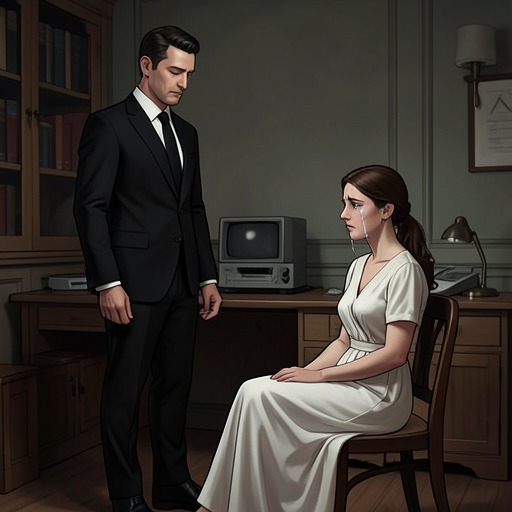
The alien kills Daniel Russell
The HumansThe alien narrator’s killing of Daniel Russell is both a calculated act of concealment and a turning point in the narrator’s understanding of human attachment. Daniel’s death follows a moment of physical contact that exposes the narrator’s abilities, and the attempt to erase evidence cannot erase what the narrator witnesses afterward: Tabitha Russell’s grief and the bond between them.
The Encounter and Its Stakes
Daniel addresses the narrator as Andrew Martin and asks him to slap his back. The request gives the narrator the contact he needs: even through their clothes, he says, he makes a reading. When he turns, his face is briefly no longer Andrew Martin’s but his own. The transformation lasts less than a second, yet Daniel has seen enough to recoil and strike his desk. The narrator is Andrew Martin again to Daniel, but the brief revelation has made their encounter dangerous.
Daniel’s startled response also makes the narrator’s actions more deliberate. With little time before Daniel can raise an alarm, the narrator paralyses his jaw. He then touches Daniel’s shoulder, a second contact the narrator says is sufficient to finish the task properly. The sequence presents the killing not as an accident but as an act carried out through the narrator’s bodily powers, with contact serving first as a means of access and then as a means of control.
Pain and Concealment
The narrator summons pain, and Daniel begins to suffer. He holds his arm, his face turns violet, and he drops to his knees. The narrator experiences head pain and fatigue as well, but continues with the practical objective that accompanies the attack: he walks past Daniel and deletes an email and its attachment. He checks Daniel’s sent folder and finds nothing suspicious. The immediate concern is not only to incapacitate Daniel but to remove the material that might expose what has happened or what Daniel knows.
After leaving the room, the narrator calls for Tabitha to summon an ambulance, saying that he thinks Daniel is having a heart attack. The call frames the emergency as a medical crisis even though the narrator knows the pain was summoned by him. That gap between the apparent explanation and the cause gives the scene its stark moral shape: the narrator can manipulate Daniel’s body, erase a record, and present the resulting collapse as something ordinary, but the explanation does not alter his responsibility for it.
Daniel’s Death and Tabitha’s Grief
Tabitha stays with Daniel as he dies. His head rests on her knee while she caresses his face and pleads with him not to leave her alone. The narrator recognizes what he is seeing as love: two life forms relying on one another. This recognition contrasts with the weakness he had expected to see. Instead, he finds that he is no longer thinking with the contempt the encounter was supposed to confirm.
Daniel stops making noise; his body seems suddenly heavier against Tabitha, and the tight creases around his eyes soften. The narrator understands that Daniel is dead. Tabitha’s howl follows, an expression of loss so forceful that the narrator describes it as though something had been physically wrenched from her. A cat appears at the doorway, startled perhaps by the sound, then leaves again, indifferent to the scene. Its brief presence sharpens the difference between the narrator’s newly troubled attention and a creature that simply withdraws.
Consequences and Narrative Significance
The killing accomplishes an immediate act of concealment: the email and attachment are deleted, and the narrator gives Tabitha an explanation that casts Daniel’s collapse as a heart attack. But the scene also marks a limit to that cold efficiency. The narrator cannot reduce Tabitha’s grief to an error of judgment or dismiss her dependence on Daniel as weakness. Her care, Daniel’s stillness, and the sound of her mourning become evidence of a kind of attachment the narrator had been prepared to scorn but now finds troubling.
The event therefore joins violence to an unwelcome awakening. The narrator’s abilities make Daniel vulnerable and help disguise the death, while the death itself brings the narrator into contact with the emotional consequences he cannot delete. The contrast between the erased attachment and Tabitha’s unmistakable grief gives the scene its lasting force: a record can be removed, but the human bond that the killing breaks remains present in the room.