The narrator’s gradual acquisition of human emotions
The HumansThe Alien narrator’s gradual acquisition of human emotions is the inner transformation at the center of the visit to Earth: an investigator who arrives committed to detachment begins to feel grief, fear, loneliness, tenderness, and wonder. The change does not come through a single revelation. It gathers in encounters with Isobel Martin, Daniel Russell’s death, Newton, music, and Gulliver Martin, each exposing a gap between the narrator’s abstract judgments about humanity and the particular lives encountered on Earth.
Starting from Detachment
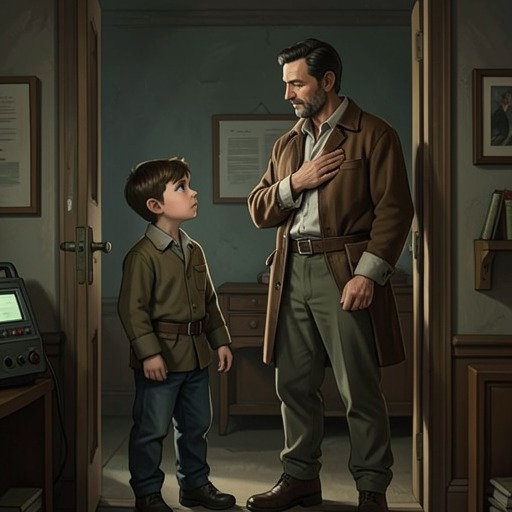
The Alien narrator initially understands the mission through a strict division between observation and feeling. It is not Andrew Martin, whose identity it has assumed, but an outsider charged with gathering information about humans and their mathematical knowledge. The task also includes eliminating Andrew Martin’s wife and child. At first, this purpose appears compatible with the narrator’s belief that emotional distance is a form of strength and that mathematical truth is sufficient in itself.
The distance is already under strain when the narrator meets Isobel Martin. It tries to regard her as merely biological matter and wishes for revulsion, believing that disgust would make its assignment easier. Instead, the meeting produces fear: the narrator finds Earth and its inhabitants frightening, and even feels uneasy at the sight of its own hands. Isobel’s poised manner and apparent reserve make her difficult to understand, while the need to spend time with her for the investigation turns the intended target into someone whose presence must be encountered repeatedly.
The narrator’s response to Daniel Russell’s death marks a further break in its attempted neutrality. After witnessing the fatal heart attack, it sees Daniel’s anguished face in memory and experiences unease that does not fit its intended account of itself. Isobel responds to the narrator’s report with compassion, despite a brief moment of suspicion. The episode places death and care together: the narrator has witnessed a human life end, then receives kindness from someone it had approached as a subject to study and a person it expected eventually to eliminate.
Grief, Care, and Dependence
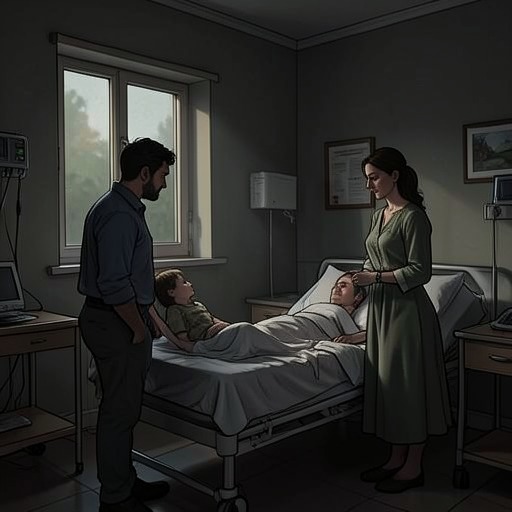
The death also gives the narrator a direct encounter with grief through Daniel Russell’s wife, Tabitha Russell. With Daniel’s head resting on her knee, she strokes his face and sings to him; after he dies, she howls with loss. The narrator recognizes their mutual reliance as love, rather than as the weakness it expected to see. Tabitha’s grief troubles it, because the scene makes emotional attachment visible not as an abstract human defect but as a bond with consequences for both people.
A different form of attachment develops with Newton. The narrator first considers the dog useful: Newton might provide information, and winning his trust seems a practical way to secure an ally. The narrator gives him a biscuit, restores his sight, and heals his painful leg, but the healing leaves it exhausted and with a headache. Newton responds with persistent affection. What begins as a calculation consequently becomes an experience of care that cannot be reduced to the information Newton might offer.
The narrator’s motives become harder to classify as it reflects on wanting both to hurt and to heal. When Newton will not leave it alone, the narrator sends him away, then calls him back after realizing that solitude has become loneliness. Newton returns, apparently glad to be wanted. The sequence matters because the narrator does not merely observe attachment in others: it experiences a need for company and acts to restore it. Its old model of self-sufficiency has begun to fail in practice.
Music, Beauty, and Human Complexity
Listening with Newton opens another path into feeling. The narrator plays Gustav Holst’s The Planets, initially finding the music’s celestial associations primitive, but notices that it soothes Newton and has an effect on itself as well. It begins to understand music as patterned sound that can produce pleasure without deliberate calculation. The narrator cannot fully explain its calm, yet recognizes that the unease following Daniel Russell’s death has lessened.
A broader sequence of listening complicates the narrator’s judgment further. Music by Ennio Morricone and David Bowie, jazz by John Coltrane and Thelonious Monk, works by Leonard Bernstein and Ludwig van Beethoven, and songs by the Beatles and Prince all become part of its investigation. It is especially struck by accidental sounds and imperfections within musical patterns. These details suggest to the narrator that human beauty may depend not on perfect symmetry but on irregularity: what it had treated as a failure of order may be part of what makes art affecting.
The music also draws the narrator’s thoughts toward Isobel Martin. The Beach Boys produce an unfamiliar emotional response associated with her embrace after the narrator told her about Daniel’s death. That memory joins compassion to beauty, rather than leaving either as a subject for detached analysis. Debussy’s Clair de Lune overwhelms the narrator with the recognition that a human being could create something so beautiful. The response frightens it, because beauty undermines the fixed belief that humans are an ugly and violent species beyond redemption.
Reconsidering Human Nature
This change in feeling becomes a change in the narrator’s account of humanity. Watching Newton run on grass, the narrator first interprets the dog’s apparent freedom as an illusion. It then recognizes a more consequential fact: humans have changed the nature of other species, including the transformation of wolves into dogs. That observation turns back upon the narrator as a possibility. If humans can change other creatures, perhaps the narrator is changing too. It hopes to remain as isolated and mentally pure as a prime number, but can no longer treat that hope as certain.
In a later exchange with its superiors, the narrator argues that human beings inhabit both appearances and underlying truths. Clothes, lawns, pets, and architecture appear to express a wish to control nature; art, by contrast, provides a bridge toward selves that civilization has concealed. This account connects the narrator’s emotional awakening to its difficulty understanding humans: their behavior cannot be explained by appearances alone, and they do not fully understand themselves. The narrator’s own growing emotions become part of the evidence that an observer cannot remain entirely outside the subject being studied.
Gulliver Martin’s sleepwalking attack sharpens the narrator’s revised view. The narrator had been about to kill the boy, but Gulliver attacks while asleep, driven by a rage the narrator takes as an expression of his unguarded nature. When Gulliver wakes, he is no longer violent. The contrast leads the narrator to see human life as a struggle between impulses rather than proof of a single, settled nature. It rejects the claim that humans are simply defined by greed, citing Grigori Perelman’s refusal of money and prizes and his care for his mother as counterevidence.
The narrator does not arrive at emotional understanding by abandoning its investigative purpose all at once. Instead, its encounters accumulate until its original categories—purity and weakness, reason and irrationality, observation and participation—no longer account for what it has done or felt. Care for Newton, distress at Tabitha Russell’s bereavement, and the beauty found in music each make detachment less convincing. The resulting state is unsettled rather than complete: the narrator recognizes that it may be changing, and that learning about humans requires accepting that their contradictions, attachments, and vulnerability cannot be understood from a position of perfect isolation.