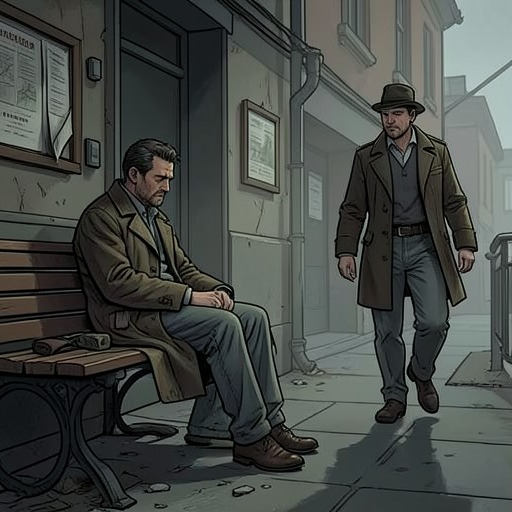
Violence and greed
The HumansViolence and greed are presented as the Alien narrator’s first comprehensive explanation of humanity and as a doctrine that his experience gradually complicates. He initially treats human violence, acquisitiveness, and collective responsibility as defining facts; the example of Grigori Perelman and a sleeping person’s change in behavior upon waking, however, expose the limits of judging every individual by the species-wide charge. The concept therefore marks both the narrator’s estrangement from human life and the beginnings of his reassessment.
The Initial Diagnosis
The narrator’s opening indictment reaches beyond individual acts of aggression or personal ambition. Humans, in his account, are arrogant and violent, and their greed shapes the way they pursue progress. They have put Earth, their only accessible home, on a path toward destruction, while continuing to advance technology faster than their psychology can keep pace. Progress itself is not the only target of his criticism: he sees people pursuing advancement for its own sake and for the money and fame it promises.
This diagnosis also concerns the social divisions through which humans understand one another. The narrator regards their categories as a failure to recognize shared interests and similarities. His charge is therefore not simply that people compete or behave selfishly, but that their arrangements and assumptions repeatedly obscure common responsibility. Harm to the planet and division among its inhabitants become connected signs of a civilization unable, or unwilling, to restrain its own ambitions.
A Doctrine of Collective Responsibility
The narrator’s reasoning extends from the species to each person he meets. He is instructed not to let an individual’s appearance or conduct separate that person from humanity’s collective crimes: a friendly face, in this view, does not cancel the capacity for harm that people share. Responsibility may be indirect, but the instruction treats that distance as insufficient to absolve anyone. Violence and greed thus function as a moral classification, not merely as descriptions of particular behavior.
That severity reflects the narrator’s contrasting point of origin. He understands his own society as having neither love nor hate, but the purity of reason; without passion, there are no crimes of passion, and actions are understood to have logical motives and the best outcome available in a given situation. Against this imagined standard, human behavior appears governed by impulses that reason alone cannot explain. The contrast helps account for the confidence of his initial verdict, while also making it possible to see that verdict as shaped by a worldview in which passion is already treated as a departure from purity.
Money, Fame, and the Value of Mathematics
The narrator’s suspicion of greed becomes especially clear when he considers the human response to mathematics. Andrew Martin had rejected public recognition, saying he did not want to become a spectacle or a mathematical hero. The narrator knows that other honors were offered, including a prize from the European Mathematical Society, an award associated with the International Congress of Mathematicians in Madrid, and the Fields Medal. Andrew refused them and chose a life of poverty and unemployment while caring for his elderly mother.
The narrator initially absorbs this story into his general accusation: humans, he concludes, value mathematics not for its own sake but for the wealth and status it can secure. Yet Andrew’s choices already trouble that claim, since they show a mathematician declining precisely the prizes and recognition the narrator says humans crave. The episode reveals a tension between evidence and interpretation: even when confronted with conduct that does not fit his rule, the narrator first uses it to reinforce the rule rather than revise it.
Counterexamples and Reassessment
Grigori Perelman provides a more explicit challenge. The narrator points to the mathematician’s refusal of money and prizes and his care for his mother as evidence that not all humans are defined by greed. He recognizes that his understanding is distorted and proposes learning more about human psychology, society, and behavior. His interest is not detached from the immediate human relationships at issue: when told that the two humans are unnecessary for such research, he insists that he needs them.
A separate encounter complicates the claim about violence. A person attacks while asleep, in a state of pure rage, but wakes and is no longer violent. The narrator acknowledges that human violence is familiar; what matters is the difference between the sleeping attack and the person’s behavior after waking. His companion treats that difference as evidence of an internal struggle and as a reason to study human nature before future decisions about humanity are made. Violence remains real, but it no longer serves as a complete account of an individual.
The concept’s significance lies in this movement from categorical judgment toward attention to particular lives. The narrator’s initial framework connects ambition, fame, technological overreach, environmental danger, and interpersonal harm in a single indictment. Its weakness is that it can make every person answer for the whole without noticing meaningful differences in conduct. Perelman’s refusals and the contrast between sleeping rage and waking behavior do not erase the larger problems the narrator identifies; they do make his certainty harder to sustain. The prospect of understanding humans better begins where the blanket accusation gives way to the possibility that individuals cannot be fully explained by it.