Violet
The HumansViolet is the novel’s recurring signal of alien influence, bodily vulnerability, and the narrator’s changing sense of what counts as human. It begins at the edge of perception as pain gathers behind his eyes, spreads into the space around him when the hosts press upon him, and later marks both Gulliver’s bruised face and the dying Jonathan Roper’s transformation. The color binds private sensation to visible change: what the narrator first experiences as an unexplained disturbance becomes a warning of the hosts’ presence and, finally, a sign of the alien body exposed beneath a human appearance.
First Appearances and the Hosts’ Warning
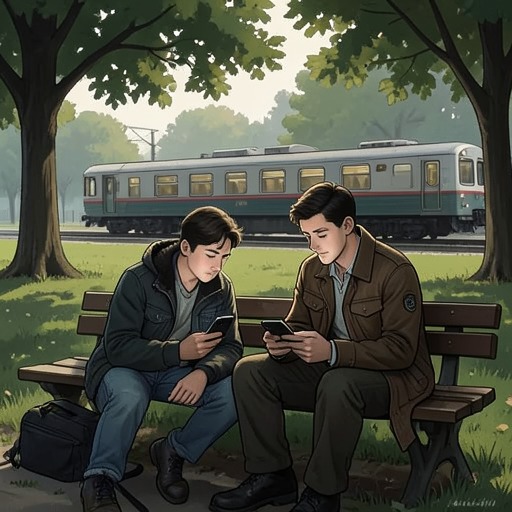
The motif first emerges during a conversation with Ari about humanity’s place in the universe. As Ari describes how unsettling scientific discoveries have challenged human self-importance, the narrator notices pain beginning behind his eyes and a violet blur at the edge of his vision. The color arrives as part of a physical reaction, before the narrator has explained his identity to Ari or fully named what is happening. Its first appearance therefore connects the challenge to human exceptionalism with a disturbance inside the narrator himself.
The violet becomes more pronounced when the narrator asks Ari to imagine an alien living among humans and being identified. Wisps appear throughout the café, unseen by everyone else. As the narrator begins to reveal that he is such an alien, the room and its occupants seem to dissolve into violet. The pain intensifies, and the narrator collapses; Ari interprets the crisis as a medical emergency and offers to call an ambulance. The color gives an otherwise invisible pressure a visual form. It accompanies the narrator’s attempt to disclose the truth, while the hosts’ apparent intervention makes that disclosure physically difficult.
Afterward, the episode does not vanish cleanly. The narrator sits with an ache that remains for a while, and with faint wisps of violet visible only to him. The pain eventually disappears and the last trace leaves the air, but he understands the pain as a warning. He does not tell Isobel Martin, author of the unfinished novel, or Gulliver Martin what happened. Violet thus marks not simply a passing sensation but an encounter the narrator knows he must conceal.
The Color on Gulliver
That warning acquires a human counterpart when Gulliver comes home with a bruised eye. His mother repeatedly asks what happened, but he gives no satisfactory answer and shuts himself in the small utility room behind the kitchen. The narrator notices that human bruises can take many shades, including a dull violet. The color is now not an uncanny haze in the air but a mark on a boy’s skin: evidence of injury that is both beautiful to the narrator and frightening to behold.
The contrast complicates violet’s meaning. In the café, it signals pressure from the hosts; on Gulliver’s face, it belongs to the visible consequences of human violence and vulnerability. The narrator’s description holds attraction and fear together rather than resolving the color into a single meaning. Its beauty does not cancel its evidence of harm. Violet connects the narrator’s alien perceptions to a human body bearing an injury, making the distinction between strange and familiar less secure.
Pain, Perception, and Human Attachment
Violet returns during the narrator’s experience of Gulliver’s survival. He sees the boy’s eyes open and recognizes a living, sensitive person, feeling what he understands as the exhausted wonder of a father. The moment of recognition is immediately overtaken by pain and violet, and he is on the verge of collapsing before darkness takes him. The color therefore accompanies a change in the narrator’s relation to Gulliver: the boy is not an abstract human but someone whose life has become emotionally consequential to him.
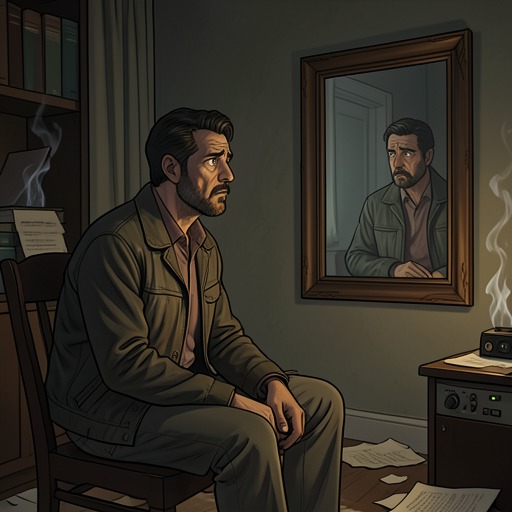
In a later bedroom episode, the violet is no longer peripheral. The narrator describes the room as filled with it, and the color persists even when he switches off the light, spreading across his perception. He urges the hosts to leave, but feels them holding him. Under their influence, he looks at Isobel Martin, author of the unfinished novel, without feeling anything for her and does not even recognize her as Isobel; she appears to him only as a human. Violet here accompanies the threatened loss of the attachments and distinctions through which the narrator has been becoming more human. The darkness cannot remove it, just as his attempt to resist the hosts does not immediately free him from their hold.
Transformation and the Alien Made Visible
The motif reaches its starkest form after Jonathan Roper dies in the kitchen. As the narrator checks Jonathan’s pulse, the knife in his chest confirms the violence of his death. His body begins the reconfiguration that follows death: his shape curls inward, his face flattens, his skull lengthens, and his skin takes on mottled purple and violet shades. The knife remains in his back while the rest of his appearance changes.
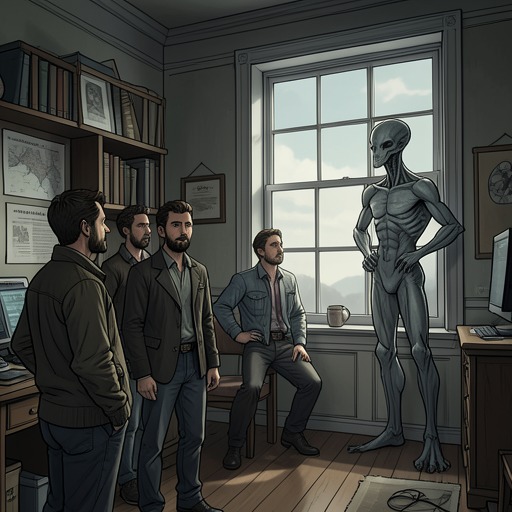
The color now belongs to a body becoming recognizably alien. The narrator, who had earlier experienced violet as an invasive presence in his own vision, sees the transformed creature as entirely other within the familiar setting of an Earth kitchen. Gulliver watches in profound shock and says nothing. Violet has moved from a private warning, to an injury on Gulliver, to the visible evidence of a concealed nature revealed by death. Across these appearances, the motif unsettles any easy division between what looks human and what is alien: it marks both the narrator’s growing capacity for attachment and the foreign body that a human appearance had hidden.