Vonnadorian civilization’s immortality and emotional absence
The HumansVonnadorian civilization’s immortality and emotional absence form a single social order: beings who cannot die have little reason to fear, while a culture that prizes reason above passion treats individual desire as subordinate to collective need. The narrator’s account presents this order as technologically powerful and psychologically adapted to its own advances, yet its serene distance from human feeling also makes it a measure against which life on Earth appears radically different.
A Post-Marital, Emotionally Ordered Society
The narrator describes belonging to a post-marital species, a phrase that signals how far Vonnadorian social life stands from the human household. Where humans organize lives around names, families living together, spouses, and children, the narrator says his people have none of these arrangements. Their society has no husbands and wives, no family homes, and no sulky teenagers; the list sets ordinary human intimacy and domestic friction alongside the absence of madness in the narrator’s own world. These are not presented as merely different customs. They belong to a wider condition in which love and hate are absent and reason is treated as pure.
The account links this emotional absence to conduct. Without passion, there are no crimes of passion; without remorse, actions proceed from logical motives and are understood to produce the best outcome available in a given situation. The narrator’s description makes the society sound internally consistent: emotion does not disrupt judgment because emotional attachment is not part of its stated order. But that consistency also marks a profound difference from humanity. The terms that make human relations recognizable—love, hate, remorse, family—are not simply suppressed in particular situations; they have no place in the narrator’s account of Vonnadorian life.
Immortality and the End of Fear
The Vonnadorians have solved the problem of death, and the narrator presents that achievement as the basis for solving fear. They will not die. This is more than an individual escape from physical ending: it changes how the species understands its place in the universe. Because its members expect to remain within the universe for eternity, they cannot simply leave events to unfold without intervention. Immortality thus carries a permanent responsibility to manage what might otherwise be left to time and chance.
The narrator sharpens the contrast by imagining a scene unavailable to his people: a person on a luxurious carpet, clutching his chest as his face turns purple and his eyes search for one last view of the surroundings. The image gives bodily form to the human condition that the Vonnadorians have escaped. A mortal life is exposed to pain, panic, and irreversible loss; an immortal one has no final moment of that kind. The contrast is not only between death and continued existence, but between the urgency mortality imposes and the boundless duration with which the Vonnadorians must live.
Mathematical Power and Collective Rule
Vonnadorian technology rests on what the narrator calls supreme and comprehensive mathematical knowledge. That knowledge allows his people to travel great distances and to rearrange their biological ingredients, renewing and replenishing themselves. Their bodies are therefore not treated as fixed limits: biological renewal is part of the same technical order that makes interstellar travel possible. Yet the narrator emphasizes that this power is matched by psychological preparation. In his account, the Vonnadorians have never been at war with themselves and do not place individual desires above the requirements of the collective.
This claim supplies the society’s governing rationale. Its advanced capabilities are not represented as achievements that have outrun the maturity of those who possess them; the narrator insists that the species is equipped to live with what it has made possible. Collective need provides a standard for action, while comprehensive knowledge is presented as a means of choosing the best outcome. The account consequently binds immortality, biological renewal, mathematics, and social discipline together: mastery over bodies and distance belongs to a civilization that believes it has also mastered the conflicts within itself.
Earth as a Measure of Difference
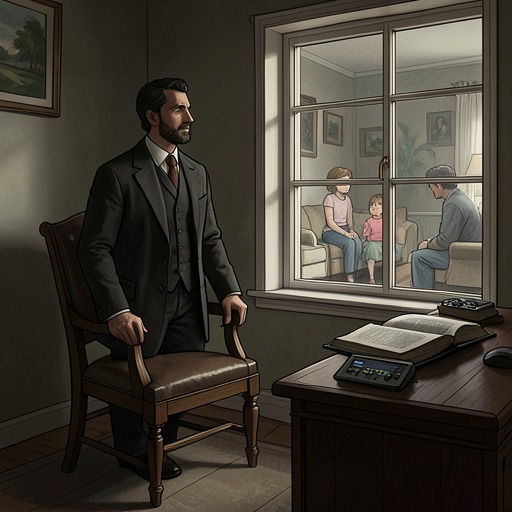
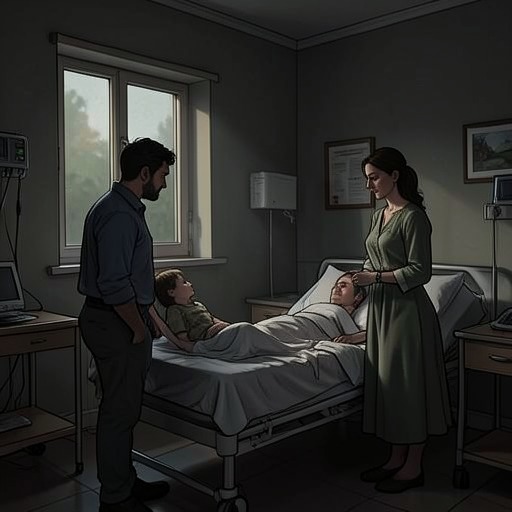
The narrator’s description of his origins occurs amid an encounter with human distress. After hearing desperate sobs and futile commands fade as he goes downstairs, he turns in thought to where he and his listener come from. The timing matters: the abstract account of Vonnadorian society follows a scene of acute human vulnerability. Its claims about the absence of fear, death, and nightmares are set against a world in which bodies can fail and people must endure the consequences.
The comparison also unsettles the idea that technical superiority settles every question of value. The narrator describes a civilization with extraordinary mathematical and biological powers, but its emotional absence means that love, hate, and remorse cannot organize its life. His account makes reason and longevity look both like solutions to human limitations and signs of a different kind of existence. In the larger contrast between his origin and his life among humans, the Vonnadorian condition is not simply an ideal endpoint: it is the alternative from which the narrator can recognize what mortality and human attachment mean.