Vonnadorian gifts
The HumansThe Vonnadorian gifts are technological abilities that shape the narrator’s bodily survival, capacity to act, and eventual choice to become human. Their most consequential contradiction is that they can be used in the service of hope and care, yet they are also designed to preserve the user rather than fulfill every purpose he chooses. Even after his powers are withdrawn, a trace of the technology remains: his left hand is still implicated in the hosts’ surveillance, and he finally uses pain to try to sever that connection.
Nature and Operation
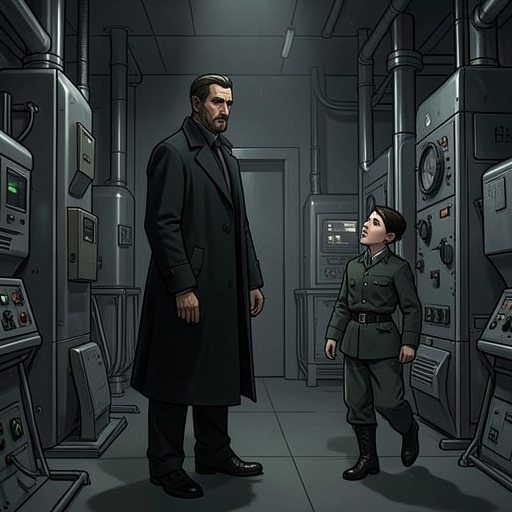
The gifts are not presented as an innate human-like talent. The narrator explains to Ari that his former special abilities were the result of technology. For a time, that technology lets him do things a human body cannot; after he loses his powers, he insists that he is exactly like a human and cannot demonstrate his former abilities. The gifts therefore mark a practical as well as a personal divide between his alien existence and the ordinary limits he chooses to accept.
Their operation is bound to bodily energy and survival. When the narrator grows weak, his body begins returning to its original state. He understands this as a built-in safeguard: rather than let him die, the energy being used to sustain the body of someone else is redirected to preserve his life. In this account, the gifts’ deepest purpose is not unlimited power but self-preservation. That purpose is reasonable on its own terms, but on Earth it threatens to undo the life he is trying to inhabit. His original state is not equipped for Earth’s air, gravity, or face-to-face contact, and he does not want Isobel Martin to see him changing. As the transformation begins, he tells her to keep doing what she is already doing: caring for Gulliver Martin.
Effort, Hope, and the Attempt to Help
The gifts also make possible an act that cuts against the effortless existence the narrator associates with home. Having read Isobel Martin’s work, he recognizes a human history of people persisting against poor odds: some succeed, most fail, and failure does not prevent others from trying. He sees hope as often irrational and requiring effort, qualities unfamiliar to someone accustomed to comfort without exertion. Yet he does not remain at a distance, merely wishing for improvement. He places his left, gifted hand against the person’s heart and begins to work.
The attempt is exhausting. That cost matters: the gifts do not make care effortless or guarantee success. Instead, they allow the narrator to commit his own energy to an uncertain intervention. The scene places technological capacity alongside a distinctly human-seeming decision to act despite the lack of assurance. His hope is not proved rational by the outcome; it becomes consequential because he spends himself on it.
The episode’s aftermath also returns attention to care in its ordinary, human form. Isobel Martin explains that she was allowed to decide whether Gulliver Martin should remain at home or be admitted, and that she judged him to be more at risk in the hospital than outside it. She understands that another attempt would leave no choice but admission and observation. This decision does not establish that the gifts determine clinical outcomes. Rather, it sets extraordinary intervention beside the continuing responsibility of someone who must assess risk and care for Gulliver afterward.
Disconnection and Its Cost
The narrator eventually decides that remaining on Earth matters more than retaining the abilities that make him conspicuously unlike its inhabitants. He asks the hosts to disconnect him, arguing that the gifts are not compulsory and refusing interference with his mind. Their response makes the cost explicit: without them he will be trapped in a body that cannot regenerate, grow old, contract diseases, and feel pain. He accepts that this suffering will be a consequence of his own choice, not an accidental sentence imposed on him.
The disconnection is definitive. The hosts tell him that the gifts are gone and that he is now human; if he claims to come from another planet, he will have no proof, and people will regard him as insane. The exchange makes loss part of the decision, not an unforeseen side effect. What he relinquishes is not simply a set of useful powers but protection against the conditions of human life. His choice gives those conditions a new meaning: vulnerability is the price he knowingly accepts in order to belong on Earth.
Residual Technology and Resistance
The loss of the gifts does not mean that every alien system has disappeared. Later, Jonathan Roper points to the narrator’s left hand: his powers have been taken, but the hosts have kept theirs, and they still listen and check. The hand that had been the instrument of intervention now looks to the narrator like an enemy. This reversal exposes a distinction between personal ability and remote oversight. Disconnection has made him powerless in one sense, but it has not immediately freed him from observation.
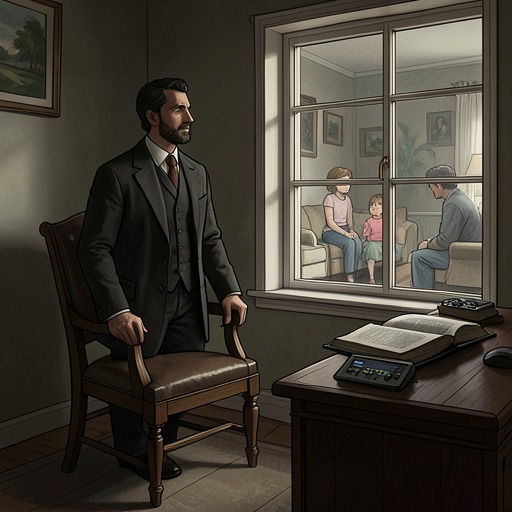
The remaining technology also shapes the danger around Gulliver Martin. As Jonathan Roper’s mind patterning begins, the narrator anticipates the attempt to make Gulliver take a sharp Knife. He goes to the bookcase, turns the power dial of the Clockwork radio through a full 360-degree rotation, and presses its green-circled button; its display lights at 90.2 MHz. When Jonathan Roper presses his hand to Gulliver’s head, the narrator switches on the kitchen radio as well, while the television remains on in another room. Classical music, newsreaders, and rock music fill the house as he pulls Jonathan Roper’s arm away from Gulliver. The passage shows him using ordinary appliances and competing sound to interrupt an act of mental control, rather than relying on powers he has already surrendered.
After warning Gulliver Martin to keep Isobel Martin away, the narrator returns to the hot plate and puts his hand beside the place where Jonathan Roper’s hand had been. He presses it down and feels total pain. The act links the lingering technology in his hand to a deliberate effort to end the hosts’ access: where the gifted hand once enabled intervention, it is now subjected to injury in resistance to surveillance. The text gives the pain a force that overwhelms space, time, and guilt, but does not make the old powers return. The gifts’ decisive significance lies in that reversal: their absence defines the narrator’s chosen human limits, while their material residue makes clear that choosing those limits does not instantly erase the systems that once empowered him.