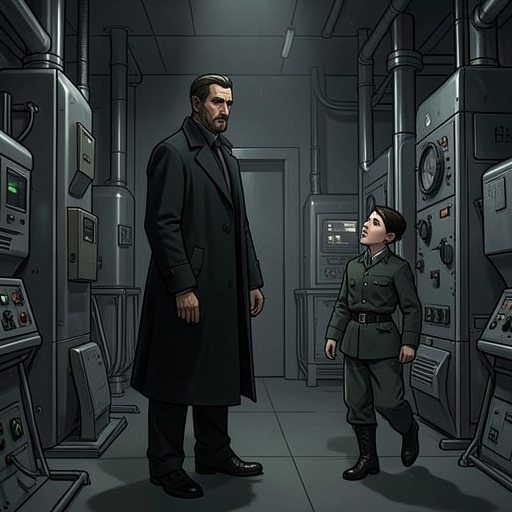
Vonnadorian mission directive
The HumansThe Vonnadorian mission directive is a mandate to halt human progress by removing the information and people that might enable it. The Alien narrator initially treats the order as an overriding duty, one that places his obligations to the Vonnadorians above any responsibility to the human beings among whom he lives. Its decisive significance lies in the conflict between that impersonal logic and the relationships he forms: the directive calls for destruction, while his growing concern for Gulliver and Isobel makes carrying it out unbearable.
Purpose and Rationale
The directive is framed not as an attempt to punish individual humans but as a response to what the Vonnadorians regard as a dangerous imbalance between human knowledge and human maturity. The Alien narrator reads about the Riemann hypothesis and considers the consequences of the proof he has destroyed. He recognizes that, in doing so, he has stopped opportunities for human advancement and killed what might have been humanity’s future.
The book he reads surveys human achievements, from fire and the plough to the printing press, steam engine, microchip, and discovery of DNA. Yet it presents these milestones as insufficient preparation for more consequential advances. Humans have built rockets, probes, and satellites, but have not achieved the developments the narrator associates with advanced civilizations: the synchronization of brains, free-thinking computers, automation technology, and intergalactic travel. This contrast helps explain the mission’s premise: human progress is real, but the Vonnadorians judge its further acceleration dangerous.
That judgment is made explicit when the narrator’s replacement argues that progress poses a serious danger to humans and that preserving them may require preventing it. In this reasoning, restraint is presented as protection rather than hostility. The claim that the boy must die even if the woman can be saved reveals how far this protective logic reaches: it treats human lives as questions of risk and information, not as relationships that impose separate claims on the agent carrying out the order.
Duties and Methods
The directive governs the narrator’s sense of obligation as well as his actions. When Isobel considers contacting the school after Gulliver has shut himself away, the narrator withholds information about Gulliver’s absence from school. He later recognizes this silence as a mistake, but at the time explains it to himself through the hierarchy imposed by his assignment: helping the family is not his duty, because his duty is not to humans. His response shows the directive operating in ordinary domestic circumstances, shaping what he will disclose and what help he believes he may offer.
Its practical method is the destruction of information. The replacement identifies himself as someone sent to do what the narrator did not, and specifies that his task is to destroy information. He also discloses a broader instruction: to eliminate anyone to whom the narrator has revealed his origins. The scope has therefore expanded beyond suppressing knowledge of the Riemann hypothesis. It includes the personal knowledge that could expose the Vonnadorian operation itself, making the narrator’s confidences to others grounds for further removal.
The replacement’s account also overturns the narrator’s belief that he has been disconnected from his people’s oversight. The Vonnadorians have taken away his powers, but, as the replacement explains, they have not taken away their own means of listening and checking. The order thus operates at a distance: the narrator’s loss of abilities has not ended the mission’s reach, and his apparent separation has not made his actions private.
The Narrator’s Refusal
The Alien narrator’s failure to obey is not presented as a sudden rejection of the directive’s logic. He begins from the belief that duty belongs to his own kind, not to humans, and even insists that this applies especially to the people in the household he inhabits. But the story repeatedly places that abstract allegiance beside his particular knowledge of Gulliver and Isobel. In the end, he acknowledges that he was sent to kill them and anyone who knew what the original Andrew Martin had achieved, but that he could not carry out the order.
He connects his refusal to feelings he had been taught were impossible: empathy, affection, worry, and love. His confession makes the cost of disobedience explicit. He has given up his power and strength rather than complete the mission. The directive’s central opposition is therefore not simply between two species or two levels of technological development. It is between a rule that reduces people to threats or sources of information and an attachment that makes their particular lives matter to the agent who has been ordered to erase them.
Escalation and Significance
The replacement’s arrival shows that the directive is not exhausted by the narrator’s decision to stop acting on it. Another operative has been sent to finish the work, and the instructions now include killing people who learned the narrator’s origins. The murder of Ari confirms the consequence of that expanded scope: the replacement admits that Ari was killed, although Ari did not know the Riemann hypothesis had been proved. The mission’s logic can therefore reach beyond the knowledge it claims to suppress, treating disclosure of the narrator’s identity as a separate danger.
The directive also creates an irony at the center of the narrator’s transformation. The Vonnadorians seek to preserve humans by obstructing progress, yet the narrator’s attempt to obey makes him increasingly attentive to the people his assignment treats as expendable. His refusal does not erase the danger posed by the mission; the replacement and the continuing surveillance demonstrate that the order remains active. Instead, it changes what the conflict means: the narrator’s emerging humanity is measured by his willingness to oppose a system that calls destruction a form of preservation.