Zeta
The HumansZeta is the document containing Andrew Martin’s proof of the Riemann hypothesis, and its importance in the story lies as much in its vulnerability as in its mathematical claim. The Alien narrator finds it on a computer, reads the proof to its final symbol, and deletes it. Later, discovering that Andrew has sent the same document to Daniel Russell, he deletes the email and attachment as well, then designs a virus to make the computer’s contents inaccessible. A result presented as a turning point for human knowledge becomes an object to be hidden and erased.
The document and its argument
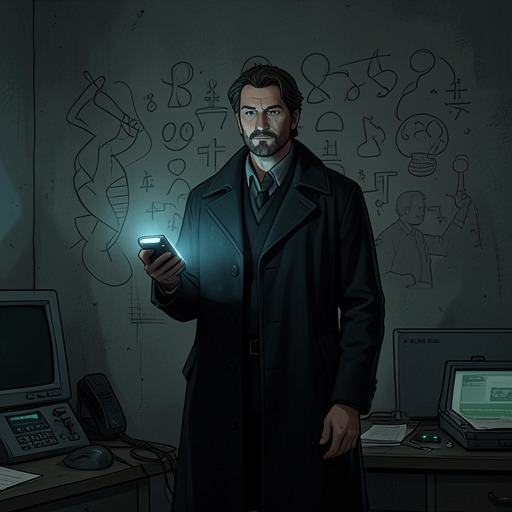
The narrator finds a file named Zeta on a computer in Andrew Martin’s study. It runs to twenty-six pages, most of them mathematical symbols, but begins with an introduction in ordinary language under the heading PROOF OF THE RIEMANN HYPOTHESIS. The combination gives the file two modes of address: a formal argument that the narrator must learn to read, and an expansive account of what the result might mean for human civilization.
The introduction describes the Riemann hypothesis as mathematics’ most important unsolved problem. It presents mathematics as a foundation of civilization, connecting ancient architecture and astronomy to later advances, while insisting that progress has never been steady. Its history is imagined through both achievement and loss: the destruction of the Library of Alexandria and the interruption of learning become examples of setbacks that might have delayed human development. The proof is thus placed inside a speculative history, not treated as an isolated technical discovery.
That speculation grows deliberately large. The introduction imagines that earlier mathematical advances might have led to human spaceflight in the age of Cardano, Newton, or Pascal, and to terraformed planets, medical breakthroughs, and perhaps an end to aging and death by the twenty-first century. It even proposes mathematics as an ideal basis for religion, reasoning that a God, if one exists, would be a mathematician. These claims belong to the document’s rhetoric: the result is made to stand for a possible change in humanity’s entire future, not merely an addition to mathematical knowledge.
Reading and destroying the proof
Before examining the symbols, the narrator traces the problem’s intellectual scale. Fermat’s Last Theorem and the Poincaré Conjecture have been solved, leaving the Riemann hypothesis as the last and largest riddle in this account. The introduction associates its solution with consequences ranging from supercomputers and explanations of quantum physics to interstellar transportation. The narrator then works through the pages of numbers, graphs, and symbols, describing this mathematical language as easier and more truthful than the language he had learned with the help of Cosmopolitan.
The reading ends with the document’s final, conclusive infinity symbol. The narrator is left without doubt that the proof has been found and that the lock has turned. His next action is immediate: he deletes the file. He takes a small pride in doing so and privately frames the destruction as a possible way of saving the universe. The contrast is central to the object’s role: the proof’s immense promise does not lead the narrator to preserve or publish it. In the sequence he is following, its significance makes it something to remove.
The email and the second erasure
The local file is not the only copy. Looking through Andrew Martin’s emails, the narrator finds the final message in the sent folder, with the subject line 153 years later . . . Andrew tells Daniel Russell that he believes he has proved the hypothesis, asks him to examine the attachment first, and stresses that the news is not yet public. His questions about whether humanity will be changed and whether this is the greatest news since 1905 reveal the excitement and uncertainty surrounding the claim. The attachment is the same document the narrator has just read.
The recipient is Daniel Russell, a sixty-three-year-old Lucasian Professor of Mathematics at Cambridge University, an author of fourteen books, and a former or current academic colleague of Andrew’s. The narrator finds that they have worked on papers together but appears to judge them colleagues rather than friends. With Andrew’s wife expected home in about twenty minutes, he treats the discovery as the first step in a sequence that must be carried out without attracting suspicion. He trashes the email and its attachment, then designs a virus using Prime numbers so that nothing on the computer can again be accessed intact. The second erasure is more comprehensive than the first: it targets not only the proof but the means by which the copy might be retrieved.
Significance in the story
Zeta is both a mathematical document and a point of conflict between knowledge and control. Andrew’s email treats the proof as a discovery to be checked privately before it becomes public; the narrator, having verified it to his own satisfaction, treats its circulation as something to stop. The file’s physical vulnerability—one copy on a computer, another attached to an email—makes the large civilizational claims of its introduction depend on ordinary acts of storage, transmission, and deletion.
The narrator’s confidence that destroying the document may save the universe is undercut by the story’s reminder that events are not so simple. His intervention does not make the proof’s consequences disappear: another person has already received it, and the narrator’s attempt to close off access requires escalating from deletion to a deliberately destructive virus. Zeta therefore marks a reversal in the meaning of mathematical achievement. The proof is described as a key to progress, but in the narrator’s hands it becomes evidence to erase, and the possibility of changing the future becomes a reason to conceal it.