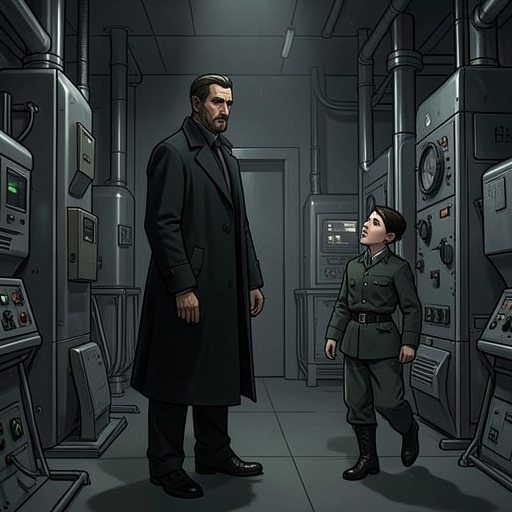
the hosts
The HumansThe hosts are a collective presence communicating with the Alien narrator during his mission on Earth. They warn him that they are listening, challenge his delay, and ultimately reveal a mission that includes killing the people who know about his origins. Their importance lies not only in the orders they issue but in the pressure they exert on his mind and choices: as he begins to care for Isobel Martin, author of the unfinished novel, and Gulliver Martin, their authority becomes the force against which he defines his emerging independence.
Identity and Presence
The hosts appear in the evidence as a collective voice rather than as individually identified characters. They address the Alien narrator as a group, using the plural to express concern about his conduct and to ask what he is doing. Their exchanges establish that they are aware of his activity, expect the mission to proceed, and regard his extended stay as a problem. The evidence does not specify the membership or structure of the collective, so its presence is defined chiefly through these communications and the control it exercises.
The hosts’ surveillance is not merely suggested by the narrator’s suspicion. Before one of his lectures, a warning tells him that they are listening. Later, when he asks whether they have continued to monitor him after he believed himself disconnected, another operative explains that the hosts still listen and check, and points to the technology in his left hand. The exchange distinguishes the removal of some of the narrator’s powers from the persistence of the hosts’ capacity to observe him. Disconnection, as he understands it, has not ended their oversight.
Mission and Orders
The hosts’ mission is revealed through the Alien narrator’s account to Gulliver Martin. He explains that the hosts extracted information from Andrew Martin, killed him, and sent the narrator to Earth in his place. The assignment was to kill Gulliver, Isobel Martin, author of the unfinished novel, and anyone else who knew what Andrew had achieved. This disclosure clarifies that the narrator’s assumed identity and his family relationships began as parts of an operation to suppress knowledge and remove witnesses.
The narrator’s own earlier reasoning shows how directly the mission governs his actions. When he questions Isobel about what she knows and what she may have told other people, he concludes that he will have to kill her, though not immediately. His concern is not simply whether she can identify him; he is assessing the risk that she might expose information. Later, he tells Gulliver that he was sent to kill both him and Isobel but could not carry out the order. The hosts’ objective therefore persists even as the narrator’s willingness to obey collapses.
The scope of the orders extends beyond the original targets. In a later confrontation, an operative explains that his instructions include killing anyone the narrator has told about his origins. This confirms that the collective is not simply trying to ensure the original mission’s completion: it is also seeking to contain disclosure about the operation itself. Surveillance and elimination reinforce one another, making the narrator’s private decision to resist a risk the hosts continue to monitor.
Resistance and the Dispute over Influence
The conflict becomes explicit when the narrator says that he cannot harm Isobel and Gulliver. The hosts answer that he has been corrupted, and when he rejects that description, they characterize his change as infection. Their language treats growing knowledge of human attachment not as a legitimate development but as contamination. The narrator, by contrast, insists that he has learned more: humans may be violent, he says, but they more often care for one another, and he has become convinced that their goodness outweighs their violence. His altered judgment is the immediate reason their mission has become untenable to him.
He asks to be disconnected because he does not want his mind interfered with, and argues that the hosts’ gifts are not compulsory. Their reply disputes his account of what is happening: they say they are not interfering with his mind but trying to restore it. The difference is consequential. The narrator experiences their involvement as a threat to his ability to choose; the hosts present it as restoration. The conversation supplies no neutral resolution of that disagreement, but the later evidence of ongoing listening despite the supposed disconnection supports the narrator’s fear that he has not escaped their reach.
The Hosts and the Narrator’s Change
The narrator’s inability to execute the order is shown as a change in relationship, not an abstract change of allegiance. He observes the intimacy between another human couple and recognizes mutual reliance as love rather than weakness. Later, when he is poised to kill Isobel, her sleeping address to him as someone she loves breaks through the collective hold over him. He recognizes her as a particular person rather than merely a human being and realizes how strongly he feels about her. The scene makes the hosts’ pressure tangible: their influence is present at the moment when his attachment to Isobel nearly fails, and his return to an individual sense of self prevents him from killing her.
He then declares that he is staying on Earth and asks to be disconnected, even though the hosts warn that his abilities do not belong on the planet and that humans may become suspicious. The decision places his wish to protect Isobel and remain with her against the benefits they say he would surrender, including immortality and the possibility of returning home or travelling elsewhere. He nonetheless asks them to leave her, Gulliver, and the family alone. The hosts’ continuing surveillance shows that this plea does not guarantee safety; his resistance is a choice made under persistent observation, not proof that their authority has vanished.
Narrative Role
The hosts frame the transformation at the center of the Alien narrator’s story as a dispute over who can define it. They call his attachment corruption or infection; he calls it knowledge and a reason to refuse murder. Their collective speech also establishes the scale of the threat behind his domestic life: the apparent father and husband is an impersonator sent by a power that has already killed the original Andrew Martin and intends to eliminate his family. When the narrator finally tells Gulliver the truth, the hosts’ orders become legible as the hidden cause of his deception and the danger surrounding the disclosure.
Their presence also complicates the narrator’s claim to independence. He rejects their mission and chooses the people he was sent to kill, yet the technology in his left hand remains a channel through which the hosts can listen and check on him. The evidence thus ends not with a settled reconciliation or a confirmed end to surveillance, but with the central contradiction intact: the narrator has refused the hosts’ purpose, while the hosts retain means to watch him. That unresolved pressure gives his decision to remain with Isobel and Gulliver its ethical weight.