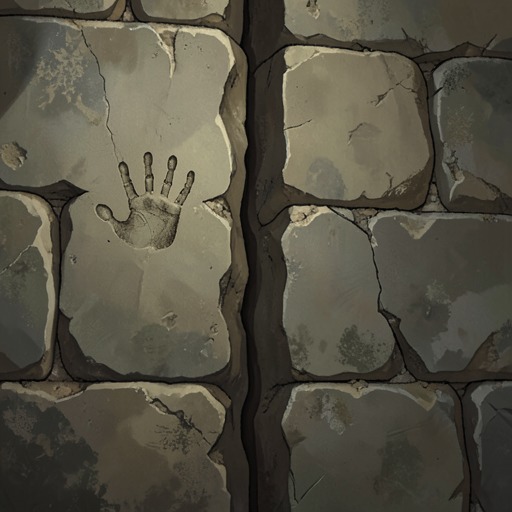
ANArKH inscription
The Hunchback of Notre DameThe ANArKH inscription is a hand-cut word discovered in an obscure nook of a tower of Notre-Dame Cathedral, and then erased from the stone. Its importance lies not in any surviving physical trace but in the chain of loss the preface records: an unknown medieval hand leaves a mark, later interventions remove it, and the author’s memory turns that absence into the foundation of the book.
Discovery and Appearance
While visiting, or, as the preface corrects itself, rummaging about Notre-Dame Cathedral, the author found the inscription in a shadowed corner of one of the towers. It consisted of the Greek capitals ANArKH, cut deeply by hand into the wall. The letters were black with age. Their forms and attitudes also bore signs of a Gothic calligraphy that seemed to the author to identify the hand as belonging to the Middle Ages.
The inscription offered no account of who had made it. Instead, its material qualities invited speculation: its age-darkened letters, the force of their carving, and their placement in an obscure part of the church gave the mark the appearance of a deliberate, private testimony. The author imagined an anguished soul unwilling to leave the world without stamping the ancient church with a sign of crime or unhappiness. That is an interpretation prompted by the inscription, not a recovered fact about its maker; the person who cut the word remains unidentified.
Erasure and Survival
After the discovery, the wall was altered. The author could not say whether it had been whitewashed or scraped down, but either process had the same result: the inscription disappeared. The uncertainty about the exact method is part of the account. It records the erasure plainly while leaving its immediate circumstances unresolved.
The preface places this loss within a longer pattern of damage to medieval churches. It describes successive acts from within and without: the priest whitewashes, the archdeacon scrapes, and the populace demolishes. The sequence moves from covering and abrading a marked surface to the destruction of the building itself. The inscription’s fate therefore becomes a small, specific instance of a wider attrition, in which the church’s traces are repeatedly altered until they can no longer be read.
Once the word had vanished from the wall, the author’s written recollection became its only remaining record. The preface emphasizes how precarious that survival is: the person who made the mark has been absent for centuries; the mark itself has been removed; and Notre-Dame Cathedral may, the author warns, also disappear. These losses are related but not identical. The inscription has already been erased, while the church’s disappearance is presented as a possibility. The book preserves the memory of the first loss and gives it a place in the face of the second.
Meaning and Narrative Function
The preface calls the word’s meaning fatal and melancholy, but does not supply a translation or settle the mystery of what its maker intended. Its force in the account comes instead from the contrast between a deeply carved mark and its eventual disappearance. A word once made physically present in stone becomes legible only through recollection. The preface thus treats the inscription at once as an object and as an absence: its material existence matters precisely because the surface no longer bears it.
The author’s response follows the same movement. The discovery prompts questions about the unknown hand and the distress behind its mark; the erasure prevents those questions from being answered by further inspection. What remains is not proof of the writer’s identity or circumstances, but the author’s fragile memory of the word and the circumstances of its loss. The preface makes that gap productive without pretending to close it: uncertainty is part of the inscription’s continuing significance.
The final declaration, that the book is founded upon this word, makes the vanished mark a point of departure rather than a solved riddle. The novel grows from a trace that cannot be revisited on the wall, linking its narrative origin to the broader vulnerability of Notre-Dame Cathedral and its accumulated history. In that sense, the inscription survives in a changed form. It no longer occupies the tower’s stone; it remains as the remembered sign from which the book begins.