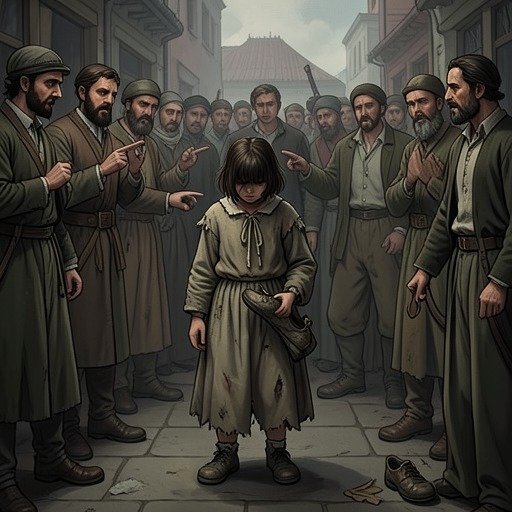
Agnes's little pink satin shoe
The Hunchback of Notre DameAgnes's little pink satin shoe is both a lovingly made article of infant clothing and the sole remnant of the daughter Paquette la Chantefleurie loses. Its significance changes with the story: first an object of maternal delight, it becomes the evidence left behind after Agnes disappears, then the silent focus of the recluse's enduring grief. The small shoe gives an otherwise vanished child a material presence, while its beauty makes the loss more piercing rather than less.
Making and Meaning
Paquette makes the shoes herself for Agnes, lavishing on them the skill and ornament she brings to embroidery. The narrative describes a pair of little pink shoes, embroidered and embellished with the delicacy of a robe for the Virgin; each is no longer than the narrator's thumb. Agnes's feet are so tiny that their ability to fit inside seems almost unbelievable. The shoe's scale is therefore not incidental: it makes the infant's fragility tangible and gives the mother's wonder a precise object.
The shoes belong to a larger world of clothes Paquette makes for her daughter. After Agnes's birth, she uses her only bedcover to swaddle the child and turns the products of her renewed work into baby clothes, caps, bibs, and tiny satin bonnets. She lavishes care on the infant's appearance without buying herself another coverlet. Within this account, the shoe concentrates that devotion: it is finely worked, but its value comes from the care and joy invested in it, not from any wealth or status it might imply.
Paquette's delight repeatedly returns to Agnes's feet. She puts them into the little shoes and takes them out again, admires their smallness, and watches the child try to walk on the bed. The shoe thus records an intimate routine of handling and looking. It is not merely a keepsake made in advance of loss; before the loss, it participates in the ordinary physical closeness through which the mother cherishes her child.
The Shoe Left Behind
Agnes is not yet a year old when Paquette leaves her asleep in their bed to tell a neighbor about the marvelous future foretold for the child. Returning to the room, she finds the door wider open than she left it and the bed empty. One of the little shoes is all that remains. Its sudden change of meaning is stark: the object that had framed the child's tiny feet now marks their absence.
Paquette rushes through the streets asking for her daughter and offering herself as a servant to anyone who will return her. When she comes home, a neighbor reports seeing two gypsies enter with a bundle and leave after closing the door. In the room, a malformed child is found in place of Agnes. The story relates that people attribute the disappearance to witches and believe the gypsies have taken the baby; the shoe itself cannot explain what happened. It can only attest to the child's former presence and to the abruptness of the loss.
Paquette throws herself upon the remaining shoe, kisses it repeatedly, and sobs over it. The narrative makes the contrast between the missing child and the surviving object unbearable: there is no reunion, only an embroidered remnant to which the mother can direct the affection formerly given to Agnes. Her later pursuit of the gypsies follows the discovery, but they are already gone. Reports of a fire, ribbons, blood, and a ram's dung lead the townspeople to a further, superstitious interpretation; none restores the child or supplies the shoe with an answer.
A Relic of Grief
Years later, Mahiette identifies the recluse as Paquette la Chantefleurie and silently directs Oudarde to look through the window. There, in the corner toward which the recluse's eyes are fixed, lies a tiny pink satin shoe embroidered with intricate gold and silver designs. Its carefully worked surface recalls the shoe made for Agnes, while its presence in the recluse's field of vision shows how completely the object has outlasted the life of joy it once accompanied.
The recluse's hands remain clasped, her lips silent, and her gaze fixed. Neither the women's looks nor their tears disturb her. For Mahiette, Oudarde, and Gervaise, knowledge of the shoe's history transforms the sight into an encounter with grief: they do not dare speak, and their silence takes on the solemnity of a church at a sacred observance. The shoe does not speak or move, yet its placement and the recluse's unwavering attention shape the whole scene. It makes the absent daughter legible to witnesses without ending the mother's isolation.
Narrative Significance
The shoe binds two moments that would otherwise remain separated: Agnes's infancy, remembered through Paquette's story, and the recluse's silent present. In the first, its smallness is a source of wonder; after the disappearance, that same smallness intensifies the pathos of what is missing. The object persists while the child's whereabouts remain unknown, carrying memory without resolving uncertainty.
Its meaning also depends on who sees it and what they know. To an uninformed passerby it might be only an ornamented scrap of clothing; to the women who have heard Paquette's history, it is the last visible connection to the child and the center of a grief they cannot interrupt. The shoe is therefore at once a domestic object, a relic of loss, and the quiet means by which the narrative reveals the recluse's past.