Architecture as collective creation
The Hunchback of Notre DameArchitecture as collective creation describes the building as a record made by a society over time: generations add their labor, artistic forms, and ways of thinking to a structure that no single person can claim as the work of genius alone. In this account, Notre-Dame Cathedral is not merely a monument but a material history, and architecture’s rise and decline reveal how a culture gives its shared thought a visible form.
A Monument Made by Many Hands
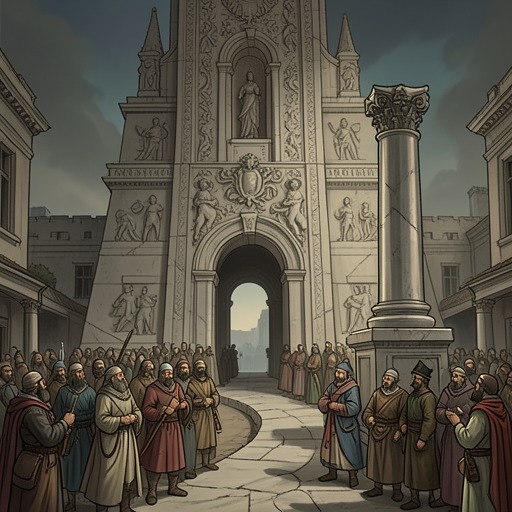
The argument begins with the hybrid character of Notre-Dame Cathedral. Its forms belong to different periods: the little Red Door approaches the delicacy of the Gothic period, while the great pillars of the nave recall the older Romanesque period. Symbols on the principal portal gather yet another kind of history, linking the Church’s learning with hermetic thought. These elements are not made uniform by their coexistence. They remain legible as different contributions, combined in a building whose parts carry the marks of their own times.
That mixture is presented as evidence of how architecture works. A great building may take centuries to complete, and art can change while construction is still under way. Later builders take up what they find, add their own forms, and continue the structure without erasing its earlier layers. The result resembles a graft taking root or new growth rising from existing material: one artistic language develops within another, and the building’s continuity depends on change. Notre-Dame Cathedral can therefore be read as a collective work precisely because it is not the product of a single moment or a single style.
In such works, individual authorship recedes. A monument gathers contributions across generations; each period adds its layer, and each builder adds a stone. The accumulated result makes visible a common effort larger than any maker. As the formulation puts it, “Time is the architect, the nation is the builder.” The aphorism assigns distinct roles: time allows the work to develop through successive periods, while the nation supplies the sustained human labor that makes the work possible.
Architecture as a Social Form
The idea extends beyond construction to the social organization that architecture records. The account compares great buildings to mountains, products of long duration rather than sudden individual invention. Their artistic changes need not arrive as a rupture: a new style can enter an existing monument, adapt it, and complete it according to its own character. A building becomes a material history of changing society, with successive forms preserved in one structure.
Architecture’s collective character also appears in the scale of the artistic effort it gathered. In an age when thought found its broadest public expression in buildings, creative work across the arts could converge on architecture. A cathedral could bring together sculpture on its façades, painting in its windows, and music sounded by its bells and organs. Poetry, too, could enter the building as hymn or prose. In this arrangement, architecture did not stand alone as one art among others: it gave a common frame to many forms of making.
The building’s social meaning is reinforced by its hybrid form. Notre-Dame Cathedral combines histories rather than presenting a pure, self-contained style. More generally, the account treats architecture as a record in which a people’s intelligence has been gathered and made visible. The individual artist may contribute, but the finished monument exceeds that contribution: the collective is not merely a group of helpers around a solitary creator; it is the source of the work’s duration, scale, and accumulated meaning.
The City as Accumulated Construction
Paris provides a larger example of this collective process. The city first occupied the island at its center, with the Seine serving as its moat and the bridges as its connections to either bank. As it expanded beyond those limits, successive walls enclosed new areas; houses pressed against the enclosures, rose upward, and eventually spread beyond them. The city’s form emerged through repeated building and outward growth, not from a single finished plan.
From the towers of Notre-Dame Cathedral, the fifteenth-century city appears as a dense assemblage of roofs, chimneys, streets, bridges, squares, spires, and towers. The view first overwhelms the observer with variety: carved fronts and projecting stories sit within the same urban field as major royal and religious buildings. Seen from above, that intricacy resolves into three connected parts—the City, the Town, and the University—whose streets form a tangled network but also share principal routes. The Seine and the bridges bind these districts together, continually carrying people between them. Paris’s architecture is thus collective in both its making and its use: accumulated structures form a shared urban fabric through which the population moves.
The idea also has a darker spatial dimension. Medieval buildings could extend below ground in chambers, galleries, staircases, and prisons, forming a subterranean counterpart to the visible structure above. The monument’s roots might include spaces of confinement as well as places of worship or power. Architecture therefore records not only a society’s public artistic effort but also the institutions and divisions housed within its buildings.
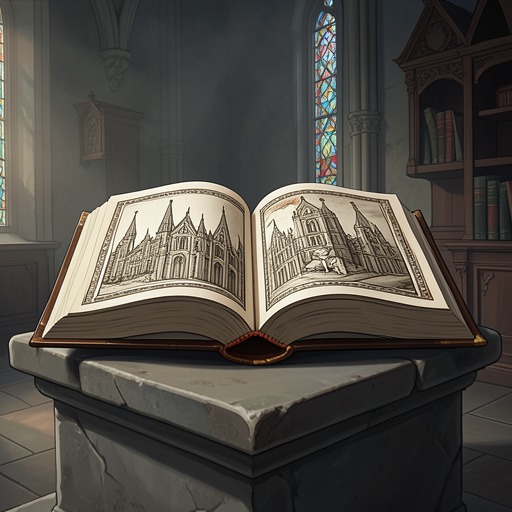
From the Stone Book to the Printed Book
Architecture’s collective prominence depends on a particular historical condition: it is described as the principal medium through which human thought became public before the age of Gutenberg. Thought could be expressed in the durable form of an edifice, and the enormous number of cathedrals across Europe reflected the convergence of society’s material and intellectual resources on building. Architecture was, in this sense, a shared language—one capable of carrying meanings that individual manuscripts could not safely or widely express.
Printing changes that relation. A book can be made quickly, costs less than a cathedral, and travels farther. Human thought consequently flows into print, which becomes the dominant medium of collective expression. The claim that architecture is “dead” refers to the loss of that social position, not to the disappearance of buildings or the impossibility of future monuments. Individual masterpieces may still be made, but architecture no longer serves as the collective, governing art through which an entire society builds its great work.
The change reverses the former hierarchy between the arts. In architectural eras, poetry and other forms could be shaped by the character of monuments; under printing, architecture becomes subordinate to the ascendancy of literature. Yet the older medium remains indispensable as a record. Its stones preserve the layered labor and thought of past societies, while printed books carry the new era’s collective expression. Architecture as collective creation therefore names both a mode of making and a historical inheritance: the building is a society’s work in material form, even after another medium takes over that work’s public role.