Architecture as humanity’s written record
The Hunchback of Notre DameArchitecture as humanity’s written record is the idea that humanity made buildings serve as a durable language: monuments preserved shared memory, while architectural forms gave visible shape to the ideas of an age. The novel develops this idea from the simplest upright stone to the cathedral, treating a building not merely as shelter or decoration but as a record assembled by generations. Its argument turns on a historical reversal: in the fifteenth century, printing begins to take over the work architecture had performed as the principal medium of collective expression.
From Memory to Monument
When human memory could no longer reliably carry the mass of inherited traditions, people fixed them in material form. Architecture began, in this account, with a stone planted upright: a single letter or hieroglyph supporting a group of ideas. Stone placed upon stone made larger units of meaning. The Celtic dolmen and cromlech, the Etruscan tumulus, and the Hebrew galgal are described as words; the vast construction at Karnac becomes a complete sentence. The progression is not simply from small buildings to large ones, but from isolated marks to increasingly complex combinations capable of holding a community’s accumulated knowledge.
As symbols multiplied and intersected, the monument had to expand to contain them. Architecture grew with human thought, fixing otherwise floating systems of meaning in visible, tangible form. The analogy between structure and language becomes precise: the pillar is a letter, the arcade a syllable, and the pyramid a word. Geometry and poetic arrangement cooperate as these elements combine into buildings. The resulting edifice is at once a work of construction and a text shaped by a general idea of its epoch.
This account treats the great monuments of different cultures as books written in distinct architectural languages. The Pagoda of Eklinga, the Rhamseion of Egypt, and the Temple of Solomon embody thought not only through individual symbols but through the organization of the whole. In the example of Solomon’s temple, the building is both the binding of a sacred text and that text made visible: its concentric walls manifest the word in successive forms, culminating in the arch. The site and physical form of a building also communicate meaning; Greece places temples on mountains, while India carves subterranean sanctuaries into the earth. Architecture’s record is therefore spatial as well as symbolic.
A Collective Language in Stone
The novel presents architecture as a register of humanity extending across thousands of years, from ancient monuments to medieval cathedrals. Its claim is broad: complicated thought, religious law, and popular ideas leave monumental traces. Buildings offer a form of cultural memory, not because every stone carries a separately decoded message, but because the structure as a whole preserves the forms through which an age understood and represented itself. Stone writing is durable and public; a manuscript may be lost to a single destructive act, whereas the destruction of a built record requires upheaval on a much larger scale.
The façade of Notre-Dame Cathedral makes this collective character legible in one immense composition. Three arched portals, twenty-eight royal niches, the central rose window and its two flanking windows, a gallery of trefoil arches, and the two massive towers gather countless sculptural and architectural details into a coherent whole. The façade is presented as a vast symphony in stone: the work of one people and one age, in which the workman’s invention is disciplined by the artist’s larger design. Its unity does not erase the distinct labor embedded in its parts. Rather, the many details and contributions make the whole possible, as in a poem formed from accumulated voices.
Paris itself can be read through this relationship between parts and totality. Seen from the towers of Notre-Dame Cathedral in 1482, the city presents a confusing multitude of roofs, chimneys, streets, bridges, squares, spires, and bell towers. Yet the apparent jumble has an underlying structure. The City, the Town, and the University form three distinct sections that are joined into one body by the Seine and by long streets crossing between them. From the tower’s height, the eye moves from individual carved houses to the larger arrangement of the city. This view makes urban form another historical record: the city’s buildings and routes preserve both local difference and the connections that bind separate districts together.
Reading the Building
Architecture’s meanings are not always self-evident. The novel distinguishes between a building’s visible form and the symbolic interpretations readers place upon it. Claude Frollo studies the portal of Notre-Dame Cathedral as if it were a page of an occult book. He attends to sculpted figures, including the wise and foolish virgins, and tries to decipher the significance of a raven whose gaze seems to point toward a hidden location inside the church. His sustained attention makes the façade an object of interpretation as well as admiration, but the novel does not make every proposed secret a settled fact: the portal can invite readings that remain uncertain.
The cathedral is also loved in sharply different ways. Quasimodo responds to its beauty, scale, and harmonies with an instinctive attachment; Claude is drawn to its myths, meanings, and riddling symbols. Their contrasting responses reveal the building’s layered character. It can be experienced as a physical world and understood as an intellectual puzzle, without being reducible to either. The same stones sustain direct attachment, aesthetic attention, and interpretive speculation. Architecture’s record is thus not inert: its forms continue to prompt new acts of looking and reading.
The novel also connects architectural styles to the social and religious orders that produce them. Theocratic architecture is described as resistant to change, preserving inherited forms and bending nature to established symbolic systems. Popular architecture, by contrast, is associated with movement, invention, ornament, and a greater willingness to revise its forms. It remains connected to religious symbols but makes them more intelligible to ordinary human perception. In this contrast, the history of building becomes a history of changing relations between religious authority, collective life, and individual expression.
The Change of Medium
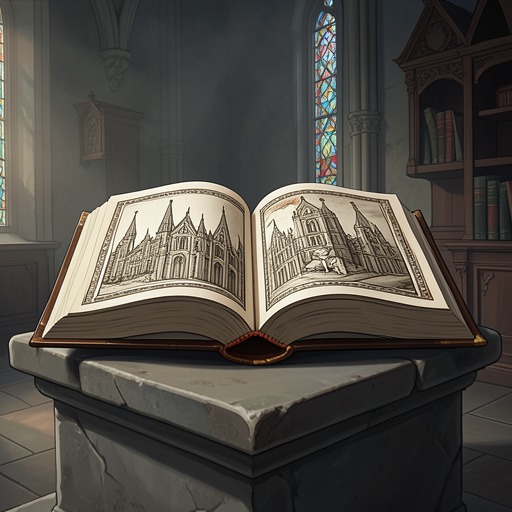
The historical turning point comes in the fifteenth century, when human thought acquires a simpler and more widely distributable means of preservation. The press does not merely add another art beside architecture; it begins to displace architecture from its former position as society’s dominant medium. The novel’s image of stone giving way to paper describes a change in how ideas are recorded, circulated, and brought together. Architecture had required material, place, and collective labor. A book can be made quickly, at low cost, and sent far beyond the place where it was produced.
This change does not mean that building ceases or that individual monuments lose their beauty. Rather, architecture no longer functions as the principal collective art that organizes the thought of an age. Under printing, it becomes subordinate to a new relation between the arts, while the printed work assumes the role once held by the monumental poem or shared edifice. The novel imagines the total output of print as a vast construction made from innumerable works: an immense, unfinished structure to which individual books contribute their own place and shape.
The contrast is not a simple claim that paper is artistically superior to stone. The visible grandeur of architectural writing remains worthy of continual attention, even as the scale of print’s achievement must also be recognized. The two media preserve human thought differently: architecture offers monumental, situated forms whose survival depends on buildings and societies enduring; printing multiplies works and carries them across distance. Architecture as humanity’s written record therefore names both a long history of collective inscription and the transformation that begins when another medium takes over its cultural function.