Architecture's Decline as a Form of Social Expression After the Rise of Printing
The Hunchback of Notre DameArchitecture's Decline as a Form of Social Expression After the Rise of Printing is the historical transition in which buildings lose their former place as humanity’s chief medium for recording and expressing collective ideas. Its decisive significance lies in a change of form: thought once made durable through monuments and cities increasingly travels through printed books. Architecture does not disappear, but the argument holds that it ceases to organize the other arts and to function as the dominant social expression of an age.
Architecture as a Collective Record
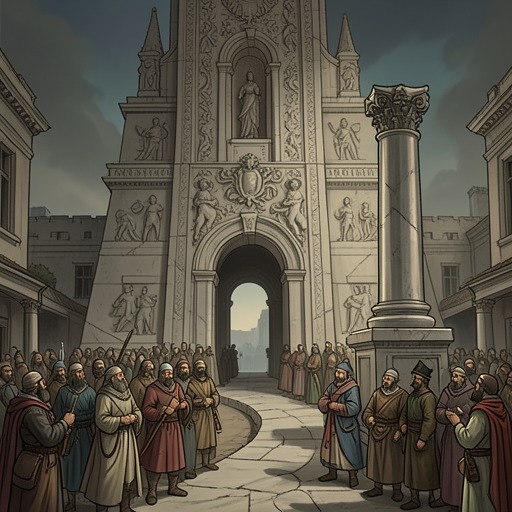
Before printing, architecture serves in this account as humanity’s great register: a durable, visible means of carrying religious symbols, social arrangements, and complex ideas across generations. A monument does more than shelter a practice or mark a place. It gives thought a material form that can be encountered and remembered. The account extends this claim across civilizations, treating each religious symbol and human idea as something that can acquire a page and monument in architecture.
This record is not limited to the design of a building. Form and site both communicate: the examples contrast Greece placing temples on mountains with India carving subterranean pagodas and supporting them with immense rows of stone elephants. The building becomes an expression of the thought it embodies, while its setting helps give that expression its character. In this model, architecture’s comprehensiveness comes from its ability to bind symbolic meaning, physical place, and the work of construction into one public form.
The account also reads architectural history as a record of changing social and religious orders. It presents Romanesque architecture as an expression of the theocratic organization of early medieval Europe, built from the remains of Greek and Roman structures. More broadly, it argues that architecture registers the movement from religious unity toward freedom of thought and democracy. Buildings therefore preserve not only particular beliefs but also shifts in the authority and organization of society.
Paris as a Stone-Written City
The fifteenth-century city gives this idea a concrete scale. Paris began on the City island, with the Seine as its moat, and expanded beyond the island through successive enclosures. Houses eventually pressed beyond the walls associated with Philip Augustus and spread across the surrounding plain. The city’s growth left it an accumulated, irregular fabric rather than a single design imposed at once: successive structures and boundaries record the pressure of expansion over time.
Seen from the towers of Notre-Dame Cathedral in 1482, Paris appears as a dense assemblage of roofs, streets, bridges, spires, and towers. The City, Town, and University districts remain distinct fragments, yet the river and the great routes crossing them bind them into one urban body. The description stresses both variety and connection: individual buildings possess their own character, while the streets and bridges join the larger whole. The city thus functions as a collective work, legible from above as a record made by many generations.
That panorama is not the only way the book presents urban space. At street level, Pierre Gringoire loses his way among the twisting alleys near the Saints-Innocents, while Esmeralda proceeds along a route that seems familiar to her. Elsewhere, from a tower, Quasimodo notices movement along a quay and then toward the square before Notre-Dame. These contrasting views make the built city more than a static image: it can be a difficult maze for someone moving through it and a field of observation from a height. They underscore the difference between architecture as a vast public record and the limited, situated knowledge available to individuals within it.
The Transfer from Stone to Print
The proposition that print will kill architecture has two related meanings. In its priestly sense, it expresses fear that the Printing press will weaken the Church’s authority by releasing thought from the control of the sanctuary. Printed ideas can circulate beyond the institutional settings that once shaped and preserved them. The anticipated change is therefore political and religious as well as artistic: a new medium shifts power from one established form of expression to another.
The broader argument concerns architecture’s loss of primacy as a medium. In the fifteenth century, human thought finds a way to perpetuate itself that is presented as more durable in practice, simpler, and easier to distribute than monumental construction. A building requires stone, timber, money, multiple arts, and the labor of a whole community; a book can be made with paper, ink, and a pen. Print can also travel and reach many places without carrying the physical bulk of an edifice. The contrast is not simply between two kinds of object, but between the different conditions under which collective thought can be produced and transmitted.
The account describes the Printing press as changing thought from something concentrated in a monument and tied to a particular place into something mobile and widely dispersed. Architecture’s durability remains part of its appeal, but physical mass cannot travel as readily as printed words. The claim that print is more resistant to loss rests on that reach: a building may be destroyed in one place, while ideas distributed through books are harder to eliminate everywhere. The medium’s mobility changes what permanence means.
Decline and Transformation of the Arts
The transition is gradual rather than immediate. In the fifteenth century, the press is still too weak to displace architecture at once. From the sixteenth century, however, architecture is described as visibly losing its role as society’s expression. The Renaissance is characterized in this argument as a magnificent but derivative phase: architecture turns toward Greek and Roman models and away from the account’s ideal of a living, indigenous expression. The older Gothic genius still casts its influence over this period, but its radiance is framed as a sunset mistaken for a new dawn.
As architecture ceases to be the comprehensive art, the arts once gathered under its authority separate and develop independently. Sculpture becomes statuary, image-making becomes painting, and the canon becomes music. The separation is presented as productive: each art gains through its independence, like provinces becoming kingdoms after an empire breaks apart. The change therefore entails loss—the end of architecture’s command over the arts—but also the emergence of distinct forms and achievements.
The account links this artistic separation to changes in religion and intellectual life. Earlier challenges to Catholicism had made inroads, but the sixteenth century breaks religious unity; print turns reform from a limited schism into a revolution. The same medium that displaces architecture also enables ideas to circulate beyond the structures that had previously contained them. The relationship between material form and social change is central: a new medium does not merely reproduce old thought more conveniently; it helps alter the scale and force with which thought can act.
A New Dominant Medium
By the seventeenth century, print is described as sufficiently established to preside over a great literary age. In the eighteenth, it takes up the intellectual struggle associated with Luther and places Voltaire within a renewed assault on the old order. By the end of that century, the account says, print has destroyed the former architectural expression of Europe; the nineteenth century begins a process of reconstruction. This sequence presents the shift as a long historical transition, not a single invention producing an instant result.
Architecture survives the change. The argument allows that exceptional monuments and isolated masterpieces may still arise, just as earlier societies produced monumental works through collective effort. What ends is architecture’s status as the social, collective, and dominating art: the grand work of humanity will now be printed rather than built. If architecture rises again, it does so under a changed hierarchy, subject to a culture whose governing medium is literature rather than stone.
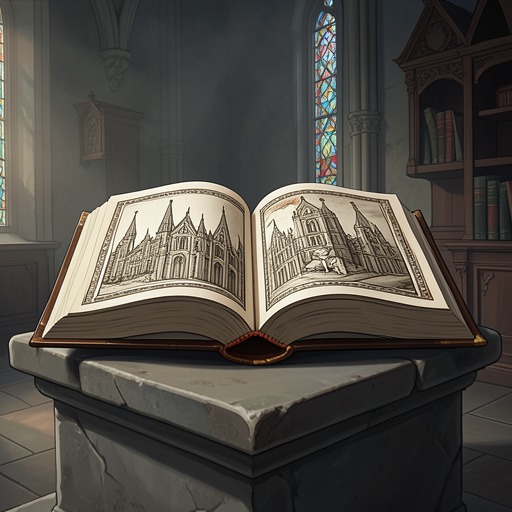
The decline is therefore not a claim that buildings have become meaningless or that the architectural record should be neglected. The account insists that the Bible of stone must still be read and admired, even as the Bible of paper assumes a new scale of influence. Its central contrast is between two modes of cultural memory: one monumental, visible, costly, and rooted in place; the other reproducible, portable, and able to circulate widely. Architecture remains evidence of what earlier societies thought and built, while print becomes the medium through which later generations most broadly express and transmit their thought.