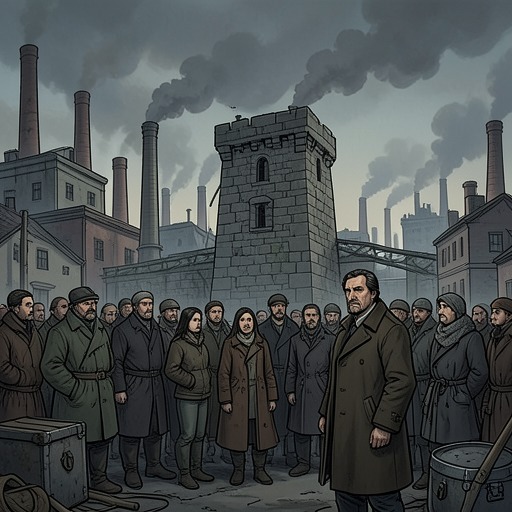
Bastille
The Hunchback of Notre DameThe Bastille is presented as a fortified state prison that also shelters Louis XI of France during his brief stays in Paris. Its contrasting functions converge in a single night: the king sleeps in a specially appointed chamber within the stronghold, while a prisoner is held in an iron-bound cage elsewhere in the fortress. Later, when the king learns that a crowd is besieging Notre-Dame Cathedral, he uses the Bastille as a command post and sends armed forces toward the church. The fortress thus concentrates royal security, imprisonment, and the exercise of power within one tightly controlled space.
Position in the City
The Bastille stands beside the Porte Saint-Antoine, on the eastern side of Paris. Its position enters the narrative first as a point of light: while Quasimodo watches the dark city from Notre-Dame Cathedral, he sees one illuminated window on a tall building in the direction of the gate. The later account identifies that building as the Bastille, where the king is spending the night. The brief sightline links the cathedral’s high vantage point to the fortress, even as the two buildings become centers of opposing action: Quasimodo watches over a threatened refugee, while the king will mobilize forces from his lodging against the crowd approaching the church.
The Bastille belongs to a city whose districts and jurisdictions are described as distinct yet bound together by streets, bridges, and the Seine. The fortress’s appearance from a distant tower gives this urban structure a political dimension: royal authority is not abstract, but occupies a fortified place within the city. In the subsequent account, the Bastille’s locks, gates, armed personnel, and state-prison cage make control of movement concrete. Its walls separate the monarch from the streets while enabling him to project force back into them.
The King’s Retreat
Louis XI has been in Paris for two days and expects to depart for Montilz-les-Tours the day after the events described. Rather than sleep at the Louvre, whose large chamber and imposing furnishings do not suit him, he chooses the Bastille. The narrator emphasizes the logic of the choice: the king prefers the fortress’s smaller quarters and considers it stronger than the Louvre. The building is therefore not merely a place of detention; it is also a residence selected for the security it affords its ruler.
The king’s room occupies the topmost story of a turret rising from the donjon keep. It is circular, with straw mats, exposed beams, gilded fleurs-de-lis, and wood paneling decorated with metallic and painted rosettes. Its single window is pointed and protected by brass lattice and iron bars, with colored panes bearing the arms of the king and queen. The detailed description makes royal comfort inseparable from fortification: the chamber is richly appointed, but access is constrained by a barred window, a single entrance, and the surrounding donjon.
The room’s furnishings mark it as private and reserved for one occupant. A single elaborate armchair stands beside a table holding writing materials and a silver goblet; nearby are a brazier, a velvet prayer stool, and a comparatively plain bed of scarlet and yellow damask. The chamber is called the retreat where the king says his prayers. Yet it is not isolated from the business of rule. When the king receives news of the siege of Notre-Dame Cathedral, the fortress becomes the setting from which he interprets the crisis and issues military orders.
The State Prison Within the Fortress
The Bastille’s carceral role is made visible through the cage the king inspects during the same sequence. After walking through a final gate burdened with locks, the royal party enters a large vaulted hall containing a massive structure of masonry, iron, and wood. It is a state-prison cage, with only a few small windows, closely barred, and a flat stone door compared in shape to a tomb entrance. The account stresses the enclosure’s severity without describing the prisoner’s conditions beyond the architecture and confinement.
A written specification records the cage’s construction in unusual detail. It measures nine feet long, eight feet wide, and seven feet high between its partitions. Its frame uses ninety-six horizontal beams, fifty-two upright joists, and ten wall plates, each three toises long. Nineteen carpenters worked for twenty days in the Bastille courtyard to prepare and fit the materials. These figures turn the prison from a vague emblem into a deliberately made structure: confinement is the result of organized labor, measured dimensions, and royal command.
The king examines the cage while Olivier Le Daim reads its account aloud. After the party has returned to the royal chamber, the king asks whether anyone is in the cage. The question presents a sharp contrast between the ruler’s secure retreat and the prisoner’s confinement, while also showing how easily the prisoner can recede from the king’s attention. The Bastille houses both the person who gives commands and the person held under them, but their presence there does not imply equal awareness or power.
From Royal Lodging to Command Post
The fortress’s military function becomes decisive when Olivier Le Daim reports that a woman condemned by the court has taken refuge in Notre-Dame Cathedral and that a crowd is trying to remove her by force. The king first understands the report as an attack on the church under his protection and, through it, on his own authority. His response turns the Bastille from a protected sleeping place into the center of a rapid deployment.
Louis XI orders Tristan l’Hermite to take the forces available to him: fifty lances belonging to the Vicomte de Gif, described as three hundred horse; the company of unattached archers associated with Phoebus de Châteaupers; the men of Tristan’s provostship; and forty archers of the dauphin’s new guard at the Hôtel Saint-Pol. He directs them to hasten to Notre-Dame Cathedral and orders that the attackers be pursued. The account records the command, not the operation’s outcome. What matters for the Bastille’s role is the speed with which a crisis reported inside its walls is converted into armed action outside them.
Narrative Significance
The Bastille gathers together the novel’s contrasting forms of enclosure. Paris has churches that can offer asylum, while its prisons confine people under civic and royal authority; the account of medieval buildings likewise presents subterranean chambers as a second, darker architecture beneath the structures above. In this setting, the Bastille is both a stronghold for the king and a prison for those subject to his power. The contrast is especially pointed because the royal chamber and the prisoner cage are described in the same episode, within the same fortified complex.
The fortress also links distant spaces through acts of watching and command. From the tower of Notre-Dame Cathedral, Quasimodo detects the single light at the Bastille; from within the Bastille, the king learns of the crowd at the cathedral and sends forces toward it. The sequence makes the city legible through its buildings, but also shows how differently people inhabit that urban map: one figure watches from a tower, another occupies a guarded chamber, and a prisoner remains inside a locked cage. The Bastille’s significance lies in this convergence of visibility, confinement, and royal power.