Châtelet Court
The Hunchback of Notre DameChâtelet Court was the principal judicial institution through which the provost of Paris exercised broad civil and criminal authority. Its work ranged from hearings and interrogations to punishment and enforcement, but it operated in a city where ecclesiastical, royal, municipal, and university jurisdictions overlapped. The novel presents the court both as a powerful apparatus and, through its cramped hearings and fallible officials, as a source of institutional irony.
Authority and Jurisdiction
In the fifteenth-century division of Paris into the City, the University, and the Town, jurisdiction followed the city’s fragmented geography. The island belonged to the bishop, the right bank to the provost of the merchants, and the left bank to the rector; above these local authorities stood the provost of Paris, a royal rather than municipal official. Churches concentrated in the City, palaces in the Town, and colleges in the University, while Notre-Dame Cathedral, the Louvre, the Hôtel de Ville, and the Sorbonne marked the distinct centers of those divisions. Châtelet Court belonged to this wider structure of royal authority, not to a single, unified civic system.
The jurisdictions could divide a single case across the city. Offences committed by scholars on the left bank were tried in courts on the island and punished on the right bank at Montfaucon, although the rector could intervene under the privileges of the University of Paris. Those privileges had, the narrator observes, often been won through revolt and mutiny. Châtelet Court therefore existed within a political order in which authority was asserted, negotiated, and sometimes resisted rather than administered through one uncontested chain of command.
Officials and Institutional Reach
The provost’s office combined judicial authority with an extensive network of personnel. Its reach encompassed police sergeants, the Châtelet’s porter and watch, auditors, commissioners assigned to the sixteen quarters, a jailer, mounted sergeants, and officers responsible for the watch. The provost exercised high and low justice, including the power to interrogate and impose severe penalties. This was not merely a courtroom authority: it connected hearings to custody, policing, and the practical enforcement of sentences.
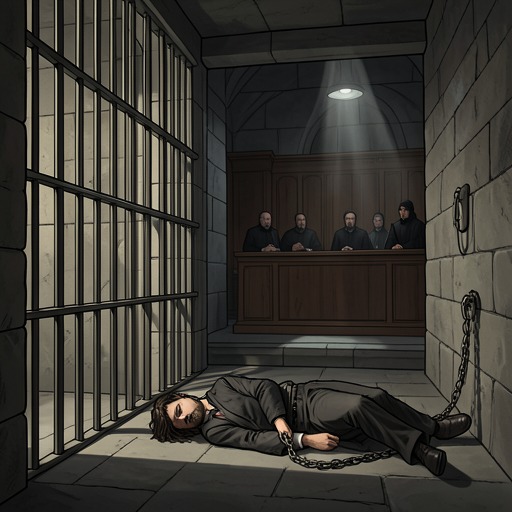
At one hearing, however, the provost was absent and his lieutenants carried on the work according to custom. Civil, criminal, and private lieutenants were among the deputies who could act in his place. The proceedings were held in a small, low, vaulted audience chamber at the Châtelet. A fleurs-de-lis table and the provost’s empty carved-oak chair marked the authority that presided over the room even when he was not there; an auditor sat nearby, a clerk recorded the proceedings, and sergeants stood at the doors and before the table. The arrangement made the institution’s hierarchy visible in the room, while also showing that its routine depended on delegated work.
Hearings and the Auditor
Master Florian Barbedienne, auditor of Châtelet Court and lieutenant of the provost, conducted the audience in the provost’s absence. He was deaf, a fact that the narrative makes central to its satirical portrait of judicial performance. Before examining an accused person, Florian studied the written complaint so he could anticipate names, titles, and charges and prepare responses to the questions he expected to ask. The document helped him negotiate an interrogation without making his hearing loss obvious to the people in the room.
The narrator distinguishes between the court’s outward appearance of procedure and Florian’s actual ability to hear. When his deafness disrupted an exchange, his confused remarks could be taken for profundity or foolishness; either interpretation, the narration suggests, left the magistracy’s reputation intact. At the start of the examination, Florian adopted a pose of authority, with his head thrown back and his eyes half closed. The scene turns a hearing into a study of how judicial credibility may be staged: papers, posture, and institutional office can sustain an appearance of command even when the presiding official is not fully attending to the accused.
Examination and Punishment
Quasimodo was brought before the court bound and under guard. The display of armed officers exceeded what his conduct in the room seemed to warrant: he appeared silent, calm, and gloomy, while onlookers mocked his appearance. Florian examined the written complaint before beginning the interrogation, relying on the record to guide the proceeding. The scene places the accused’s vulnerability beside the court’s ceremonial authority and the crowd’s appetite for spectacle.
The institution’s reach also extended from judicial examination to physical punishment. At Quasimodo’s public punishment, Master Pierrat Torterue, identified as the Châtelet’s official torturer, appeared on the platform. His presence connects the court not only to the issuing or handling of judgments but to their enforcement through designated personnel. The sequence makes clear how public authority could move from a formal hearing into a punishment staged before a crowd, while the crowd’s ridicule compounded the condemned man’s isolation.
Sanctuary and Competing Powers
Châtelet Court’s authority existed alongside the protection claimed by churches and other places of asylum. The novel describes sanctuary as a refuge from the city’s punitive jurisdictions: once a fugitive entered it, the law could not ordinarily seize that person by force. Yet sanctuary was also confining, because leaving its boundaries restored the threat of arrest and punishment. Rare parliamentary decrees could override asylum, while armed violations risked conflict with ecclesiastical power. The court’s authority was thus substantial but not absolute; its operation depended on a contest among legal forums and institutions.
The sentence pronounced against Esmeralda illustrates the severity of the court’s punitive reach. A formal announcement condemned her for alleged sorcery, magic, debauchery, and murder in connection with Phoebus de Châteaupers, and included her goat in the sentence. The announcement presented the accusations as crimes already confessed, even as the larger narrative shows how an accused person could be swept into a harsh process. Châtelet Court’s procedures and punishments belong to a world where judicial power intersected with religious accusation, popular prejudice, and the coercive authority of the state.
The court’s limits also appear in the complaint of the Court of Miracles outcasts against their bailiff. They objected to recognizing him as either judge or highway officer, revealing resistance to the very jurisdictional claims on which local authority depended. Set against the provost’s elaborate system of officers and tribunals, their challenge shows that legal power was not simply imposed from above: it was continually asserted against communities that disputed who could judge them. Châtelet Court consequently embodies both the reach of royal justice and the instability of medieval Paris’s divided legal order.