Charles de Bourbon
The Hunchback of Notre DameCharles de Bourbon, known as the Cardinal de Bourbon, is an ecclesiastical dignitary whose standing is inseparable from court politics and public spectacle. In the episode set during the Feast of Fools in Paris, his entrance abruptly halts a performance already struggling to hold the crowd. The scene presents him as both a powerful churchman and a practiced courtier: accustomed to ceremony, eager to preserve his standing, and less in command of popular feeling than his rank might suggest.
Identity and Political Position
Charles is Archbishop and Count of Lyon and Primate of the Gauls. His family connections bind him to opposing centers of power. Through his brother, Pierre, Seigneur de Beaujeu, whose wife was Louis XI’s eldest daughter, he was allied to the French king; through his mother, Agnes of Burgundy, he was related to Charles the Bold. The narrator identifies the spirit of the courtier and devotion to those in power as the defining traits of his character.
These ties had made his political career difficult to navigate. He had to steer between Louis XI and Charles the Bold, presented as dangers on either side, while other powerful men—including the Duke of Nemours and the Constable de Saint-Pol—had been destroyed amid such political hazards. Charles, by contrast, had come through successfully and reached home. Yet safety did not erase the strain of the journey: he continued to recall his political career with unease. His place in the story thus suggests the precariousness of high rank as well as its privileges; kinship brings influence, but also obliges him to manage competing allegiances.
Public Persona and Private Loss
The account balances his political caution with a worldly, sociable character. Charles enjoyed what the narrator calls a joyous cardinal’s life and liked the royal wine of Challuau. He favored giving alms to pretty girls rather than old women, a detail that makes his generosity selective rather than simply virtuous. He traveled with bishops and abbots of high lineage, described as gallant and jovial. Their after-hours drinking and singing scandalized devout women who had heard the same clerics sing vespers during the day. Charles’s circle therefore embodies a conspicuous gap between religious office and convivial conduct.
The year 1476 remained a painful marker in his memory. He described it as “white and black”: in that year he lost both his mother, the Duchess of Bourbonnais, and his cousin, the Duke of Burgundy. The narrator observes that one grief had consoled him for the other. This compressed, unsettling account gives his recollection a dryly ironic edge, while showing that personal bereavement is part of the history he carries into public life.
Arrival at the Feast of Fools
When the usher announces Charles, the audience turns toward the reserved gallery and the prologue is interrupted for a second time. The narrator stresses the force of the moment through Pierre Gringoire’s dismay: the cardinal’s name lands more painfully than a great burst of noise. Charles pauses at the entrance, looks over the audience with apparent indifference, and then moves slowly toward his scarlet velvet chair. He bows with what the narrator calls the hereditary smile of the great toward the people, while seeming to think of something else.
His arrival might have provoked resentment: the crowd had been displeased moments earlier and was preparing to elect a pope on the very day he appeared late to the spectacle. Instead, his existing popularity protects him from a hostile reception. The Parisians have already asserted their authority by forcing the play to begin, and that small victory has satisfied them. His handsome appearance and scarlet robe also win him the women in the audience, whom the narrator describes as half the crowd. Public favor here is neither a simple endorsement of clerical authority nor a rejection of it; it is shaped by the crowd’s own triumph, his reputation, and his appearance.
Ceremony, Embassy, and Popular Resistance
Charles’s entrance is followed by his ecclesiastical entourage, whose arrival renews the commotion. The audience tries to identify the dignitaries, while students and clerks use the licensed disorder of the festival to jeer at the newcomers. The scene places ceremonial rank inside a public celebration that temporarily permits mockery of church authority. Charles does not appear especially troubled by that customary irreverence; the embassy from Flanders weighs more heavily on him.
He is not, the narrator says, fretting over the political consequences of royal marriages or changing alliances. His discomfort is more immediate and social: as a cardinal and Frenchman, he resents having to receive Flemish representatives and bourgeois aldermen in public, at the king’s pleasure. Nevertheless, he turns toward the door and greets the envoys with practiced grace when they are announced. The episode shows courtly performance operating as a duty: private irritation must yield to a public display of welcome.
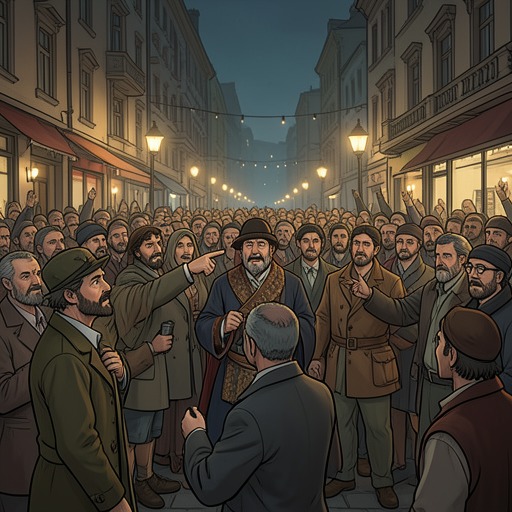
That performance falters when Charles sees Clopin Trouillefou seated beneath the gallery. Mistaking the beggar’s presence for an audacious appeal for alms, he orders the bailiff to throw him into the river. Jacques Coppenole, still holding Clopin’s hand, answers that the beggar is his friend. The crowd cheers Coppenole, and the cardinal bites his lips before remarking privately on the quality of the archduke’s ambassadors. The exchange sharply reverses the expected balance of authority: Charles can issue an order, but Coppenole’s public defense wins immediate popular approval. The cardinal remains a powerful and practiced courtier, yet the episode makes clear that ceremony and rank cannot guarantee command over the audience whose favor he enjoys.