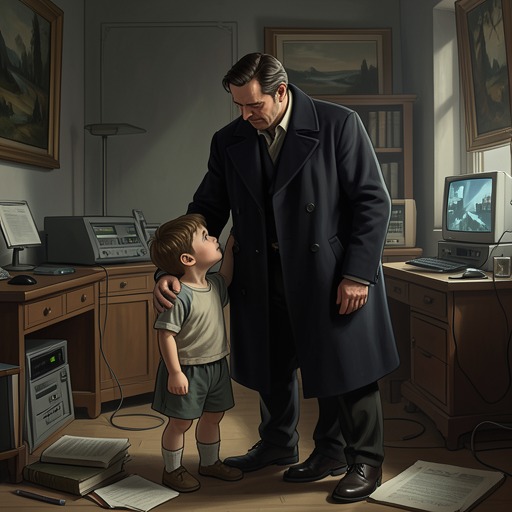
Claude Frollo adopts Quasimodo
The Hunchback of Notre DameClaude Frollo adopts Quasimodo on Quasimodo Sunday in 1467, taking a foundling from the public charity bed at Notre-Dame Cathedral as a crowd debates the child’s fate. The decisive act turns threatened abandonment into a life under Claude’s care; its motive is not simple benevolence, but pity joined to his devotion to his younger brother, Jehan. Claude names the child Quasimodo, connecting him both to the day he was found and to the sense that he is only partly formed.
Background and Setting
The adoption begins at a customary place of public charity in Notre-Dame Cathedral. After mass, a living child has been left on a wooden bed in the vestibule, on the left, opposite a great image of Saint Christopher. Foundlings exposed there could be taken by anyone willing to care for them; a copper basin in front of the bed held alms. The arrangement makes the child’s abandonment visible and places his survival in the hands of whoever chooses to act.
The encounter occurs on Quasimodo Sunday in 1467, sixteen years before the period in which the story is set. A crowd has gathered around the bed, mostly women and, in the narrator’s description, almost entirely old women. Four women in gray cassocks belong to a devout sisterhood: Agnes la Herme, Jehanne de la Tarme, Henriette la Gaultière, and Gauchère la Violette. They had left their house with their mistress’s permission and under the statutes of Pierre d’Ailly to hear the sermon, but now bend over the exposed child with the others.
The crowd’s attention is not protective. Its members discuss the child as a little magician, and the threat of burning is made explicit. The scene therefore sets public curiosity and danger against the possibility of private compassion: the foundling is an object of speculation to the crowd, but a child in immediate need to Claude.
Claude’s Intervention
Claude is returning from saying mass at the Altar of the Lazy, beside the door leading into the nave on the right and near an image of the Virgin. He has listened for several minutes to the women’s reasoning and to the notary’s pronouncements. Then he thrusts silently through the crowd, scrutinizes the child, and reaches out just as the devotees are already anticipating a burning. His intervention interrupts the threat before it can become action.
Claude declares that he will adopt the child. He takes the foundling into his cassock and carries him away; the spectators follow with frightened looks as Claude disappears through the Red Door, which then connects the church with the cloister. The movement is swift and practical: he does not leave the child on the bed or entrust his safety to the crowd, but removes him from its reach and carries him into the religious precinct beyond.
Motive and the Child’s Condition
The narrator explains Claude’s decision through a convergence of pity and personal memory. The foundling’s distress, deformity, and abandonment move him; at the same time, he thinks of his young brother Jehan. Claude suddenly imagines that, if he were to die, Jehan too might be left miserably on the same bed. The child before him thus becomes inseparable from the brother for whose future Claude feels responsible.
When Claude removes the child from the sack, he sees the extent of his physical differences: a wart on the left eye, a head set directly on the shoulders, a crooked spine, a prominent breastbone, and bowed legs. Yet the child seems lively, and, though his cry cannot be identified as belonging to any language, it indicates strength and health. The sight increases Claude’s compassion rather than diminishing it. He resolves to rear the foundling for the love of Jehan, treating the care he gives as good works accumulated in his brother’s name, should Jehan someday lack them.
Naming and Consequences
Claude baptizes the child Quasimodo. The name may commemorate the day on which he found him, or it may express how incomplete the child seems to Claude: blind, hunchbacked, and knock-kneed, an almost-made creature. The narrative leaves both explanations in view, making the name at once a record of the rescue and a label shaped by the body that provoked it. Adoption gives the child a place in Claude’s life, but the naming also shows how that care is entangled with the language used to describe his difference.
The adoption has consequences beyond the churchyard encounter. Claude’s thought of Jehan is not incidental: from that time onward, he takes life seriously under the burden of responsibility for his brother, and Jehan becomes the object of his studies and plans. Claude resolves to devote himself to securing Jehan’s future and to have no other wife or child than his brother’s happiness and fortune. The foundling’s upbringing becomes part of this commitment, a charitable act Claude makes in Jehan’s name.
By 1482, Quasimodo has grown up and has been bellringer of Notre-Dame Cathedral for several years, a position he owes to his adoptive father, Claude Frollo. The rescue therefore begins a lasting bond between the child and the cathedral, as well as between Quasimodo and the man who took him from the crowd. The scene’s significance lies in its sharp reversal: a child treated as a danger and threatened with destruction is carried away by a priest whose pity is intensified by the fear that his own brother might otherwise have shared the foundling’s fate.