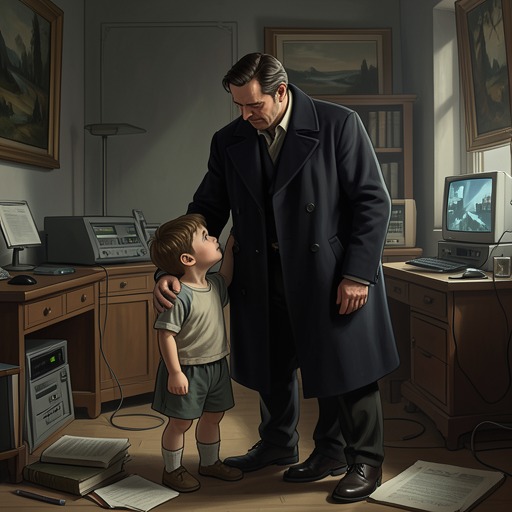
Claude Frollo takes responsibility for raising his brother Jehan
The Hunchback of Notre DameClaude Frollo takes responsibility for raising his brother Jehan after the plague of 1466 leaves them both orphaned. The act marks a decisive passage from a life absorbed in learning to one governed by kinship and duty: Frollo carries the surviving infant from the family home, entrusts him to a nurse, and reshapes his own future around the child’s care.
Scholarly Life Before the Crisis
Before the loss of his parents, Frollo’s existence had been ordered by study. He moved from theology into canon law, reading successive collections of decretals and tracing the long conflict between civil and ecclesiastical law. He then turned to medicine and the liberal arts, learning about herbs, ointments, fevers, bruises, sprains, and abscesses. He also studied Latin, Greek, and Hebrew, and advanced through the stages of licentiate, master, and doctor of arts.
By eighteen, he had passed through all four faculties. Learning seemed to him the sole purpose of life; books occupied the attention that, as the narrative presents it, he had not yet given to the affections. This background matters to the later act of care because Frollo’s responsibility for Jehan does not emerge from an established domestic life. It arrives abruptly and changes what he understands life to require.
The Plague and the Orphaned Household
In the summer of 1466, excessive heat preceded a major outbreak of plague that killed more than forty thousand people in the vicomty of Paris. Rumor held that Rue Tirechappe was especially afflicted. Frollo’s parents lived there, and the young scholar hurried to the family house in alarm. He found that both had died the previous day. In the cradle, still alive and crying, was his very young brother.
The child was all that remained to Frollo of his family. He took the infant under his arm and left the house pensively. At nineteen, he had become an orphan and the eldest surviving member of the family, suddenly responsible for a brother too young to care for himself. The narrative marks this as a turning point: until then he had lived in the life of the mind; the catastrophe recalled him to the claims of ordinary human life.
Jehan’s Care and Frollo’s New Attachment
Frollo’s response is described not as reluctant guardianship but as an intense, newly discovered affection. He had barely known his own parents, having been separated from them since infancy, and had spent his youth enclosed in books. His bond with Jehan therefore becomes his first sustained experience of tenderness. The infant’s vulnerability draws out a compassion that the scholar had not previously recognized in himself; he watches over the child as something fragile and precious, becoming, in the narrator’s formulation, more than a brother and almost a mother to him.
Since Jehan had lost his mother while still nursing, Frollo arranged for a nurse. Their father had left him not only the fief of Tirechappe but also the fief of Moulin, a mill on a hill near the château of Winchestre at Bicêtre and a dependency of the square tower of Gentilly. A miller’s wife there was nursing a healthy child. Because the place was not far from the university, Frollo carried Jehan there himself and entrusted him to her care. The concrete journey from the family home to the nurse’s household gives form to his changed priorities: study remains part of his life, but care for the infant now requires practical decisions and personal attention.
Vocation and Consequences
Once he felt the weight of responsibility, Frollo began to take life with great seriousness. Jehan became not merely a source of comfort but the object around which Frollo organized his studies and imagined his future. He resolved to devote himself to securing his brother’s prospects, and to have no wife or child of his own, treating Jehan’s happiness and fortune as the family future for which he must answer before God.
This commitment drew Frollo more firmly toward the clerical profession. His learning, merits, and status as an immediate vassal of the Bishop of Paris opened the Church’s doors to him. At twenty, by special dispensation from the Holy See, he became a priest and served as the youngest chaplain of Notre-Dame Cathedral, at the altar known as altare pigrorum, where a late mass was said. He remained deeply absorbed in his books, leaving them only to spend an hour at the fief of Moulin with Jehan. His assumption of responsibility thus shapes both his private attachment and his public vocation: scholarship continues, but it is now framed as service to a future for which he considers himself answerable.